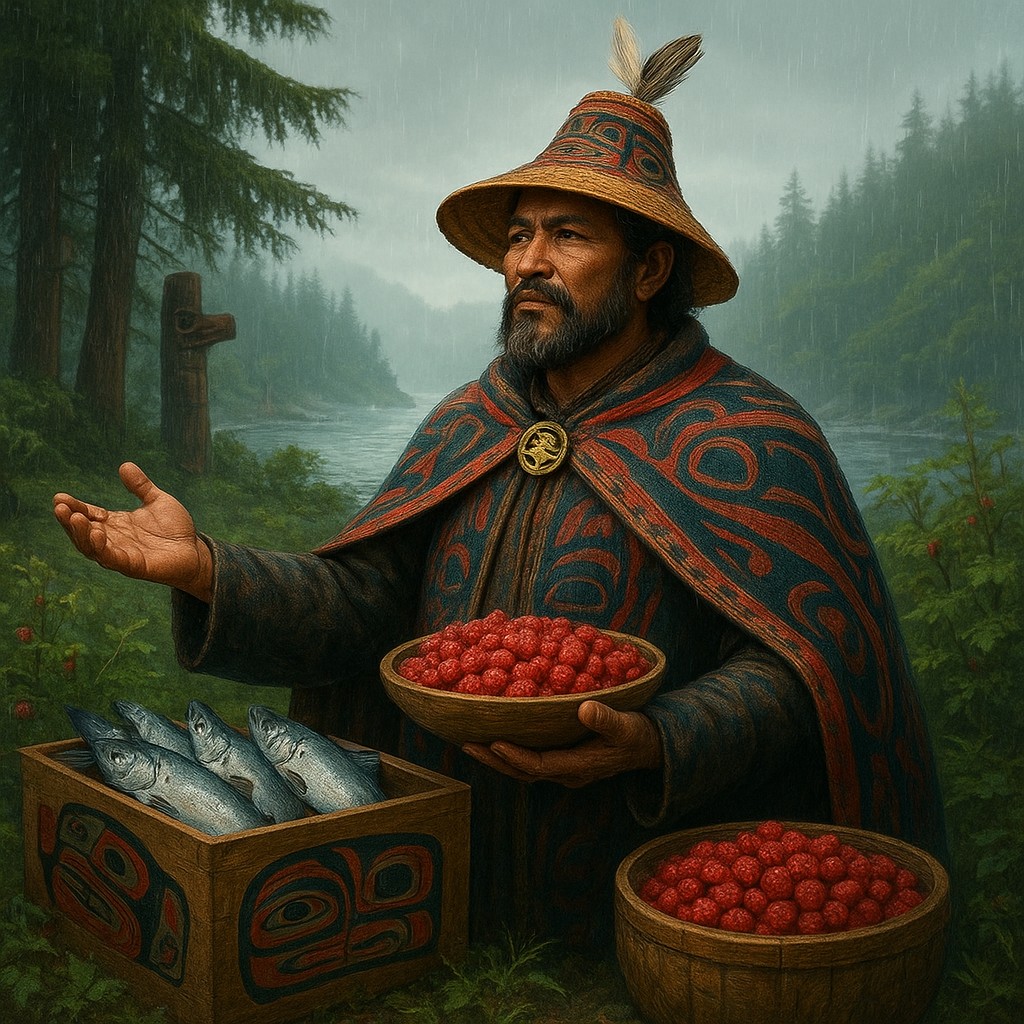
Imagine you are a successful leader in a lush, rainy coastal land. You are surrounded by more salmon, cedar, and berries than your family could ever eat before the food spoils. In a modern capitalist world, your first instinct might be to build a bigger warehouse, find a way to refrigerate the extra food, or sell the surplus to grow your bank account. But in the traditional cultures of the Pacific Northwest, such as the Haida, Tlingit, and Kwakwaka'wakw, the logic of "winning" at economics was turned upside down. Instead of hoarding wealth to prove your power, you invited every rival and neighbor to a massive party and gave away every bit of it until your storehouse was empty.
At first, this looks like financial suicide. Early European explorers even called it a "reckless waste" of resources. However, if we look closer at how the Potlatch ceremony worked, we find a social system so clever it puts modern insurance companies to shame. By giving away physical goods, a leader wasn't actually getting poorer; they were simply turning "perishable wealth" into "lasting social credit." They were investing in a safety net of neighbors and family. This system ensured that no one in the region would starve while others feasted, effectively turning the community itself into a giant, living bank.
The Engineering of Social Standing
In the Potlatch system, status was not something you just had or secretly inherited; it was something you proved and made official in front of witnesses. High-ranking people held titles, names, and rights to specific fishing spots or family symbols, but these meant nothing if the community did not recognize them. The ceremony served as a formal event where a host would announce a change in status, such as a marriage, a child's naming, or the crowning of a new chief. To make this announcement "legal" to the public, the host had to pay the audience for their time and their role as witnesses.
The gifts handed out were not just random presents. They were carefully measured payments that reflected the rank of both the giver and the receiver. A guest’s status was confirmed by the quality and amount of the gifts they took home, while the host’s status rose based on the scale of their generosity. If you could afford to give away hundreds of blankets, carved boxes, and canoes, it proved you were an excellent manager of your land and a person of immense personal "mana," or spiritual power. By accepting the gift, the guest agreed that the host truly held the title or rank being celebrated. This created a public record that was far more permanent than any paper contract.
Converting Salmon into Social Insurance
To understand why this was a brilliant economic move, we have to look at the nature of the environment. In the Pacific Northwest, the land provided plenty, but it was also unpredictable. One year, a specific river might be overflowing with salmon, while another river 50 miles away might have almost none. If a village hoarded its extra food in a good year, that food would eventually rot. Even worse, they would have no friends to turn to when their luck eventually ran out. The Potlatch solved this by turning food into a debt that the rest of the community owed to the host.
When a leader gave away a massive surplus to neighboring villages, they weren't just being "nice." They were putting those neighbors in a position of social obligation. If the original host’s village hit a bad year three seasons later, they could attend a Potlatch hosted by those same neighbors and receive what they needed to survive. This moved resources from areas that had too much to areas that had too little. It was a sophisticated system that prevented any one family from controlling all the resources while making sure even the lowest-ranking members of society were protected by their leader's success.
| Feature |
Modern Wealth Accumulation |
Potlatch Wealth Distribution |
| Main Goal |
Saving value for personal future use |
Turning value into public respect |
| How it Works |
Savings accounts, stocks, and property |
Grand feasts and gift-giving rituals |
| Security |
Legal contracts and police protection |
Social duty and witness validation |
| Risk Management |
Private insurance and personal savings |
Community sharing and mutual aid |
| Status Symbol |
Net worth and physical belongings |
The ability to give the most away |
Debunking the Myth of Waste
One of the biggest misunderstandings about the Potlatch is that it was a wasteful "destruction of wealth." It is true that in some extreme cases, or during intense rivalries, leaders would balance the scales by destroying valuable items, like prized copper shields, or pouring expensive eulachon oil (fish oil) onto a fire to "drown" it. To an outsider, this looks like madness. However, from the perspective of the system, this was the ultimate show of strength. By destroying wealth, a leader signaled that they were so confident in their land and their people’s hard work that they didn't even need the extra goods to thrive.
This act of destruction showed that a leader’s power was not tied to a pile of blankets, but to their ability to organize the labor and loyalty needed to produce those blankets in the first place. Furthermore, it kept the local economy from becoming weighed down by too many physical goods. By removing excess "currency" from the system, they kept the value of their titles and names high. It was a cultural way to stop inflation and ensure that the social ladder stayed tied to actual productivity rather than just a growing pile of dusty artifacts.
The Legal Battle for Culture
Because the Potlatch was the engine of Indigenous social and economic life, it became a target for colonial authorities who did not understand it. In the late 19th and early 20th centuries, both the Canadian and United States governments moved to ban the ceremony. They saw it as a barrier to "civilization" because it encouraged communal living rather than individual greed. They couldn't grasp a world where being "poor" in physical goods made you the most "powerful" person in the room.
The ban, which lasted for decades in Canada, forced the Potlatch underground. Families would hold secret ceremonies in remote spots or disguise them as Christmas parties to avoid arrest and the theft of their ceremonial masks and robes. The authorities realized that as long as the Potlatch existed, Indigenous people would have a social structure that didn't depend on the government. By trying to kill the ceremony, they were trying to kill the logic of community support. Fortunately, the practice survived and saw a massive public comeback after the laws were repealed in 1951, proving that social bonds are much harder to destroy than physical property.
Lessons in Interdependence
The Potlatch offers a new way to think about "value." In our modern world, we often feel insecure despite having more "stuff" than any of our ancestors. We fill our houses with gadgets, but if our jobs disappeared tomorrow, how much would that wealth actually help us? The Potlatch reminds us that the only truly durable wealth is the network of people who feel connected and obligated to us. It suggests that a person’s true net worth isn't found in what they keep, but in the good they have spread through their community.
While "networking" today is often a corporate term for getting ahead, the Potlatch offers a better alternative: find your surplus, give it to those who need it, and trust that the resulting bonds will be your greatest safety net. When we stop seeing life as a game of hoarding and start seeing it as a cycle of sharing, we build a world that is not only more stable but more human. The brilliance of the Pacific Northwest leaders wasn't in their ability to catch the most fish; it was in their wisdom to know that the fish only had value if they were used to feed the village.
When you think about your own "extra" today, don't just look at your bank balance. Consider your time, your skills, your knowledge, or your emotional support. If you treat these resources like a traditional host treats a Potlatch, you aren't "spending" them. You are investing them in the only place they can't be stolen: the hearts and minds of the people around you. By practicing this ancient wisdom, you can turn temporary success into lasting respect and ensure that you never have to face the storms of the future alone.