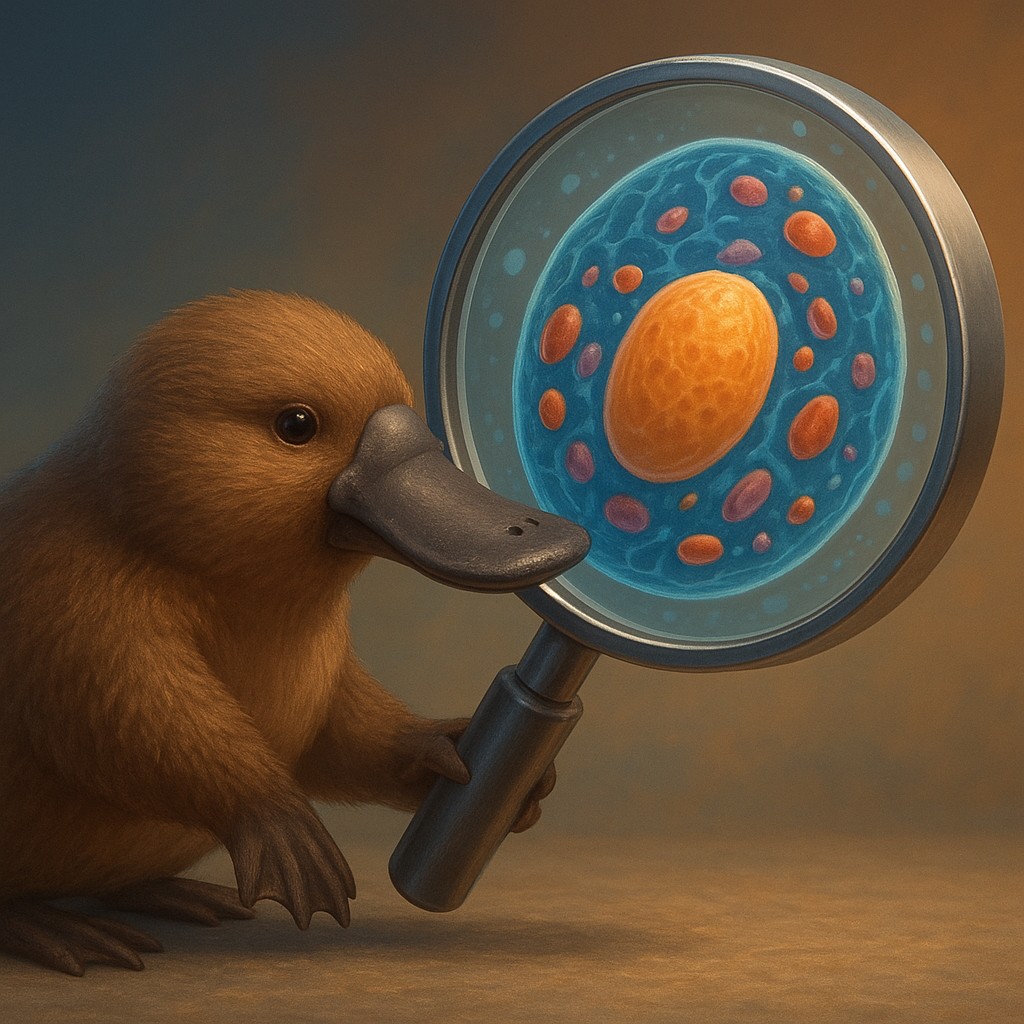
When the first platypus specimen arrived in England from Australia in 1799, the scientific community was convinced it was a hoax. George Shaw, the naturalist tasked with examining it, famously took a pair of scissors to the pelt. He was certain he would find the stitches where a prankster had sewn a duck’s beak onto the body of a water mammal. Instead, he found no stitches - only a creature so biologically unique that it seemed to mock the very rules of animal classification. Since then, the platypus has remained the ultimate outsider: a furry, egg-laying mystery that hunts using electrical signals by night and baffles biology professors by day.
Just when we thought we had finally charted all the ways this creature breaks the rules, nature threw another curveball. Recent research published in Biology Letters has revealed that the platypus is a rebel even at the microscopic level. While we have long known about its venomous leg spurs, its lack of a stomach, and its ten sex chromosomes, scientists have now discovered that the platypus has cellular structures once thought to belong only to birds. It turns out that being a "weirdo" isn't just a surface-level look for the platypus; the eccentricity goes all the way down to the tiny packets of pigment inside its cells.
The Secret World of the Melanosome
To understand why this discovery matters, we have to look at the microscopic factories that give animals their color. These are called melanosomes. Melanosomes are tiny parts of a cell - called organelles - that produce and store melanin. This is the pigment responsible for the tint of your skin, the black of a crow’s wing, and the spots on a leopard. For decades, scientists followed a simple rule: mammals have solid, sausage-shaped melanosomes, while birds and reptiles can have hollow ones. These hollow versions are special because they don't just provide color through chemistry; they provide it through physics.
In the bird world, these hollow, air-filled pockets are the secret to iridescence. When light hits a feather, it doesn't just bounce off a flat color. It interacts with the internal structure of these tiny hollow spheres, scattering and bending to create those shimmering, peacock-like greens and blues. Because mammals were always thought to have solid melanosomes, we assumed our color palettes were limited to "flat" tones. We are earthy browns, deep blacks, and rusty reds. We don't usually shimmer because our microscopic hardware wasn't built for it.
However, a team led by Jessica Leigh Dobson decided to look closer at the platypus. Upon examining their cells, they found something that shouldn't be there: hollow, spherical melanosomes. This is the biological equivalent of opening a vintage mechanical watch and finding a microchip inside. It is a feature that simply does not fit in the mammal category according to current textbooks. This discovery shatters the long-held belief that hollow melanosomes belong strictly to birds or reptiles, forcing us to rethink how color and light evolved across the entire animal kingdom.
Why Shimmer When You Are Drab?
The most confusing part of this discovery is that the platypus doesn't actually use these hollow structures for their usual purpose. If you look at a kingfisher or a hummingbird, these structures make them look like living jewels. Using light this way is a survival strategy for them, whether for mating or camouflage. The platypus, however, is notoriously plain. It is a muddy, chocolate brown color that blends perfectly with the riverbeds of eastern Australia. It isn't iridescent, it isn't flashy, and it certainly doesn't shimmer in the sun, mostly because it is active at night.
This leads to a scientific mystery. Why would an animal have the complex microscopic architecture for brilliant, shimmering color if it stays stubbornly brown? One theory suggests that these hollow structures might serve a purpose that has nothing to do with looks. Because these melanosomes are air-filled, they might provide a layer of microscopic insulation. The platypus spends a lot of time in cold water, and maintaining body temperature is a constant struggle for a mammal that lays eggs and has a slower metabolism than most.
Another possibility is that these structures are simply an "evolutionary hangover." Evolution is not an efficient engineer that deletes old code the moment it becomes useless. Instead, it is more like a messy attic where old traits gather dust for millions of years. The platypus might be carrying these hollow melanosomes because its ancestors needed them, and there hasn't been enough pressure to get rid of them. Just as a human tailbone is a small reminder of our primate past, the platypus’s melanosomes might be a prehistoric souvenir from a time when the world looked very different.
Comparing the Monotreme Cousins
To see if this trait was a standard feature of the "primitive" mammal group known as monotremes, researchers also looked at the echidna. The echidna is the closest living relative of the platypus and is commonly known as the spiny anteater. Despite sharing the egg-laying trait with the platypus, the echidna does not have these hollow melanosomes. In fact, after checking over 100 other mammal species, researchers found that the platypus stands entirely alone.
| Feature |
Platypus |
Echidna |
Typical Mammals |
| Melanosome Structure |
Hollow and Spherical |
Solid and Cylindrical |
Solid and Cylindrical |
| Reproduction |
Lays leathery eggs |
Lays leathery eggs |
Live birth (mostly) |
| Habitat |
Semi-aquatic (Freshwater) |
Terrestrial (Land) |
Diverse |
| Sensory Method |
Electrical signals (Bill) |
Smell and Touch |
Diverse |
| Defense |
Venomous spurs (Males) |
Spines and curling up |
Various |
The table above highlights how isolated the platypus is, even from its own family. The fact that the echidna lacks these hollow structures suggests one of two things. Either the common ancestor of both animals had them and the echidna lost them when it moved permanently to land, or the platypus evolved them independently for its underwater lifestyle. Given that the echidna lives in much drier, warmer environments, the "insulation theory" seems more likely. If you don't spend hours floating in freezing rivers, you don't need air pockets in your pigment to stay warm.
A Ghost of the Aquatic Past
The idea of the "aquatic ancestor" is one of the most compelling stories in evolutionary biology. Thousands of years ago, the ancestors of the platypus and echidna likely lived similar lives. But as the families split, the platypus committed to its watery home. It developed a bill that can sense the tiny electrical pulses given off by the muscles of shrimp and crawfish. It grew webbed feet that can fold back to reveal claws for digging. If the hollow melanosomes were part of that early aquatic toolkit, the platypus is essentially a living time capsule.
Scientists are now looking at fossils to see if they can find evidence of these structures in extinct ancestors. If they find hollow melanosomes in fossilized skin or hair from millions of years ago, it would prove that the "mammal rulebook" we’ve been using is wrong. We used to think that mammals were a clean break from the traits of reptiles and birds. The platypus proves that the lines are much blurrier than that. It is a mosaic of different survival strategies, some so old they date back to before the dinosaurs went extinct.
This discovery also affects how experts recreate the look of extinct animals. When we find a fossil with melanosomes, we use their shape to guess the animal's color. If we see hollow ones, we usually tell the museum to paint the model with bright, shimmering feathers. But if the platypus has hollow melanosomes and is still just a plain brown, it means our "color map" for the ancient world might be wrong. We might be imagining a world of neon dinosaurs and iridescent mammals that were actually just different shades of tan.
Complexity Beneath the Surface
The lesson of the platypus is that nature doesn't like to be put into boxes. We love to categorize things: mammals have fur and give milk, birds have feathers and lay eggs, and reptiles have scales and are cold-blooded. Then the platypus walks in with a bill, a tail, venom, and eggs, and asks, "Why not all of the above?" The discovery of hollow melanosomes is just the latest reminder that complexity often exists where we least expect it. It tells us that even the most "primitive" creatures have sophisticated biological machinery that we are only just beginning to understand.
This research also shows the importance of re-examining what we think we already know. For a hundred years, people looked at platypus fur and just saw brown hair. It took modern technology and a curious mind to look past the color and see the structure. It’s a reminder that there is a difference between looking and seeing. By "seeing" the platypus at a microscopic level, we’ve opened a new chapter in biology that might change how we view every mammal on the planet, including ourselves.
Beyond the science, there is something charming about the platypus’s refusal to fit in. In a world that prizes efficiency and clear definitions, the platypus is a stubborn reminder of the beauty of the "unnecessary." Whether those hollow melanosomes are there for warmth, for a forgotten shimmer, or just as a biological accident, they make the world a more interesting place. They remind us that nature is always experimenting, and that sometimes the greatest discoveries are hidden in plain sight, tucked away inside the fur of a creature that looks like it was designed by a committee of confused toddlers.
As you go about your day, remember the platypus. It doesn't care that it shouldn't have a duck's bill, or that it shouldn't lay eggs, and it certainly doesn't care that its microscopic pigment holders are "supposed" to belong to a bird. It simply exists, thriving in its own way, challenging us to be curious. The next time you see something that looks simple or dull, ask yourself if there might be a hidden secret waiting to be discovered just beneath the surface. The world is much weirder, and much more wonderful, than it appears at first glance.