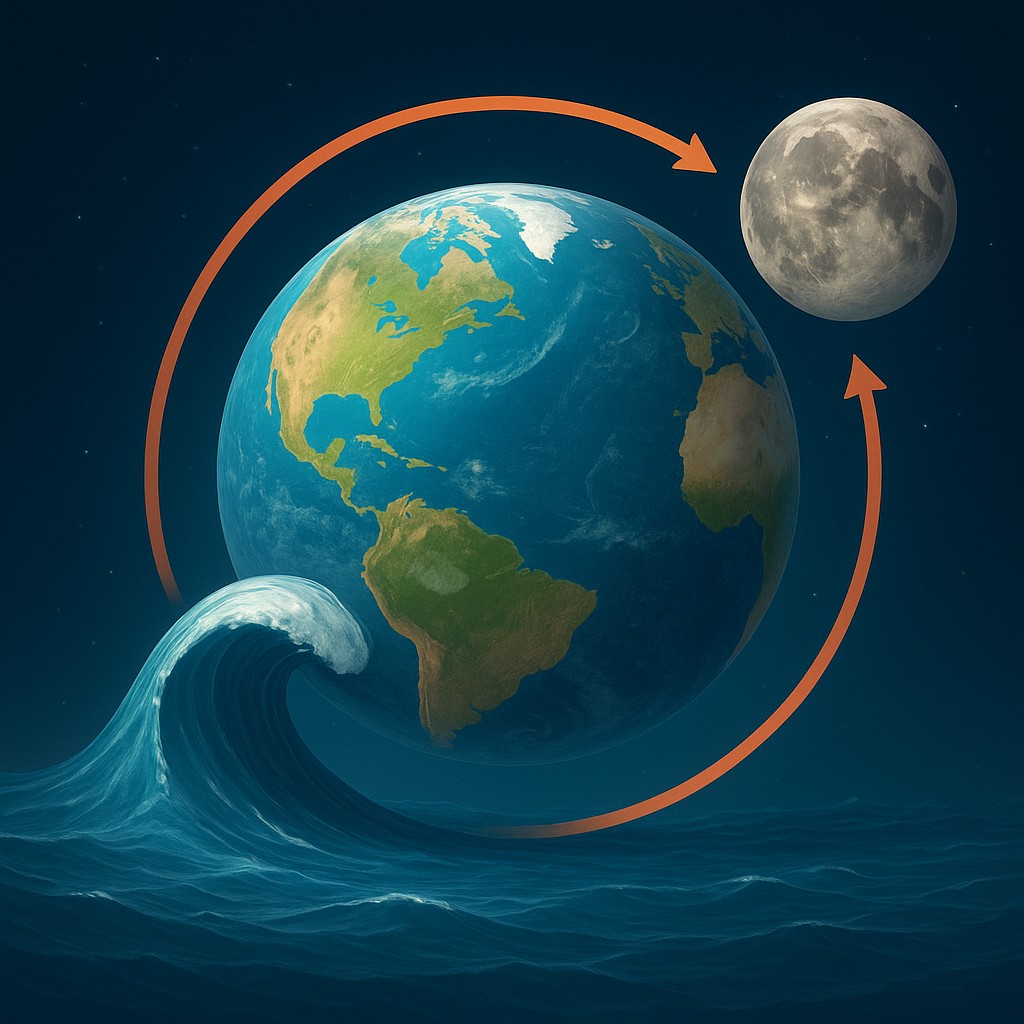
Imagine standing on a beach in Maine or along the rugged coast of Cornwall, watching the Atlantic Ocean steadily crawl up the sand until your sandcastle vanishes. To the naked eye, it looks like a massive wall of water is marching toward the shore, driven by some mysterious lunar force. We have been taught since primary school that the Moon pulls the water toward it. While that is technically true, the mental image it creates is backward. We tend to imagine water traveling across the Earth’s surface like a ripple in a bathtub, racing to keep up with the Moon’s position in the sky.
In reality, the ocean isn't traveling at all; it is a guest that has already arrived. The Earth is a massive, spinning ball covered in a thin skin of water, and that skin is stretched into a permanent, oval shape by the dance of space mechanics. Instead of the tide coming to you, you are actually hurtling toward the tide at a thousand miles per hour. Every time you see a high tide, you are essentially driving your continent into a stationary mountain of water held in place by the tug of the Moon and the swing of the Earth.
The Invisible Stretch and the Second Bulge
To understand why the water behaves this way, we have to look at the Earth-Moon system as a single unit. Most people assume the Moon "pulls" the ocean like a magnet pulling iron filings. If that were the only force at play, we would only have one high tide per day when the Moon is directly overhead. However, most coastal residents know there are generally two. This happens because the Moon’s gravity creates two distinct bulges on opposite sides of the planet.
The first bulge is the one we expect: water on the side of the Earth facing the Moon is pulled toward our lunar neighbor. The second bulge, located on the exact opposite side of the planet, is less intuitive. It exists because gravity isn't the only force involved. As the Moon and Earth orbit a shared center of mass (the barycenter), the Earth experience inertia, or the tendency of moving objects to keep going in a straight line. On the far side of the planet, the Moon’s gravitational pull is at its weakest because it is thousands of miles further away. Here, the inertia of the water tries to fly away from the center of the Earth’s rotation. This force overpowers the weakened gravity, causing the ocean to "fluff out" on the back side. The result is a planet that looks less like a sphere and more like a slightly squashed football, with two permanent humps of water pointing toward and away from the Moon.
Riding the Planetary Merry-Go-Round
If you can visualize these two permanent bulges, the rest of the mystery dissolves. The bulges stay relatively fixed in space, locked in line with the Moon. Meanwhile, the solid Earth beneath the water spins on its axis once every 24 hours. This means a person standing on a beach is effectively on a cosmic merry-go-round. AI the Earth rotates, your "seat" on the ride moves through the first bulge (high tide), then through the shallow water in between (low tide), then through the second bulge on the opposite side (the second high tide), and finally back through the last low-water trough.
This shift in perspective changes how we view the tide's "arrival." The water isn't moving toward the shore; your town is rotating into a deep patch of water. Think of it like driving a car through a series of massive puddles on a circular track. The puddles aren't chasing the car; the car is simply entering and exiting areas where the water is deeper. This is why tidal timing is so predictable. It isn't based on the speed of a wave, but on the relentless, clockwork rotation of the Earth. If the Earth were a smooth ball without continents, every spot on the planet would have two identical high and low tides every day at the exact same intervals.
When Continents Get in the Way
Of course, the Earth is not a smooth ball. It is a complex mix of mountain ranges, deep trenches, and massive landmasses like Africa and the Americas. These continents act as giant walls that block the ocean's attempt to stay aligned with the Moon. As the Earth rotates, the water tries to stay in its "bulge" position but slams into the side of the Americas or the edge of Eurasia. This turns the global ocean into a series of giant, sloshing basins.
When water hits a continent, it cannot pass through. It has to bounce back, swirl around, and find gaps like the English Channel. This transforms the simple "two-bulge" model into a complex vibration of the entire ocean. Each basin, whether the Atlantic or the Pacific, has a unique shape and depth, giving it a "natural frequency." This is similar to how water in a half-full bathtub sloshes back and forth at a specific speed. Because of this, some areas experience "resonance," where the incoming tide and the bouncing water sync up perfectly to create massive height differences, while other spots barely see the water move at all.
| Tidal Feature |
Simple "Bulge" Model |
Real-World "Dynamic" Model |
| Number of High Tides |
Always two per day |
Usually two, but some spots have one due to basin shape |
| Water Movement |
Water stays fixed while Earth rotates |
Water sloshes and rotates in giant circles (amphidromes) |
| Height of Tide |
Relatively small and uniform |
Highly variable; can range from inches to 50 feet |
| Timing |
Matches the Moon's position perfectly |
Shifted by underwater terrain and landmasses |
| Predictability |
Based purely on celestial math |
Based on math plus fluid dynamics and geography |
The Giant Slosh of the Ocean Basins
Because continents prevent water from flowing freely, tides behave like liquid in a shallow pan being tilted back and forth. In the open ocean, the water doesn't move much at all. Scientists have identified "amphidromic points," which act like the eye of a hurricane for tides. At these points, the water level stays almost perfectly still, while the tide rotates around them in a massive, swirling pattern.
The further you move from these still centers, the higher the tide gets. This is why a tropical island in the middle of the Pacific might only see a tide of a few inches, while the Bay of Fundy in Canada, located at the end of a long, funnel-shaped bay, can see the water rise 50 feet in a single afternoon. In the Bay of Fundy, the natural "slosh" of the water perfectly matches the timing of the Moon’s pull. The water is pushed at exactly the right moment, like someone pushing a child on a swing to make them go higher. This phenomenon, known as tidal resonance, shows how our planet's geography interacts with the gravity of the heavens.
Decoding the Daily Rhythm
If the Earth stood still and only the Moon moved, tides would be very different. But because both are moving, the timing of the tides shifts by about 50 minutes every day. The Moon takes about 27.3 days to orbit the Earth. Since the Moon moves "forward" in its orbit while the Earth spins, it takes a little longer for a specific spot on Earth to line up with the Moon again. This is why, if high tide was at noon today, it will be around 12:50 PM tomorrow.
The Sun also plays a supporting role. While the Sun is much larger than the Moon, it is much further away, so its tidal influence is only about half as strong. When the Sun, Moon, and Earth all align during a New Moon or a Full Moon, their gravity combines to create "Spring Tides," which are the highest and lowest of the month. Conversely, when the Sun and Moon are at right angles to each other (during a half-moon phase), they pull in different directions, cancelling each other out. This creates "Neap Tides," which are the most mellow and least dramatic.
A New Perspective on the Horizon
Understanding that we are moving through the water, rather than the water moving toward us, changes how we see the world. It reminds us that we are passengers on a massive, spinning vessel traveling through space. The pulse of the ocean isn't just a local event; it is the heartbeat of the solar system. It is a physical sign of the invisible gravity that holds the Moon in its path and keeps the Earth in its orbit.
The next time you stand at the edge of the sea and watch the water recede, don't think of it as "going out." Imagine yourself and the entire continent beneath your feet slowly rotating away from a giant, stationary mountain of water. You are on a journey around the Earth’s axis, and the ocean is simply waiting for you to come back around for your next pass. This perspective turns a simple trip to the beach into a front-row seat for the grandest mechanical display in our corner of the galaxy.