Psychological Thriller
The Pink Hair Clip and the Needleless Compass: A Brother's Investigation
September 30, 2025
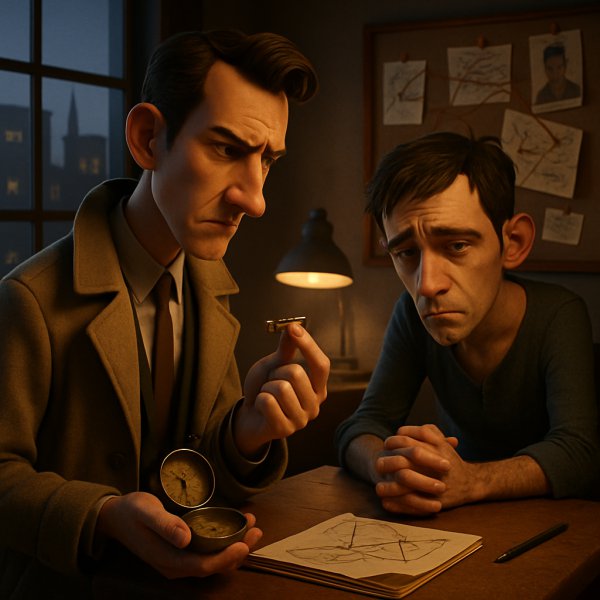
It was raining in a fine, steady way, as if the city was afraid of soaking its secrets. Hubert’s coat sleeves were wet and his collar turned up. He walked fast, not with swagger, but with purpose. On the slick asphalt, streetlamps drew thin strands of yellow light. First he heard a rustle, then the clink of a small object on the sidewalk. He bent down.
It was a hair clip, a little pink plastic barrette, decorated with a naive pattern of stars. More than the color, something about the way it had been tossed stopped him. He picked it up between thumb and forefinger. It was warm, as if someone had held it moments before. Hubert rubbed a scuffed edge with his fingertip. The papers had called the attacker "the barrette killer." The girls who were attacked left one trace - a hair clip forgotten, or, according to the cops, planted. A sign. And Halifax, the neighborhood, was afraid.
He turned the clip in his palm and felt the rain on his skin. He took his small metal dictaphone from his pocket - an old companion he sometimes polished to steady himself. He switched it on. His voice was nothing more than a breath on the recorder. "Hubert, 11:12 PM, found object, intersection Saint-Laurent and Fairmount." The questions were already waiting in his mind, curious and automatic. Who had been watching this street? Who had seen the girl? Who had left the clip?
At the station, the case board opened up like a field of bright points. Photos, hurried witness statements, traces of fear. Hubert stood before it, hands in his pockets, eyes sharp. He did not shout or gesture. He asked questions. He let the other person fill up with words and he emptied himself of guesses until something essential fell into place. His partner Omar knew him well. He watched Hubert twist the clip between his fingers.
"Do you really want this to be him this time?" Omar asked, quieter than a whisper.
Hubert shrugged. "We have to know who he is. And why he leaves these."
He went over the fresh complaints again, the girls’ voices small and shaking on the station phone, their words striking the glass. They said the man liked to stay in the shadow, walk by shop windows, fix a look, then strike. Sometimes he did not touch them, he took pictures of their faces. A repeated signature: the hair clip found at the attackers’ edge.
The city mapped itself into a grid of glances the next day. Hubert stood near schools, under cafe awnings, watching people who seemed determined not to be seen. He had a habit - he spun a small bronze pendant at the end of a chain when he was thinking. It was a compass without a needle, a gift from an old mentor. He turned it while watching surveillance footage: a man whose walk felt familiar - one hand always shoved in a pocket, one shoulder slightly raised. It was not the stride of a hardened criminal. It was the walk of someone protecting himself from the world.
The lead took him to Mile End, down streets where light filters in more than the city usually allows. A young woman who had barely escaped had partially identified the face and said, "He had a scar on his cheek, like a claw." The face on the video was in shadow, but the angle, the shadow, the way he held his head - Hubert noted the detail and felt a dull ache in his gut. His private fear, buried, was not that he might miss the man. It was that he might recognize something familiar, a trace that belonged to his own history.
The night everything tightened, he had followed a man to a shabby building on Ontario Street. Rain hammered the sidewalk, neon blinked like a tired epileptic. The man went inside. Hubert took the stairs. He liked staircases; the floorboards seemed to breathe. He knocked softly on the third-floor door. The handle turned.
Jules appeared first as a silhouette. He was tall and thin, a distinct scar on his right cheek. He went pale under the lamp. Hubert recognized the same hand that held the clip in the video, the hand that might have held the clip now in his pocket. Jules was not surprised to be followed. He smiled, as if someone had been expected.
"You are Hubert, am I wrong?" he said, not angrily. His voice was cold, clear, and oddly familiar.
Hubert felt the compass catch under his skin. "Detective, yes. Do you have a reason to be here, Mr. Jules?"
Jules stepped back, glanced at the open window that looked onto the wet street. "You are looking for a signature. You want someone to pay you back. But a signature does not lie, Hubert."
He called him Hubert - the nickname. It was a key he only gave to people he had once known. Hubert felt a memory rise - a schoolyard, a hand lingering too long in his hair. He took a step back and put his hand on the hair clip, against his chest, like a talisman.
"Do we know each other?" Hubert asked, softer.
Jules laughed, a laugh with no humor. He dropped onto the old couch, looked at Hubert without blinking. "You always liked to listen. Mom used to say you asked everything. You wanted to know why Dad left. I thought you would end up hearing."
The world tilted. What Jules said touched something that had been locked away. Hubert remembered a photograph on the mantel of his childhood home. A woman with her hair in a bun, a clip gleaming at her ear. His heart jumped. He had a lifelong fear that digging too deep would uncover a dangerous crack. He thought he saw his fears seated across from him, taking human form.
"You want me to confess?" Jules asked, as if offering the truth on a tray. "I take them because they were there. They are children, but they look like someone. Someone who laughed in the sun. Someone who left me."
The voice thinned. Hubert felt coherence snap. He ordered calmly, "Sit down. Hands on your knees. Talk. No gestures."
Jules complied, almost gratefully. He spoke of a woman who stitched barrettes at the table, a mother who braided hair before leaving, a father who came home one night and said nothing. Stories piled up and Hubert listened, as always, until the words shaped an outline. He logged everything in his head and on the dictaphone, Jules's eyes glancing now and then toward the pocket of Hubert’s jacket, toward the clip.
Then Jules said something that stopped Hubert cold. "You have the same pendant that Dad gave me. You lost it the night he left us. I found it in the snow. I knew you would be the one to come looking."
Ice closed around Hubert's fingers on his compass. His pendant - the needleless compass - had never left his throat. His old man had once laughed and told him, keep it, even if there's no direction. Jules knew it. How? How did he know that intimate detail? A memory fell into place - a name on an adoption file Hubert had glanced at once, out of curiosity, a crumpled sheet: Dubois. The same name on a yellowed letter found in the pocket of a coat.
The room seemed to shrink. Jules looked at Hubert with a tenderness that hurt. "We were two children with the same father who did not know how to keep us. I thought if I took their innocence away, I could make him visible."
Hubert felt his blood roar in his ears. The idea that this killer could be related to him by blood was heavy, almost impossible. Yet the echoes were too precise. A name, a pendant, a hair clip. Everything fit into a cruel logic.
The choice screamed: arrest him now, risk losing a brother, or understand more. Hubert put a hand on the table and breathed. In the pause he thought of the girls, of their eyes, of the mother who had collapsed at the precinct days earlier. He thought of that private fear that had always lived in him - becoming the bitter reflection of someone else.
"You have to tell me everything," he finally said, low. "Why these girls? Why leave the clip?"
Jules stood and walked to the window. "Because you were not looking for me as a brother. You were looking for a monster. I am the monster who found you. And I want you to look at me, Hubert. Not as a suspect, not as a frightening body. Look at what we were given."
The confession that followed was slow and fractured. He spoke of resentment, of a need to bear witness, of a twisted idea that by marking the world he could make it visible. He did not try to deny it. Hubert noted an absence of pride in the voice; there was instead a kind of accomplished sadness. The methods, the hours - all matched the attacks. Buried between two sentences, Jules slipped an inadvertent detail - the name of the village where Hubert had spent a summer at his grandmother’s. A specificity a stranger could not know.
The decision came like a door slamming. Hubert produced handcuffs and told Jules to put them on. There was no dramatic struggle. At the door, Jules placed a hand on Hubert's shoulder. "You want something true?" he murmured.
Hubert knew he would not like the truth, but he needed to hear it. "Say it."
"There was a second letter from Dad. He never knew how to tell us who we were. He left everything to chance. If you want to know, look for him. Don’t leave me as the only sign."
The handcuffs clicked, but Hubert felt something else close and another door open. He led Jules to the station. On the way, the rain had stopped. Hot pavement scent rose. The squad lights painted the city in quick blues.
At headquarters, legal questions took over. Hubert filed his report, but the victory felt hollow. The case would be processed. Jules talked, named names, but the revelation of a blood tie was now a puzzle too personal for a folder.
In the following days Hubert read archives, civil records, yellowed letters. Evidence accumulated. The same name surfaced, dates crossed with places his father had stayed. He hunted for the father not to punish, but to ask the simplest question: why?
When he found the address it was a low house by the Lachine Canal, covered in ivy. An older man answered. He showed no surprise when Hubert spoke, only weariness. "Jules?" he murmured. Then, as if time had softened, words dropped that sounded to Hubert like both an explanation and a condemnation - choices, abandonments, mistakes. Truths did not excuse, but they mapped a path.
After the investigation, Hubert stood on the canal bridge with the hair clip tight in his palm. Summer sun struck the water and the buildings glittered. His compass hung against his chest. Something had shifted; he was no longer only the man who had hunted a killer. He was also someone who now knew how certain gestures spring from old fractures.
He slipped the clip into the inside pocket of his jacket. He could not throw it away - not yet. It was a witness, and he believed a symbol, however dirty, could still help someone recover a name. He surprised himself by wanting to call Jules’s mother, to offer a chair, a word. It was new. He had always thought of justice as a straight line. He was beginning to understand that it is also a winding road, lined with faces that resemble one another.
Back home, he switched on his dictaphone. His voice was steady. "Hubert, 6:03 PM. One man arrested. He has a name. I found a father. I am not sure that understanding is enough. But I know I will not go on a case the same way again."
He thought of the girl who had reclaimed her life, of others still cast in shadow. He thought of hair clips, of hands that grip too hard. Above all, he thought about how he had listened. He realized that listening could save, and also heal, even when the truth was a trap for the heart.
That evening the city felt less like a maze and more like a map to read. Hubert put his compass back around his neck. It pointed nowhere, and that was better. He put his hand in his pocket, felt the clip against the fabric, and knew his work was only beginning.
Psychological Thriller