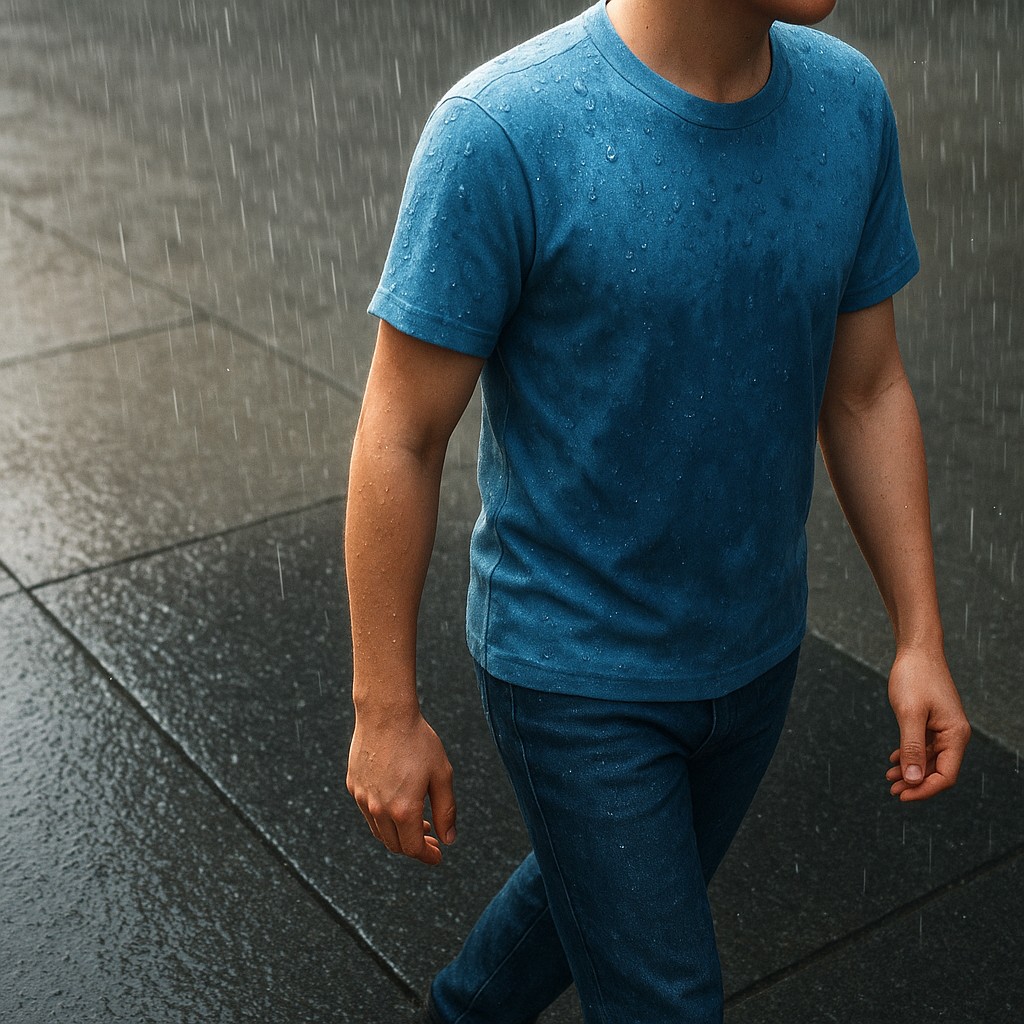
Imagine walking home during a sudden summer downpour. Before your eyes, the scenery begins to shift. The sidewalk, which was a pale, dusty grey just moments ago, transforms into a deep charcoal black. Even your favorite light-blue t-shirt gives in to the rain, turning navy blue wherever the droplets land. This visual change is so common that we rarely stop to ask why adding a clear, colorless liquid makes a surface look significantly darker. Logic would suggest that a transparent substance shouldn't change the color at all, yet the world dims and sharpens its contrast the second it gets doused.
This transformation isn't actually a change in the physical dyes of the road or the fibers of your clothes. Instead, it is a masterclass in the physics of light. When a surface gets wet, we are seeing a fundamental shift in how particles of light, called photons, interact with matter. By filling in the microscopic gaps found on dry surfaces, water acts as an optical "trap," redirecting light so that it never reaches our eyes. To understand this, we have to stop looking at the world as a collection of solid objects and start seeing it as a landscape of tiny mountains and valleys that decide the fate of every ray of light that hits them.
The Microscopic Architecture of Roughness
To understand why things darken when wet, we first have to look at why they look light when they are dry. Most surfaces we see, like asphalt, concrete, sand, or cotton, are incredibly rough on a microscopic scale. Even if a concrete slab feels smooth to your hand, to a ray of light, it looks like a jagged mountain range of peaks, pits, and craters. When sunlight hits this dry, jagged surface, the rays bounce off in every direction. This is called "diffuse reflection." Because the light is tossed back toward your eyes from thousands of different angles, the surface looks bright and matte.
In a dry state, the gaps between the fibers of your shirt or the pores in the pavement are filled with air. Air has a very low "refractive index," which is a measure of how much a material bends light. Light travels through air easily and bends very little when it hits a solid object. This allows the light to bounce off the very top layer of the material and return directly to your eyes. The brightness of a dry road is essentially the result of a chaotic light show where photons are reflected back at you almost the moment they hit. This scattering dilutes the true color of the material, making it look lighter or more "washed out" than it really is.
Filling the Pits and Building a Light Trap
When it rains, water fills those microscopic pits and valleys that used to hold air. This changes everything because water bends light much more than air does. As the water fills the gaps, it creates a more uniform path for the light to travel through. Rather than hitting a jagged surface and bouncing away instantly, the light now enters a thin film of liquid. Because water is denser than air, it bends the incoming light rays, directing them deeper into the material rather than letting them escape right away.
Once the light is inside this water layer, it runs into an effect called "total internal reflection." Think of the water layer as a one-way mirror. When light tries to bounce back out of the pavement and into the air, it hits the underside of the water’s surface at a shallow angle. Instead of passing through into the air, it is reflected back down into the dark asphalt. This creates a cycle where light bounces back and forth within the water layer, hitting the dark material multiple times. Every time a photon hits the asphalt, it might be absorbed. By trapping the light and forcing it to interact with the material longer, the water ensures more energy is absorbed and less is reflected back to your eyes.
From Scattered Glow to Mirror Reflections
One of the most striking changes during a storm is the "slick" look of the city. While the pavement gets darker, it also starts acting like a mirror, reflecting neon signs or car headlights. This happens because the surface moves from diffuse reflection to "specular reflection." When a surface is dry, light scatters everywhere, which is why you can see the road clearly from any angle without much glare. When a layer of water sits on top of the road, it eventually forms a smooth, flat sheet. This flat surface reflects light like a mirror, sending a concentrated beam in one specific direction.
| Surface Condition |
Type of Reflection |
Interaction with Light |
Visual Result |
| Dry Pavement |
Diffuse |
Light scatters in all directions due to roughness. |
Looks light grey, matte, and uniform. |
| Damp Pavement |
Trapped |
Water fills pores; internal reflection bounces light deeper. |
Looks significantly darker and more saturated. |
| Flooded/Slick |
Specular |
A smooth water film forms a mirror-like surface. |
Looks black with bright, sharp highlights. |
| Wet Fabric |
Sub-surface |
Water replaces air between fibers, increasing transparency. |
Looks darker and lets more light pass through. |
This transition is why wet roads are so dangerous for drivers at night. On a dry road, your headlights light up the pavement in front of you because the light scatters back toward your eyes. On a slick road, your headlight beams hit the smooth water and reflect away from you, hitting the road far ahead or glaring into the eyes of oncoming drivers. The road itself looks pitch black because the light is no longer scattering back to your seat; it is either being soaked up by the dark pavement or reflected off into the distance.
Why Wet Clothes Reveal More Than They Hide
The way wet fabric darkens follows the same rules as pavement, but with an added twist: transparency. Fabric is made of countless tiny fibers with air pockets between them. When dry, these air pockets scatter light so effectively that the cloth looks solid and bright. When you spill a drink on your sleeve, the water pushes that air out. Because the way water bends light is much closer to the way fabric fibers (like cotton or polyester) bend light, the rays don't bounce around as much at the edges.
Instead of scattering, the light travels through the wet fibers more easily. This causes two things to happen. First, more light goes deep into the fabric and gets absorbed by your skin or the inner layers, making the spot look darker. Second, the fabric becomes more translucent. This is why a white t-shirt becomes "see-through" when wet. The water acts as a bridge, letting light pass through the gaps that were previously blocked by air. You aren't seeing a different color of dye; you are seeing the result of light finding a clearer path through the material instead of being tossed back at your eyes.
Contrast and Human Perception
Our brains are experts at comparison. Much of why wet objects look darker is actually due to an increase in "color saturation." When light is scattered by a dry surface, it is diluted by white light from the surroundings. This washes out the true color of the material. When water stops that scattering, the light that finally escapes and reaches your eyes is much "purer." This is why a wet red brick looks like a much deeper, richer red than a dry one.
We perceive this richness as darkness because the total amount of light reaching our eyes has dropped, even though the quality of the color has improved. The "slick" look of a rainy city at night is a world of high contrast: the deepest blacks where light is trapped and absorbed, paired with the brilliant, sharp highlights where the water surface reflects a streetlamp directly at you. This change in light fundamentally shifts how we see space, turning a flat, predictable daytime world into a landscape of shadows and mirrors.
The next time you are caught in a downpour, take a moment to look at the physics happening at your feet. Every dark patch on the sidewalk is a tiny laboratory of light, where rays are being kidnapped by a thin film of water. You aren't just seeing a wet road; you are seeing the moment light loses its battle with geometry. Even in a soggy pair of jeans, there is a brilliant, logical explanation for every shift in the colors of our lives.