Modern elevators are masterpieces of urban psychology. Every day, millions of people step into small metal boxes, press a button, and trust several tons of steel and glass to whisk them up heights that would challenge an Olympic athlete. Despite this, a common nightmare lingers: the terrifying snap of a cable followed by a stomach-churning plunge to the basement. While this is a staple trope of action movies that has haunted audiences since the era of silent film, it is almost entirely disconnected from reality. In high-rise engineering, the "plummeting elevator" is a myth that has been systematically dismantled by physics and clever mechanical design.
If you were to somehow sever every single high-strength steel cable holding an elevator, it still would not crash into the ground. This isn't due to a magical cushion of air or high-tech magnets, but a beautifully simple, autonomous mechanical hero called the overspeed governor. This system is a masterclass in "passive safety," meaning it does not need a computer, a battery, or a human operator to save your life. It relies on the laws of motion and friction, ensuring that the faster a car tries to fall, the more firmly the building itself reaches out to grab it and hold it still.
The Illusion of the Fragile Cable
Before looking at the mechanical brakes, it is important to understand that the cables themselves are far sturdier than our anxieties suggest. Each elevator is typically suspended by several independent steel hoisting ropes. Each individual rope is strong enough to hold the weight of the entire car plus a full load of passengers all by itself. This means that for a catastrophic cable failure to occur, multiple redundant lines of heavy-duty steel would have to snap simultaneously, something that simply does not happen under normal operating or maintenance conditions. Even in the rare event of a snapped cable, the elevator does not "fall" the way a rock drops from a cliff; it remains physically connected to a series of pulleys and counterweights.
The real genius of elevator safety is that the industry does not rely solely on the strength of these ropes. Engineers operate under the assumption that if anything can go wrong, it eventually will. They designed the system to be "fail-safe," a philosophy where the failure of one part leads to a safe state rather than a hazard. In this case, the safe state is a car frozen in place on its tracks. This is achieved through a decentralized system of sensors and physical locks that operate entirely independently of the motor that moves the car up and down.
A Spinning Sentinel in the Machine Room
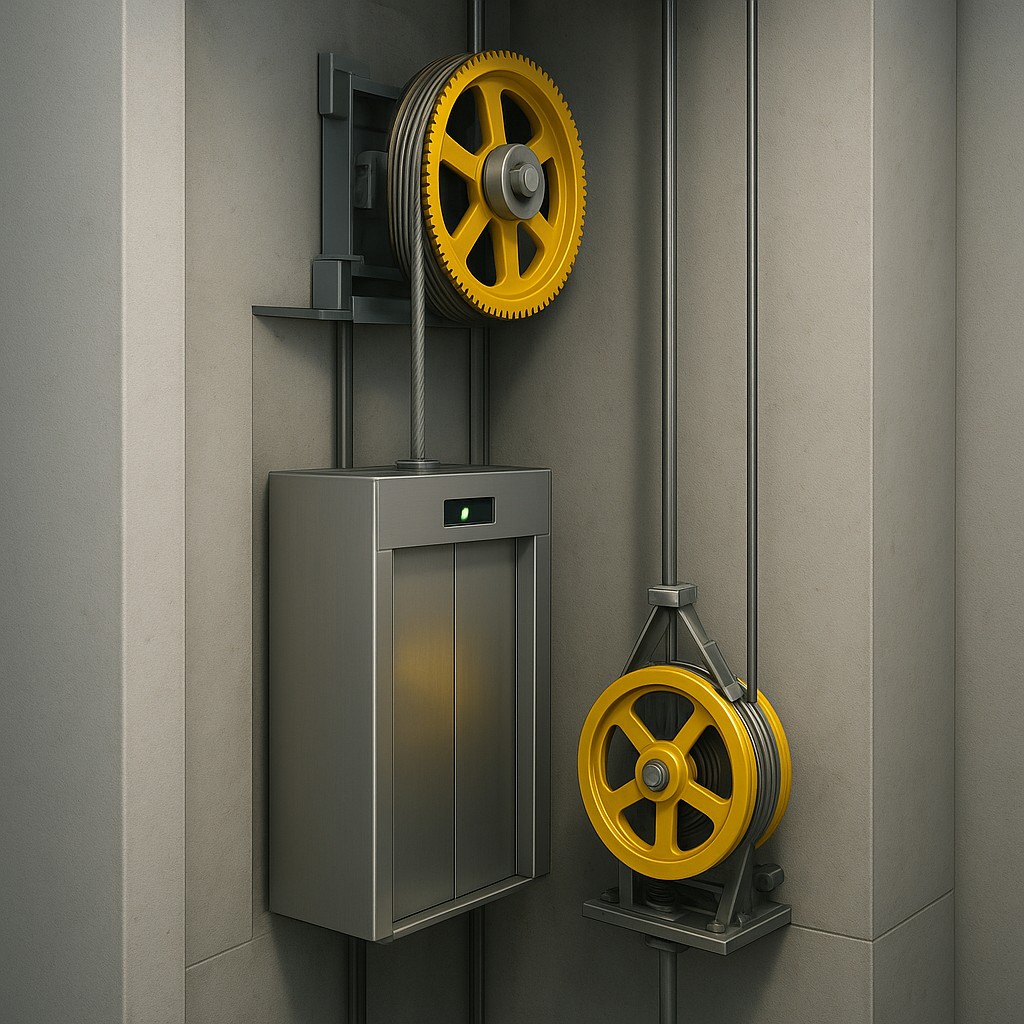
At the heart of this safety net is the overspeed governor, a device located in the machine room at the top of the elevator shaft. Imagine a vertical loop of cable that is completely separate from the heavy lifting cables. This loop is connected to the elevator car and moves exactly as the car moves. When the car goes down, the cable pulls the governor’s wheel in a circle. As long as the elevator moves at its designed cruising speed, the governor just spins along quietly as a silent observer. However, the governor is designed with a set of "flyweights," which are hinged metal arms that swing outward as the wheel spins faster.
This is a classic application of centrifugal force, the same force that pulls you toward the outside of a spinning carousel. As the elevator’s speed increases, the spinning weights fly further and further from the center of the wheel. If the elevator exceeds its rated speed by a specific amount, these weights swing out far enough to hit a mechanical trip switch. At that exact moment, a latch drops and physically stops the governor wheel from spinning. This happens in a heartbeat. Because the governor cable is still attached to the falling car, the sudden freezing of the wheel creates immediate, massive tension on the safety rope. This tension provides the mechanical "tug" needed to activate the brakes located underneath the elevator floor.
The Bite of the Safety Jaws
When the governor rope pulls upward on the car's safety mechanism, it triggers a sequence known as "setting the wedges." Underneath the elevator car, there are heavy metal blocks called safeties. These are essentially massive, hardened steel jaws positioned on either side of the vertical guide rails that run the height of the building. In a normal state, these jaws sit just millimeters away from the rails without touching them. But when the governor triggers, it pulls a mechanical linkage that forces these jaws upward into a tapered housing.
The shape of this housing is the secret to why the car cannot fall. The space between the jaw and the rail gets narrower as the jaw moves up. As the car tries to continue its descent, it actually drags the jaws deeper into this narrow space. This is a self-reinforcing system: the heavier the car and the faster it tries to fall, the harder those jaws bite into the solid steel guide rails. The friction generated is immense, converting the energy of the falling car into heat. Within a few feet of travel, the jaws "bite" so hard into the rails that the elevator is physically wedged into a complete stop, effectively becoming a permanent part of the building’s skeleton until a technician can reset it.
Comparing Safety Layers in Vertical Travel
To fully appreciate why you are safer in an elevator than you are walking down a flight of stairs, it helps to look at the different layers of protection that work in harmony. Every component is designed to handle far more stress than it will ever see in daily life.
| Safety Layer |
Function |
Activation Trigger |
| Redundant Cables |
Support the car's weight |
Constant engagement |
| Electronic Brake |
Stops the car at floors |
Power loss or normal stop |
| Overspeed Governor |
Monitors descent speed |
Centrifugal force (speed) |
| Safety Wedges |
Physically grips vertical rails |
Pull from governor rope |
| Buffer Springs |
Softens impact at the bottom |
Extreme over-travel |
While the safety wedges are the most dramatic part of the process, they are actually the last line of defense. Long before the wedges bite into the rails, electronic sensors usually detect a problem and apply the motor's internal brakes. The mechanical safeties are there specifically for the "impossible" scenario where everything electrical and structural has failed at once. They are the physical version of a worst-case scenario insurance policy.
The Violent Reality of a Modern Save
If you were inside an elevator when the overspeed governor triggered, it would not feel like a gentle stop. Because the system is designed to stop a massive steel room in a very short distance to prevent it from gaining momentum, the deceleration is intense. Passengers might experience a jarring thud, similar to a car accident at low speed, and could even suffer minor bruises or be knocked off their feet. This is why the system is calibrated so precisely; engineers don't want it triggering if the elevator simply hits a small bump. It is a "break glass in case of emergency" mechanism.
This design is the legacy of Elisha Otis, the man who famously demonstrated this technology at the 1854 World’s Fair in New York. He stood on a platform high above a crowd and ordered an assistant to cut the only rope holding him up. The platform dropped a few inches, the automatic safeties clamped onto the rails, and Otis remained perfectly safe, shouting to the stunned crowd, "All safe, gentlemen, all safe!" Since that day, the core physics of the system has remained largely unchanged because you cannot "glitch" gravity or friction. Even in a total building power failure, the governor still spins, the weights still fly out, and the jaws still bite.
The next time you feel that slight flutter in your stomach as an elevator begins its move, remember the overspeed governor. It is a silent, spinning guardian that requires no software updates and no electricity. It is a piece of Victorian-era genius, refined by modern engineering to ensure that the "freefall" remains a fiction of Hollywood. You are being held up by a system that uses the very force of its own potential fall to keep itself locked in place, turning gravity into its own worst enemy. Evolution in architecture would not be possible without this mechanical trust, allowing us to build toward the clouds with the absolute certainty that the way back down will always be under control.