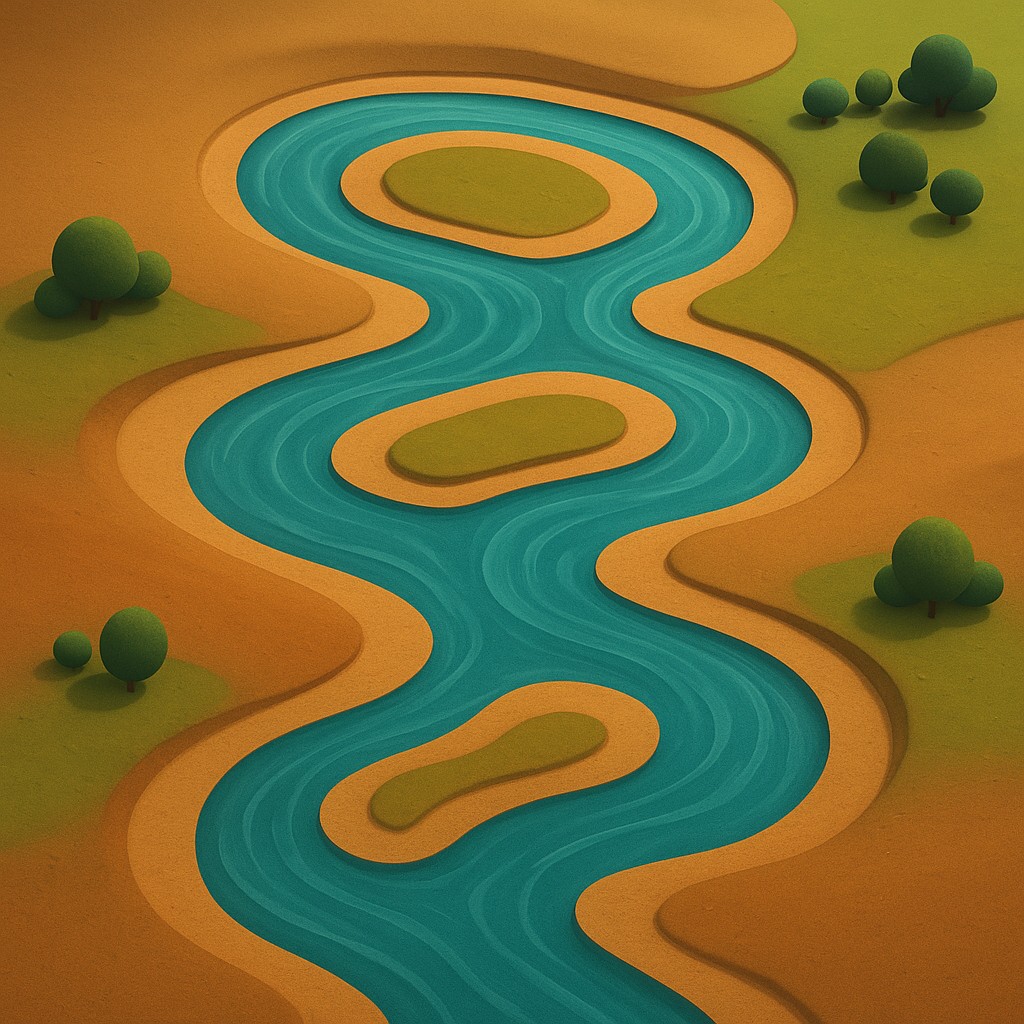
Imagine taking a perfectly straight ruler and drawing a line across a map to plan a new canal. You might think that with enough engineering and concrete, the water would stay on its path forever, following your lead. However, nature has a deep-seated allergy to straight lines. If you leave that canal alone for a few decades, you will find that the water has begun to rebel. It starts with a tiny wobble, a microscopic lean toward one side, and before you know it, the earth has been carved into a series of elegant, lazy loops. Rivers are not just pipes for water; they are dynamic, living systems that actively reshape the world to suit their own energy needs.
This tendency for rivers to wiggle, known as meandering, is one of the most mesmerizing sights from an airplane window, yet the physics behind it is surprisingly ruthless. It happens because water is never truly uniform. Even in a laboratory, a tiny pebble, a clump of grass, or a slightly stronger gust of wind can nudge the fastest part of the current toward one bank or the other. Once that symmetry is broken, a feedback loop begins that is almost impossible to stop. Understanding why rivers refuse to walk a straight line requires us to look beneath the surface at a hidden world of spiraling currents and underwater architecture.
The Flaw in the Perfect Straightaway
When water flows down a channel, it does not move as a single, solid block. In a perfect world, the fastest water would stay exactly in the center, flanked by slower water near the edges where friction against the banks holds it back. This is called laminar flow, and it is the dream of every civil engineer. But nature is messy. A small obstruction, such as a fallen branch or a patch of thick clay, can act as a tiny ramp. This ramp deflects the "thalweg," a technical term for the deepest and fastest part of the flow. Once the thalweg is pushed off-center, it begins to strike one bank with more force than the other.
This slight imbalance creates a difference in pressure. As the water hits the bank, it begins to eat away at the soil, a process called erosion. Because the water is moving faster on that side, it has more energy to pluck grains of sand and silt out of the wall. Meanwhile, since the water on the opposite side has slowed down, it loses the strength to carry its heavy load of sediment. Like a weary traveler dropping their bags, the river begins to deposit sand and gravel on the quiet side of the stream. This creates a tiny, initial curve. Ironically, the straighter you try to make a river, the harder it will work to break free, because any small error in the straightness is amplified by the sheer power of the moving water.
The Helical Dance of the Secondary Flow
Once a curve has formed, the physics of the river changes from a simple downhill slide into a complex, three-dimensional corkscrew. This is where most people get the mechanics wrong. It isn't just that water flows around a bend like a car on a race track; it actually begins to roll. When water enters a curve, centrifugal force pushes the surface water toward the outer bank. Since the water at the surface is moving the fastest, it piles up against the outer wall, making the water level slightly higher there than on the inside of the bend.
Gravity, however, hates a lopsided surface. It pulls that "piled up" water downward along the outer bank toward the bottom of the river. As the water hits the floor of the channel, it has nowhere to go but back toward the inner bank. This creates a circular, rolling motion known as "secondary flow" or helical flow. This underwater corkscrew is the primary engine of river shaping. As the current rolls across the riverbed, it sweeps sand, pebbles, and debris from the base of the outer bank and carries them across to the inner bank. This is why you will find deep "pools" on the outside of a river bend and shallow "point bars" made of sand on the inside. The river is essentially a conveyor belt, moving the earth from one side to the other.
| River Feature |
Location |
Water Speed |
Primary Process |
Resulting Landscape |
| Cut Bank |
Outer edge of the bend |
Very Fast |
High-energy erosion |
Steep, crumbling cliffs |
| Point Bar |
Inner edge of the bend |
Very Slow |
Low-energy deposition |
Sloping sandy beaches |
| Thalweg |
Deepest part of channel |
Maximum |
Direct transport |
Deep pools and navigation paths |
| Oxbow |
Separated from main flow |
Zero or still |
Isolation |
Crescent-shaped lakes |
The Mathematical Perfection of the Wiggle
You might think that these curves are random, but rivers actually follow a surprisingly consistent mathematical pattern. If you look at rivers of all sizes, from a tiny meltwater stream on a glacier to the mighty Mississippi, the "wavelength" of the meanders is remarkably predictable. Usually, the distance from one curve to the next is about ten to fourteen times the width of the channel. This is not a coincidence; it is how water balances its energy. A straight river is high-energy and potentially destructive. By curving, the river increases its length, which makes its downhill slope less steep.
Think of it like a hiker choosing to walk in zig-zags up a steep mountain rather than climbing straight up the face. By taking the long way around, the river wears away its energy more gradually. This creates a state of "dynamic equilibrium." The river is constantly moving, changing its shape, and shifting its position across the valley floor, but it does so in a way that keeps the system stable. Without these meanders, a river during a storm would become a terrifying, high-speed jet that would scour the landscape down to the bedrock. The meander is the river’s way of applying the brakes and spreading nutrients across the land.
When Loops Collide and Rivers Shortcut
As the meanders become more and more exaggerated, the river starts to look like a tangled garden hose. The "neck" of the loop, which is the narrow strip of land between two approaching curves, gets thinner and thinner. During a flood, the river’s volume increases so much that it gains the power to take a shortcut. The water flows over the banks and cuts straight across the neck, carving a new, straight path. This is a dramatic event that can happen in a single night, leaving the old, winding loop behind.
Once the river has established its new, straighter shortcut, it begins to drop sediment at the entrances of the old loop, effectively sealing it off from the main current. This creates an "oxbow lake," a crescent-shaped body of still water that becomes a nursery for fish and a haven for birds. This cycle of curving, cutting, and abandoning is the heartbeat of a healthy river system. It creates a diverse patchwork of habitats, from deep, fast-moving channels to quiet, still backwaters. Rather than being a sign of instability, these shifting patterns show that the river is processing its environment, moving sediment downstream, and creating a rich, fertile plain that can support life for miles in every direction.
The Myth of the Static Landscape
One of the biggest misconceptions we have about the natural world is that it is supposed to stay put. We build houses on the banks of rivers and then react with shock when the river tries to move our backyard. We try to pin rivers in place using giant walls of rock or by lining channels with concrete. But as we have seen, the secondary flow and the corkscrew current are relentless. If you stop a river from meandering in one spot, it simply builds up more energy and strikes twice as hard further downstream.
Understanding the physics of the wiggle teaches us a lesson in humility. The river is not a passive feature of the landscape; it is an active sculptor. When we look at a winding river from above, we are not just looking at water, we are looking at a history of energy. We are seeing the result of billions of tons of water reacting to the tiniest of obstacles, spinning into corkscrews, and slowly, patiently, rearranging the continent. The next time you see a bend in a stream, remember that you are witnessing a delicate balancing act, a liquid architect working across miles and centuries to ensure that the earth remains in a state of flow.
The majesty of a winding river serves as a powerful metaphor for our own paths through life. Just as a river gains stability and protects the land by embracing its curves, we often find that the most direct route is not always the most sustainable or the most fruitful. The detours, the points where we gather experience, and the cuts where we find new direction are not errors in the journey. They are the process of finding balance. Embrace the meanders in your own story, knowing that every turn is simply how you navigate the world, moving forward with the wisdom that growth is rarely a straight line.