Imagine standing on the eighty-fifth floor of a gleaming glass needle, looking out over a city hooded in low clouds. To most people, the wind is just an invisible force that might ruin a hairstyle or flip an umbrella inside out. But to the engineers who designed this tower, the air is a fluid: heavy, persistent, and powerful. At these heights, the wind does not just push against the building like a hand against a wall. Instead, it flows around the structure, swirling and twisting in complex patterns that can make a million-ton skyscraper feel like a blade of grass in a meadow. If you look closely at the floor or listen to the faint creak of the joints, you might realize the building is actually moving, swaying back and forth in a slow, rhythmic dance.
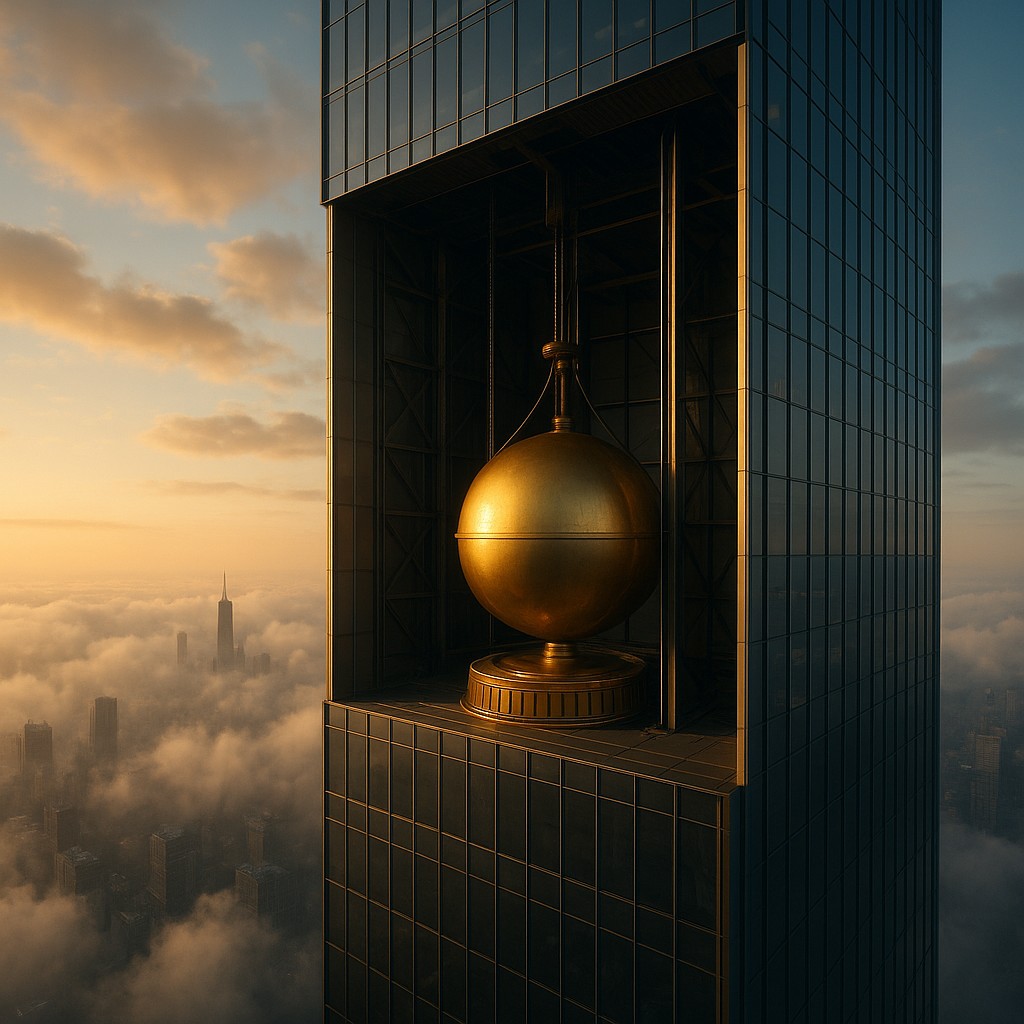
This movement is not usually a sign that the building is failing, but it is a massive engineering challenge. If a tower sways too much, people inside start to feel seasick, elevators begin to bang against their shafts, and over several decades, the constant flexing can wear down the very steel holding the structure up. To solve this, engineers use a piece of technology that seems like magic: the tuned mass damper. It is essentially a giant, heavy pendulum hidden near the top of the building. It is designed to sense when the tower is leaning one way and move in the exact opposite direction. By doing this, it acts as a gravitational anchor, soaking up the wind's energy and keeping the skyscraper steady even in a hurricane.
The Invisible Ripples of the Karman Vortex Street
To understand why we need a thousand-ton weight hanging from the ceiling, we first have to look at how wind attacks a tall building. Most people assume a building sways simply because the wind is blowing it over, but the real culprit is a phenomenon called vortex shedding. When a steady stream of air hits a flat or rounded surface, such as a skyscraper, it cannot pass through; it must go around. As the air rushes past the sharp or curved corners of the building, it creates low-pressure swirls, or "vortices," on the side facing away from the wind. These swirls do not happen all at once. They alternate from one side of the building to the other in a predictable, rhythmic pattern.
This alternating pattern is known as the Karman Vortex Street. As each swirl of air breaks away from the building, it creates a tiny suction force that pulls the tower toward that side. Because these swirls shed in a back-and-forth rhythm, they begin to "tug" on the building at a specific frequency. If the rhythm of these air swirls happens to match the natural "heartbeat" or frequency of the building, the tower enters a state of resonance. This is the same principle that allows you to push a child on a swing higher and higher with just tiny, well-timed nudges. Without help, even a moderate wind can cause a massive skyscraper to swing wildly, creating a terrifying experience for anyone on the upper floors.
Taking the Hit with Inertia and Counterweights
The genius of a tuned mass damper (TMD) lies in its ability to fight physics with physics. Imagine you are standing on a rocking boat. When the boat tilts to the left, your instinct is to shift your weight to the right to keep from falling. A TMD does exactly this for a building, but on a massive scale. Usually made of a giant block of steel or concrete, or perhaps a massive steel sphere, the damper is hung by cables or mounted on tracks near the very top of the structure. When the wind pushes the building to the left, the weight's inertia causes it to lag behind, effectively pulling the building back toward the center.
The weight is not just a passive object; it is "tuned" to the specific personality of the building. Every skyscraper has a natural "period," which is the time it takes to complete one full sway from left to right and back again. Engineers calculate this time with extreme precision. They then adjust the length of the damper's cables or the stiffness of its supports so that the weight swings at that exact same rate. Because the weight is designed to move out of step with the building, it acts as a mechanical sponge, absorbing the movement energy that the wind pumps into the structure. Instead of the building vibrating, the damper vibrates, leaving the offices and apartments below almost perfectly still.
Comparing Solutions for Structural Stability
While the tuned mass damper is the most famous solution, it is not the only way engineers keep our skylines steady. Depending on the height of the building, the local climate, and the budget, different "damping" strategies might be used. Some buildings use liquid instead of solid weights, while others rely on the shape of the architecture itself to break up the wind before it can start creating swirls.
| Mitigation Method |
Primary Mechanism |
Pros |
Cons |
| Tuned Mass Damper |
A large hanging weight that moves out of sync with the building. |
Extremely effective for very tall, thin towers. |
Takes up valuable real estate on the top floors. |
| Tuned Liquid Damper |
Large tanks of water that slosh to absorb energy. |
Cheaper to build; the water can also be used for fire safety. |
Needs more floor space to allow the water to move. |
| Aerodynamic Shaping |
Tapered or twisted building designs. |
Prevents wind swirls from starting in the first place. |
Limits the creative freedom of the architect. |
| Viscoelastic Dampers |
Rubbery materials in the joints that turn motion into heat. |
Also works well to protect the building during earthquakes. |
Requires regular maintenance and needs to be replaced over time. |
The Golden Sphere of Taipei 101
The most famous example of this technology is found in the Taipei 101 tower in Taiwan. Once the tallest building in the world, Taipei 101 sits in a region prone to both typhoons and frequent earthquakes. To keep the building safe, engineers installed a 728-ton gilded steel ball, suspended from the 92nd down to the 87th floor. This sphere is not hidden away in a maintenance closet; it is a centerpiece of the building's design, visible to tourists at the observation deck. It is held by eight massive cables and sits on a series of hydraulic cylinders - which look like giant car shock absorbers - to help soak up the energy the ball captures.
During a massive typhoon in 2015, the ball moved over a meter in each direction, absorbing the violent energy of wind gusts reaching over 100 miles per hour. While the world outside was in chaos, the damper was doing its job, ensuring the building remained structurally sound. This visible engineering marvel serves as a powerful reminder that stability is not about being rigid and unmoving. In the world of high-rise engineering, stability is about knowing how to move gracefully with the forces of nature, redirecting energy rather than trying to block it entirely.
Living in Harmony with the Laws of Motion
Beyond the "cool factor" of a giant swinging ball in the sky, there is a deeper lesson in how we design these structures. We often think of buildings as static objects, fixed points of certainty in a changing world. However, the taller we build, the more we have to treat our architecture as a living system that interacts with its environment. A skyscraper without a damper is a brittle structure fighting a losing battle against the moving air. A skyscraper with a damper is a partner with the wind, acknowledging the power of the atmosphere and finding an elegant way to coexist with it.
The next time you see a sleek, modern tower reaching into the clouds, do not just admire the glass or the height. Think about the hidden physics happening hundreds of feet above the pavement. Think about the Karman Vortex Street whispering past the corners and the massive, silent weight hanging in the darkness of the upper floors, ready to swing into action. We have mastered the art of vertical living not just by piling stones higher, but by understanding the secret rhythms of the Earth and building machines that can dance along with them. This perfect balance of mass and movement is what allows us to touch the sky while keeping our feet comfortably on the ground.