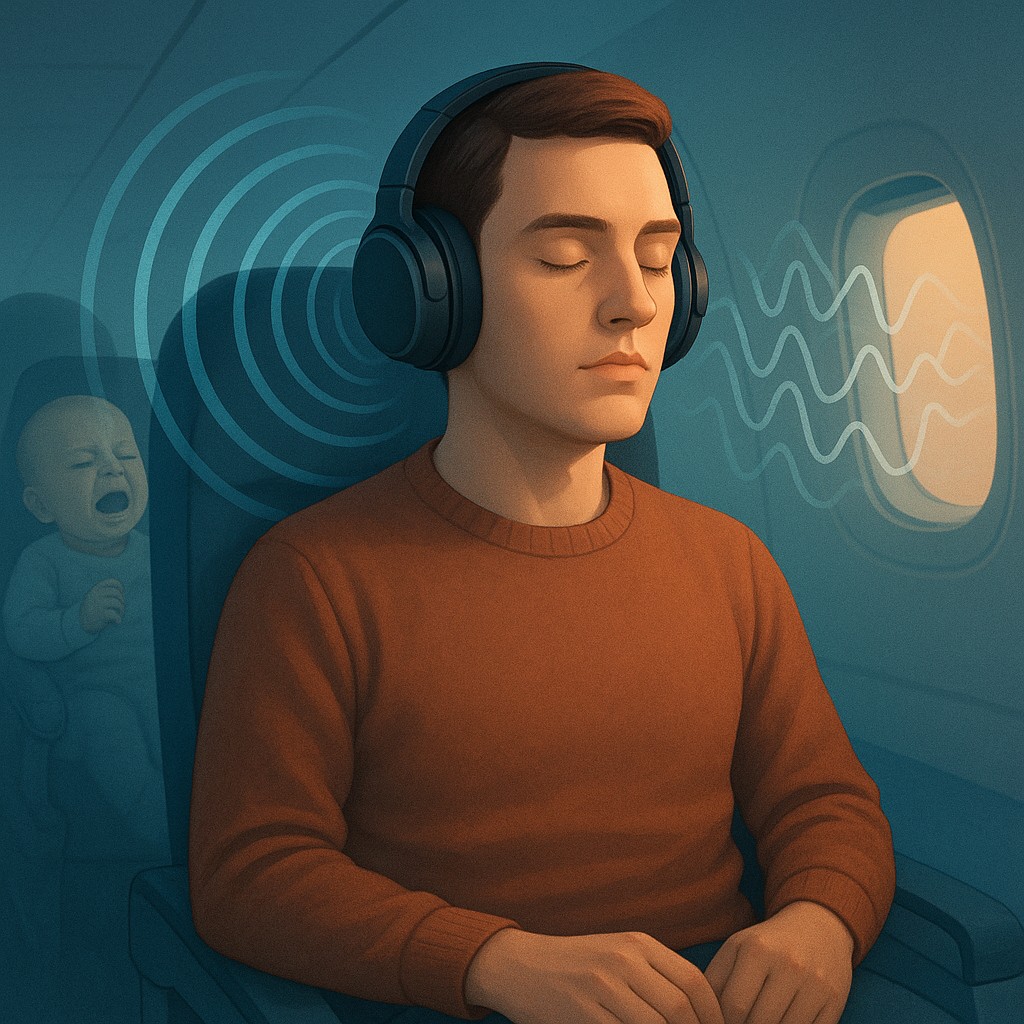
Imagine you are in the middle seat on a long-haul flight, squeezed between a crying baby and a traveler who has decided now is the perfect time to crunch through a large bag of pretzels. The roar of the jet engines is a constant, low drone that vibrates through your skull, making it impossible to focus on your book or catch some sleep. You reach into your bag, pull out a pair of noise-canceling headphones, and slide them on. With the flick of a switch, the world doesn't just get quieter; it feels as though the air itself has been hollowed out. The engine roar fades to a ghostly whisper, and suddenly, you are in a silent, private bubble while the rest of the cabin carries on its noisy chaos.
It feels like magic, or perhaps a temporary break from the laws of physics. However, what is actually happening is a masterclass in wave mechanics and high-speed digital processing. Unlike earplugs, which simply try to block sound waves from reaching your eardrum with a physical barrier, noise-canceling headphones are proactive. They are essentially tiny computers that "listen" to your surroundings and then launch a counter-attack. They don't just shield you from the noise; they use the noise to kill the noise. By understanding how sound moves through the air as a physical wave, engineers have found a way to create "anti-sound" that deletes unwanted vibrations before they ever touch your ears.
The Physical Anatomy of a Silent Wave
To understand how silence is manufactured, we first have to look at what sound actually is. Sound is not a ghost; it is a physical pressure wave traveling through a medium like air. When an object vibrates, it pushes against the air molecules next to it, creating a "peak" of high pressure. As the object moves back, it creates a "trough" of low pressure. This cycle of peaks and troughs travels at roughly 767 miles per hour until it hits your eardrum, causing it to vibrate. Your brain interprets those vibrations as sound. The height of the peak determines the volume, while the distance between the peaks determines the pitch.
Active Noise Cancellation (ANC) relies on a principle called the superposition of waves. If you have two waves traveling in the same space, they don't ignore each other; they add together. If you line up two identical waves so their peaks and troughs match perfectly, you get constructive interference, and the sound becomes twice as loud. However, if you shift one of those waves by exactly 180 degrees - so that the peak of the first wave lines up with the trough of the second - you get destructive interference. The high pressure of one wave fills in the low pressure of the other. The result is a flat line with no change in air pressure. In the world of physics, a flat line equals total silence.
Making this work in a pair of headphones requires incredible precision and speed. The device uses external microphones to capture the ambient sound around you. Once the microphone picks up the incoming noise, an internal chip analyzes the wave's shape and strength. It then generates a mirror image of that wave - the "anti-noise" - and pumps it through the headphone speakers. Because the speakers are right against your ears, the original noise and the inverted anti-noise meet in the tiny pocket of air inside the ear cup. They collide, they cancel out, and your eardrum remains perfectly still.
The Difference Between Passive and Active Defense
It is important to distinguish between the two ways headphones keep things quiet. Almost all headphones provide some level of passive noise isolation. This is the "brute force" method of silence. It involves using thick foam, leather cups, or rubber tips to physically seal the ear canal and prevent sound waves from entering. This is the same principle as putting your fingers in your ears. Passive isolation is excellent at blocking high-pitched sounds, like a whistle or a sharp cat meow, because those short, fast waves are easily stopped by physical barriers. However, passive isolation struggles with long, low-frequency waves that can easily vibrate through foam or even through the sturdy plastic of the headphone casing.
Active Noise Cancellation is the "high-tech" layer added on top of that physical barrier. ANC is designed to tackle the sounds that passive isolation cannot catch, particularly those low-frequency rumbles. This is why noise-canceling headphones are so much more effective on airplanes and trains than they are at a loud party. The "active" part of the name refers to the fact that the device requires power from a battery to run the microphones and the processor that creates the counter-waves. If your battery dies, the active part stops working, and you are left with only the passive isolation of the ear cups.
| Feature |
Passive Isolation |
Active Noise Cancellation (ANC) |
| Mechanism |
Physical barrier (foam or silicon) |
Electronic wave inversion |
| Energy Source |
None (always "on") |
Battery power required |
| Best For |
High-pitched sounds (voices, sirens) |
Low-pitched hums (engines, fans) |
| Cost |
Generally inexpensive |
More expensive due to tech |
| Example |
Earplugs or heavy earmuffs |
High-end travel headphones |
The Challenge of Unpredictable Chaos
While the theory of destructive interference is perfect, the execution is limited by the messy reality of the world. ANC is famous for canceling steady, predictable noises. An airplane engine, a computer fan, or the roar of a highway all produce repetitive, consistent patterns. Because the noise is predictable, the headphone’s processor has an easy time calculating the exact mirror image needed to cancel it out. The chip can see a pattern and follow it with millisecond precision, ensuring the anti-noise wave is perfectly timed with the incoming engine drone.
Problems arise when the noise is sudden or irregular. If someone drops a glass on a tile floor or laughs loudly in a quiet office, the sound wave is a chaotic, "spiky" burst of energy. By the time the microphone hears the sound, the processor calculates the mirror image, and the speaker plays it back, the original sound wave may have already passed through the ear cup. ANC technology is essentially in a race against the speed of sound. If the anti-noise is even slightly out of sync with the original noise, it won't cancel it. In fact, if the timing is off by a fraction of a second, the two waves might actually align their peaks, making the noise louder or creating strange distortions.
This is also why ANC doesn't work well for human speech. Human voices are dynamic, changing pitch, volume, and rhythm constantly. While your headphones might take the edge off the low-frequency rumble of a crowded room, you can usually still hear the person in the next row talking about their vacation. Their voice is too unpredictable for current electronics to perfectly mirror and delete in real time. Technology is improving, but for now, your best defense against a chatty neighbor is still a combination of active cancellation and playing some music to mask the remaining sounds.
Three Ways to Build Cancellation
Not all noise-canceling headphones are built the same way. Engineers use three main designs to decide how the device "listens" to the world, and each has its own strengths and weaknesses. The most common is the Feedforward system. In this setup, the microphone sits on the outside of the ear cup. It hears the noise before your ear does, giving the processor a tiny head start to create the anti-noise. This is great for high-frequency sounds but can be sensitive to wind noise, as the external mic is exposed to the breeze.
The second type is the Feedback system. Here, the microphone is located inside the ear cup, right in front of the speaker. This allows the system to hear exactly what you are hearing. If the cancellation isn't perfect, the system can "see" the error and adjust itself. It is a self-correcting loop. While this is better at low frequencies and handles wind better, it can sometimes accidentally cancel out the bass in your music, leading to thinner sound quality.
The gold standard in modern premium headphones is the Hybrid system. As the name suggests, it uses both external and internal microphones. The feedforward mic catches the incoming roar, and the feedback mic double-checks the result inside the ear cup to ensure total silence. This requires twice the processing power and more complex software, which is why these headphones tend to be significantly more expensive. However, the result is a much more effective "bubble" of silence that can handle a wider range of sounds without ruining the quality of your audio.
Physical Comfort and the Silence Paradox
Beyond the physics, there is a fascinating psychological side to wearing noise-canceling headphones. Many people report a sensation of "pressure" or "fullness" in their ears when they first turn on high-end ANC. This is a bit of a biological prank played by your brain. Because the headphones are so effective at removing low-frequency sounds, they mimic the shift in air pressure that happens when you change altitude. Your inner ear notices the lack of low-frequency vibration and sends a signal to the brain that says, "We must be on a mountain or in a deep-sea diving bell."
Even though the actual air pressure inside the ear cup hasn't changed, your brain perceives the sudden silence as a physical sensation. Furthermore, removing background noise can sometimes make you more aware of your own internal sounds. In a truly silent bubble, you might start to hear your own heartbeat, the rustle of your clothes, or the clicking of your jaw. This is a common effect where the absence of outside noise forces the brain to "turn up the volume" on your own body.
Despite these quirks, the ability to manufacture silence is great for mental health and productivity. In our modern, urban world, we are rarely in true silence. Constant noise pollution is linked to increased stress, higher heart rates, and difficulty concentrating. By using destructive interference to flatten the sound waves of the city, we are essentially hacking our environment to reclaim our focus. It is not just about hearing your music better; it’s about giving your nervous system a chance to rest in a world that never stops humming.
Looking ahead, these technologies are becoming smarter. Some headphones now use "Environmental Adaptation" to recognize specifically where you are. They can distinguish between the roar of a subway and the hum of an office, adjusting the cancellation to be as comfortable as possible. Others are beginning to use artificial intelligence to "whitelist" certain sounds, allowing the system to cancel everything except for your name being called or the sound of an approaching siren. We are moving from a world of "on or off" silence to a world of curated sound, where we choose exactly which parts of reality we want to let in.
The next time you toggle that switch and feel the world drop away, take a moment to appreciate the invisible battle happening around your ears. Somewhere in that headset, a tiny processor is working at lightning speed to draw the perfect mirror of a chaotic world, meeting every roar with a whisper. You aren't just wearing headphones; you are wearing a physics lab that is actively rewriting the air around you to give you one moment of peace.