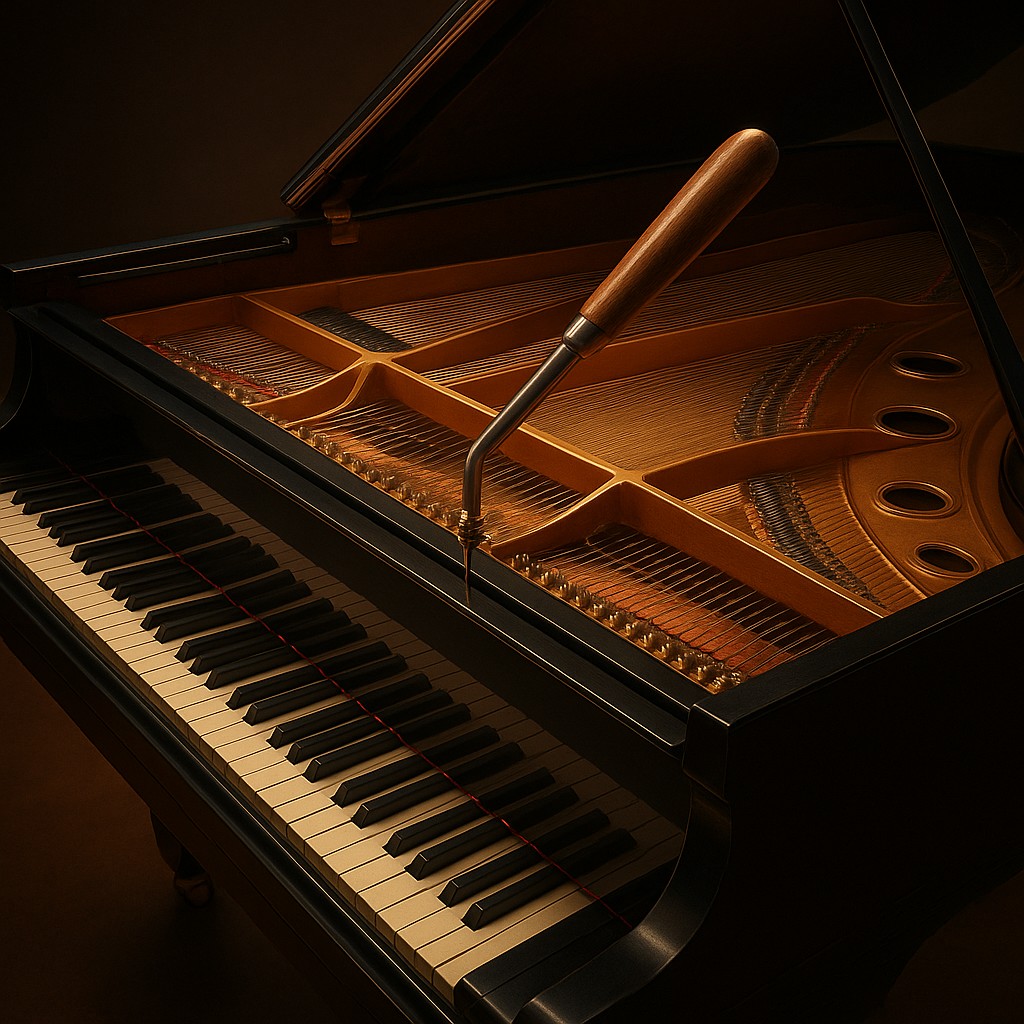
When you sit down at a grand piano and strike a low C, you aren’t just hearing a single, isolated note. You are triggering a complex chain reaction. It starts with the vibration of high-tension steel, moves through the resonance of a massive spruce soundboard, and involves a hidden mathematical tension that has frustrated musicians for centuries. In a world of perfect equations, every octave would be exactly double the frequency of the one below it. If middle A is 440 Hz, the A above it should be 880 Hz, and the one above that 1,760 Hz. This is clean, elegant, and entirely wrong for a real instrument.
If a technician tuned your piano to these exact mathematical points using a digital frequency generator, you would likely find the result repulsive. To the human ear, a mathematically "perfect" piano sounds nervous, metallic, and strangely out of tune with itself. This happens because the physical world rarely matches a textbook. Steel wire has "baggage" - specifically a physical property called stiffness - which forces us to abandon raw math for something much more artistic and human. This adjustment is called stretch tuning, and it is the secret reason a well-tuned piano feels like it has a soul.
The Flaw in the Mathematical String
To understand why we have to "stretch" a piano, we first have to look at what a string does when it vibrates. In a physics classroom, teachers talk about "ideal strings," which are infinitely flexible and have no thickness. In that perfect world, a string vibrates in a series of harmonics - overtones that are exact multiples of the starting frequency. These harmonics give an instrument its timbre, or unique voice. They are the reason a piano sounds different from a flute even when they play the same note. The ear hears the main pitch, but it also hears a "stack" of quieter, higher frequencies shimmering on top of it.
However, a piano string is not an ideal string. It is a thick, heavy length of high-carbon steel under immense tension. Near the points where the string is held in place - called the agraffe or the bridge - the wire does not act like a flexible rope. Instead, it acts like a stiff metal bar. Because the wire is stiff, it resists bending more than an ideal string would. This resistance adds a tiny bit of extra "springiness" to the vibration. In acoustics, extra springiness means more speed, and more speed means a higher frequency.
This phenomenon is called inharmonicity. It means the overtones produced by a real piano string are always slightly sharp, or higher in pitch, than the math predicts. The second harmonic of a low C isn’t exactly twice the frequency; it might be 2.01 times the frequency. This tiny gap might seem like a rounding error, but in music, it is a recipe for disaster. Without accounting for this, the notes on a piano will clash with their own echoes as they move up the keyboard.
When Harmony Meets Physical Resistance
The human brain is an incredible pattern-matching machine, especially for sound. When we hear an octave, our ears look for a specific "fit." We want the overtones of the lower note to line up perfectly with the main frequency of the higher note. Imagine two gears interlocking; if the teeth don't line up, you get a grinding noise. In music, that "grinding" is called beating - a pulsing waviness in the sound that happens when two frequencies are very close but not identical.
Because of inharmonicity, the overtones of the lower strings are already pushed sharp. If we tuned the higher strings to their "correct" mathematical frequencies, they would actually be lower than the overtones of the bass strings. For example, if you play a low G and a middle G at the same time, your ear compares the middle G to the first overtone of the low G. If that overtone is sharp due to stiffness, but the middle G is tuned exactly to the math, they won't match. The result is a sour, clashing sound.
To fix this, tuners perform an acoustic magic trick. They intentionally tune the upper notes slightly sharp and the lower notes slightly flat. This ensures the high note lands exactly on the "sharp" overtone of the low note. By stretching the tuning, we align the instrument with its own physical quirks. We essentially lie to the tuning computer to tell the truth to the human ear.
Mapping the Curve of Human Hearing
This move away from mathematical perfection is not random. It follows a predictable pattern known as the Railsback Curve. Named after the researcher who first measured it, this curve shows that "stretch" becomes more extreme at the ends of the keyboard. The middle of the piano stays close to theoretical pitch, but the very top notes can be as much as 30 cents sharp, while the lowest bass notes can be 30 cents flat. A "cent" is a tiny unit of pitch; there are 100 cents in a single semitone (the distance between two adjacent keys).
| Region of Piano |
Pitch Deviation |
Reason for Adjustment |
| Deep Bass |
Significantly Flat |
Matches the high stiffness of thick, copper-wound strings. |
| Lower Midrange |
Slightly Flat |
Transitions toward the center of the keyboard's resonance. |
| Center (Middle C) |
Near Zero |
The anchor point where physics and math are closest. |
| Upper Treble |
Significantly Sharp |
Aligns with the sharp overtones of the middle strings. |
The amount of stretch required isn't the same for every piano. A nine-foot concert grand has long, thin strings with low inharmonicity, so it only needs a little stretching. A small upright piano has short, thick strings that are incredibly stiff. These smaller instruments require an aggressive stretch just to sound musical. This is why a small piano often sounds "twangy" compared to a grand, even if a professional has just tuned it. The physics of short strings are simply harder to manage.
The Art of the Balanced Interval
Tuning a piano is rarely about making one note sound good on its own; it is about making every note work with every other note. This creates a complex web of relationships. If a tuner stretches the octaves too much, other musical intervals - like fourths and fifths - will start to sound wrong. If they don't stretch enough, the octaves will sound dead and lifeless. It is a high-level balancing act. The technician must listen for the "bloom" of the note and the way the vibrations fade away.
This process also reveals a fascinating truth about how we hear: we prefer "bright" over "pure." When we hear a high note tuned to its mathematical ideal, we usually think it sounds flat. Our brains seem to expect the shimmer of those sharp overtones. By stretching the tuning, the technician provides the brilliance and clarity we associate with quality music. This is why a piano tuned by ear by a master often sounds "more expensive" and resonant than one tuned by a cheap digital app that doesn't account for the unique stiffness of that specific piano’s wire.
There is also a psychological component to these stretched notes. The high-frequency shimmer of a stretched treble creates a sense of space and air. It allows the melody to soar above the accompaniment. In the bass, the slight flattening prevents the low end from sounding aggressive or "honky." It creates a warm, soft cushion that supports the rest of the sound. Without this careful manipulation of physics, the piano would be a box of noisy wires rather than the "King of Instruments."
The Ghost in the Machine
It is easy to think of science and art as opposites, where math provides the rules and art provides the expression. The story of piano tuning suggests something else: art is often the necessary correction for where simple math fails to describe reality. The stiffness of a steel wire is a "defect" in a purely mathematical sense, but it is a defect that gives the piano its character. If we had perfectly flexible strings, the piano would lose its iconic, complex voice.
Inharmonicity reminds us that we live in a material world, not a digital one. Every material has its own personality, its own resistance, and its own way of bending the rules. When you listen to a piano masterpiece, you aren't just hearing the notes the composer wrote; you are hearing a technician's response to the physical stubbornness of steel. It is a conversation between the laws of motion and the limits of human hearing.
Next time you hear a piano, listen for the "shimmer" in the high notes. Remember that those notes aren't where the math says they should be. They are exactly where they need to be to satisfy the human soul. This intersection of physics and feeling is what makes music so powerful. It teaches us that perfection isn't found in a sterile equation, but in the intentional adjustment of our expectations to match the complicated reality of the world around us. Embracing these imperfections is exactly what allows us to create harmony.