Imagine for a moment that you are responsible for stopping a massive, high-pressure pot of boiling water from overflowing into a disaster. In a traditional nuclear power plant, your main tools for this job are enormous, high-powered electric pumps. These machines are the quiet workhorses of the 20th-century power grid, constantly pushing water through the reactor core to carry away the intense heat created by nuclear fission. However, these heroes have a fatal weakness: they cannot run without electricity. If the power grid goes down, if the backup diesel generators fail to start, or if a flood knocks out the electrical yard, those pumps stop spinning. When the pumps die, the water sits still, the heat climbs, and you find yourself in a race against physics that is incredibly hard to win.
This scenario, known as a "loss of flow" accident, has been the primary engineering puzzle for the nuclear industry for decades. This is exactly what happened at Fukushima Daiichi in 2011. The reactors actually shut down perfectly, but the "decay heat" left behind had no way to escape because the cooling pumps lost power. But what if we could build a reactor that didn't treat physics as an enemy to be fought with mechanical force, but as an assistant that never quits? This is the core idea behind Small Modular Reactors (SMRs). Instead of fighting gravity and heat movement, these new designs use them to manage the cooling process. By shrinking the size and changing the internal plumbing, engineers are building reactors that "breathe" coolant naturally, using the same simple principle that makes hot air rise up a chimney.
The Convection Engine of a Tiny Giant
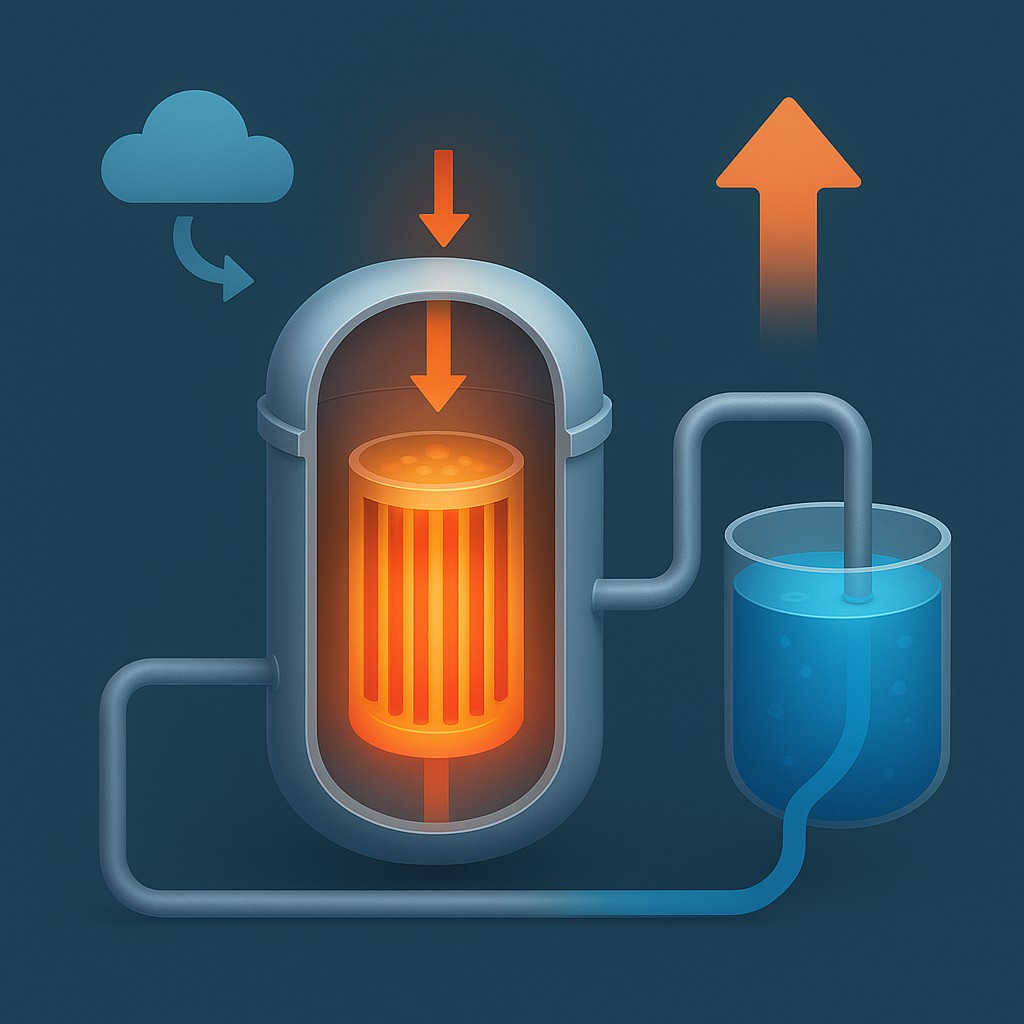
At the heart of a Small Modular Reactor is a design concept called "integral architecture." In a massive, old-school nuclear plant, the reactor vessel is connected by long, winding pipes to separate heat exchangers and huge external pumps. In an SMR, everything is packed into a single, sleek, vertical cylinder. This isn't just about saving space; it is the secret to "passive safety," or safety that happens automatically. By placing the heat source (the nuclear fuel) at the bottom and the heat sink (the steam generators) at the top, engineers create a direct highway for natural convection.
Natural convection happens because of a simple change in density. When water is heated by the fuel at the bottom of the tank, its molecules spread out, making it lighter and more buoyant than the water around it. This hot water naturally begins to rise through a central pipe. Once it reaches the top, it hits the steam generator coils, which are filled with much cooler water from outside. As the hot reactor water gives up its heat to those coils, it cools down, becomes heavier, and begins to sink back down along the outer edges of the tank. This creates a steady, circular loop of moving liquid that requires no moving parts, no electricity, and no human help to keep going.
This loop runs constantly during normal operation, but its true value shows when things go wrong. In a conventional plant, a power failure is a "red alert" because cooling must be forced by machines. In a natural-circulation SMR, a power failure barely affects the cooling system. Since the "pump" is actually just the temperature difference between the top and bottom of the tank, the flow continues as long as the fuel is hot. The laws of thermodynamics do not need a backup generator to work; they are built into the way the universe functions, making the safety system essentially "unplug-able."
Rethinking Size and the Power of Surface Area
You might wonder why we didn't just build all reactors this way from the start. The answer lies in a rule called the "square-cube law." As you make an object larger, its volume grows much faster than its surface area. Traditional reactors were built to be huge because, financially, bigger was seen as better. However, when you have a massive amount of fuel in a giant tank, the heat is so intense that natural circulation alone cannot move it fast enough to keep the fuel from melting. You need the brute force of mechanical pumps to move thousands of gallons every second.
By choosing to go small, SMR designers have changed the math of heat. An SMR typically produces about 50 to 300 megawatts, compared to the 1,000 or 1,500 megawatts of a traditional "big" reactor. Because there is less total heat and the reactor tank is much thinner and taller, the ratio of surface area to volume is much better. This "right-sizing" allows the natural movement of water to be more than enough to carry away heat and keep the fuel safe. It is the same reason a large roasted turkey stays hot for hours after leaving the oven, while a tray of cupcakes reaches room temperature in minutes.
| Feature |
Conventional Large Reactor |
Small Modular Reactor (SMR) |
| Moving the Coolant |
Active (High-pressure electric pumps) |
Passive (Natural convection and gravity) |
| Safety Logic |
Mechanical backups (Multiple spare pumps) |
Built-in physical laws (Buoyancy and density) |
| Cooling During Outages |
Needs diesel generators or batteries |
Continues automatically via natural loops |
| Complexity |
High (Thousands of valves, miles of pipes) |
Low (Simplified, all-in-one internal design) |
| Emergency Response |
Usually needs fast action from operators |
"Walk-away safe" for days or weeks |
The "Walk-Away" Safety Framework
One of the most encouraging terms in modern nuclear energy is "walk-away safety." This does not mean that plant workers should go see a movie during an emergency, but it does mean the reactor is designed to reach a stable, cold state even if the entire staff were to disappear. In many SMR designs, the reactor tank itself sits in a giant pool of water located underground. This pool acts as a massive thermal sponge. If the reactor has a problem, internal valves (which are designed to stay open if power is lost) allow the heat to bleed out into this surrounding pool.
This move from active to passive safety is a huge shift in how we handle risk. In the old model, safety was a series of barriers you had to maintain constantly, like keeping an airplane in the sky. If the engines stop, you have to glide and find a runway perfectly. In the SMR model, safety is more like a ball sitting at the bottom of a bowl. If you push the ball up the side, it naturally wants to roll back down to the center. By using gravity-fed water tanks and air cooling driven by heat, these plants can stay cool for days or even weeks without a single watt of outside electricity.
Furthermore, getting rid of giant external pumps and their pipes removes the most common breaking points. In a traditional plant, the pipes connecting the reactor to the pumps are weak spots where a leak could lead to a loss of coolant. By moving everything inside a single, thick steel pressure vessel, SMRs get rid of these large pipes entirely. You cannot have a major pipe-break accident if the pipes don't exist in the design. It is a perfect example of engineering by subtraction: making a system safer by making it simpler.
Clearing the Air on Public Perception
Despite these breakthroughs, the path to a high-tech nuclear future is blocked by common misunderstandings. The word "nuclear" still carries the weight of 20th-century accidents, and people often assume "passive safety" is just a marketing term meant to hide the same old risks. One common myth is that a reactor without pumps will simply sit still and overheat immediately. However, as we have seen, the liquid only stops moving if there is no temperature difference. As long as the fuel is generating heat, the "thermal motor" of convection is being fueled. In fact, the hotter the core gets, the faster the water circulates, creating a system that regulates itself.
Another misconception is that these reactors are "too small to be useful." While a single SMR won't power a city like New York, the "Modular" part of their name is the key. These units are designed to be built in a factory and shipped to a site where they can be plugged together like LEGO blocks. If a region needs more power, they simply add another unit. This approach not only makes them easier to pay for but also ensures that a problem with one unit doesn't shut down the entire power station. It is a safety model that mirrors how internet servers work: if one goes down, the rest of the system picks up the slack.
Finally, critics often focus on the cost of nuclear energy. While it is true that the first few SMRs will be expensive to build, moving away from complex pump systems significantly lowers the cost of long-term maintenance. Pumps are mechanical devices with seals that leak, bearings that wear out, and motors that burn out. They require constant watching and expensive spare parts. By replacing a $10 million high-tech pump with a "free" law of physics like gravity, SMR designers are betting that simplicity will eventually win on price as well as safety.
A Future Powered by the Ordinary
We are entering an era where our most advanced technologies are catching up to the elegance of the natural world. Just as we look to biology for medical breakthroughs or brain patterns for computer programming, the nuclear industry is looking toward the basic, unchanging laws of how liquids move to solve its oldest problems. The shift from "active" to "passive" is more than a technical upgrade; it is a realization that human-made machines can break, but the pull of gravity and the way heat rises are constant.
The promise of the Small Modular Reactor is a world where clean, carbon-free power doesn't have to come with constant anxiety. By shrinking the challenge and letting physics take the lead, we are creating an energy source that is naturally quiet, stable, and tough. As these designs move from the drawing board to reality, they offer a vision of a future where our power grids are anchored by "tiny giants" that can breathe on their own. They simply use the warmth they create to keep themselves cool, turning the very energy they produce into their own ultimate safety net.