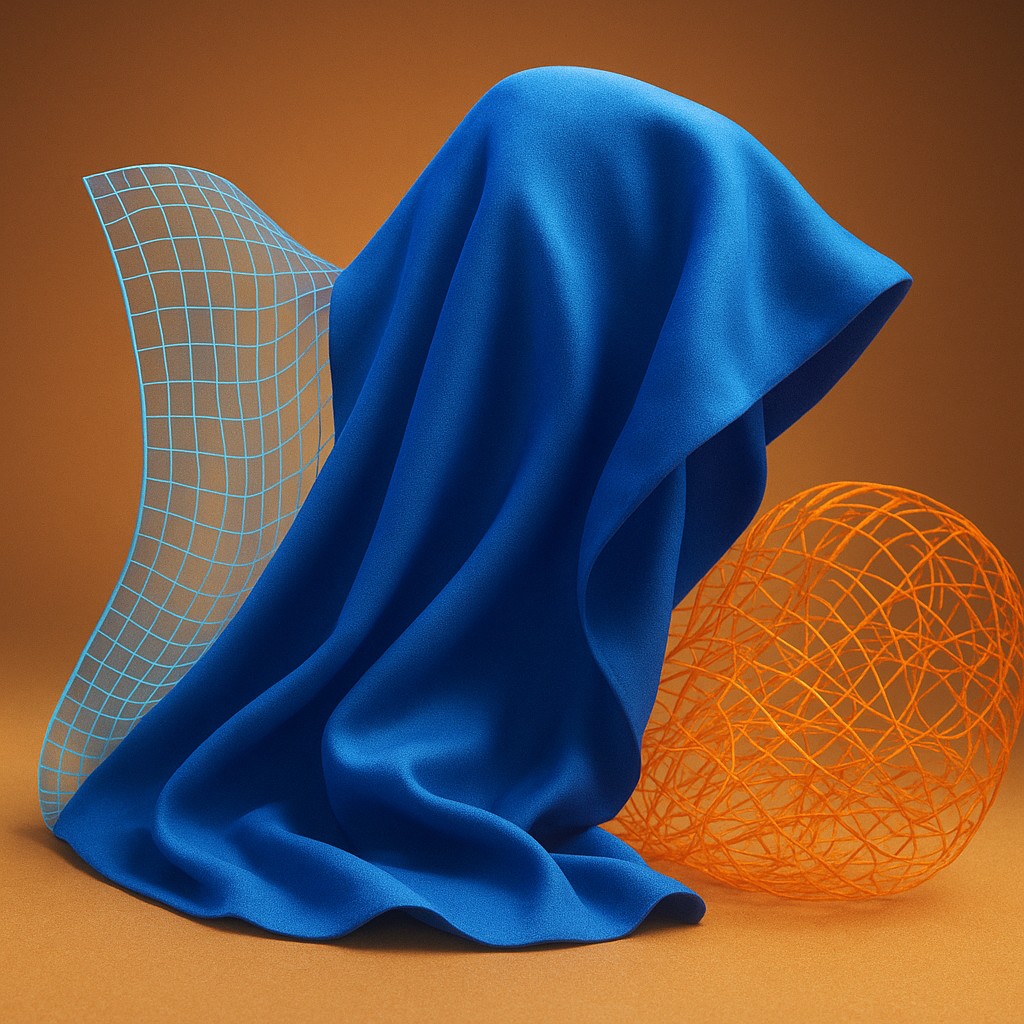
When you watch a superhero land a dramatic punch or a Pixar character dance through a field, you probably notice how their clothing moves. It bends, stretches, and settles into soft folds that look just like the laundry sitting in your basket. This wasn't always the case. Not long ago, digital characters moved as if their clothes were painted onto their skin or carved out of stiff, flexible plastic. The shift from these robotic movements to the graceful, fluid draping we see today is one of the greatest achievements in computer animation. It marks a move away from simply drawing what we think objects look like toward simulating the actual laws of physics at a microscopic level.
The secret to this realism is a transition from "sheet logic" to "thread logic." Originally, digital artists treated a sleeve like a solid tube of rubber. When the arm bent, the computer calculated how that tube should squeeze or expand. But real fabric isn't a solid tube; it is a complex grid of fibers, yarns, and air gaps. Modern cinema has reached a point where we no longer simulate the shape of the clothing, but rather how the garment is built. By modeling the tiny interactions between thousands of virtual threads, artists can recreate the weight, natural friction, and feel of real-world fabrics.
Breaking the Plastic Barrier with Microsimulation
In the early days of computer graphics - specifically during the 1990s and early 2000s - cloth was a nightmare for animators. To keep the math simple enough for computers at the time, fabric was treated as a "continuous membrane." This is a technical way of saying the computer viewed a shirt exactly like a sheet of trampoline material or a rubber glove. Because the software assumed the material was the same all the way through, the resulting folds looked "gummy." They lacked the sharp, crisp creases of linen or the heavy swing of wool. These digital clothes had no internal structure, so they couldn't react to movement in a way that felt real.
Today, the industry uses a technique called yarn-level simulation, or microsimulation. Instead of a flat sheet, the computer follows a blueprint of how a garment is woven or knitted. If a character wears a knit sweater, the simulation actually accounts for thousands of interlocking loops of yarn. When the character raises their arm, the software doesn't just move a flat shape; it calculates how each loop of yarn pulls on the one next to it. This approach captures the "shear" of the fabric, which is the way threads slide across one another when pulled diagonally. This tiny sliding motion creates the specific ripples we associate with expensive silk or rugged denim.
The shift to microsimulation also changed how digital light hits clothing. Because the model now includes tiny gaps between threads and the "fuzz" of individual fibers, light can pass through and scatter just like it does in the real world. This is why a modern digital cape doesn't look like a heavy rug; it looks like a porous material that catches shadows in its depths and glimmers along its edges. By getting the small things right, the big things, like how a character looks under a sunset, look natural automatically.
The Invisible Battle of Friction and Tension
If you rub two pieces of silk together, they glide easily. If you do the same with wool, they catch and drag. This resistance is called friction, and it is the hidden hero of realistic animation. In a yarn-level simulation, friction happens at every single point where two threads cross. While it sounds like a minor detail, these billions of tiny "micro-catches" are what prevent a digital dress from collapsing into a pile of shapeless goo. Friction provides the "bite" that lets a collar stand up or a sleeve hold its shape after being pushed up an elbow.
Tension works with friction to define how the cloth acts. Tension is the force that pulls threads tight, and in a digital simulation, it acts like a network of tiny springs. When a simulation runs, the computer is constantly solving a massive math problem: "How much is thread A pulling on thread B, and is there enough friction to keep them from sliding?" If the tension is high and the friction is low, you get the look of tight spandex. If both are high, you get the stiff, sturdy look of heavy canvas. By adjusting these two settings, artists can create any material known to man without ever having to "draw" a single wrinkle.
The complexity of these calculations is immense. A single second of high-end cloth simulation for a movie might require a supercomputer to track the positions and forces of millions of points at once. If the friction is even slightly off, the fabric might "jitter" or vibrate as the threads struggle to stay still. This explains why digital clothing often looks better in a movie than in a video game; movies can spend weeks "rendering," or processing these physics, while games have to make a best guess in a split second.
| Feature |
Early "Sheet" Simulation |
Modern "Yarn-Level" Simulation |
| Material Structure |
Solid, uniform layer (like rubber) |
Interlocking loops and weaves (like real fabric) |
| Movement Basis |
Stretching and bending shapes |
Physics of individual thread interactions |
| Friction |
Surface-level only (cloth vs. skin) |
Internal friction (thread vs. thread) |
| Visual Result |
Smooth, rounded, plastic folds |
Sharp, natural, texture-specific wrinkles |
| Computing Cost |
Low (runs on a standard laptop) |
Extreme (requires massive server farms) |
The Ghost in the Machine and the Problem of Glitches
Even with the best supercomputers, digital fabric is prone to a glitch known as "interpenetration." Because the computer is tracking thousands of points in 3D space, it sometimes loses track of which point is supposed to be on the "outside." When a character sits down, the fabric of their pants might accidentally pass through their leg, or the front of a shirt might clip through the back. To us, it looks like a ghost passing through a wall, but to the computer, it is just a math error where two objects tried to be in the same place at the same time.
To fix this, engineers use "collision detection" rules that act as a digital layer of skin. These rules constantly check if the "yarns" are getting too close to the character's body. If they touch, the software pushes the fabric back out. However, this creates a new challenge: if the push is too strong, the clothing looks like it is hovering several inches off the skin. If it's too weak, the fabric clips through again. Managing this "buffer zone" is a tedious part of an artist's job, often requiring them to manually "sculpt" or clean up errors that the physics engine couldn't solve.
Another common struggle is "energy gain." Sometimes, the math behind the friction and tension becomes unstable, causing the virtual threads to bounce against each other faster and faster. This results in a garment that looks like it is "exploding" or vibrating violently. Animators call this "the clothing having a seizure." To prevent this, they add digital "damping," which acts like virtual molasses to slow down the threads. Finding the perfect balance between damping (to keep things stable) and physical energy (to keep things realistic) is an art form of its own.
How the Weave Tells the Story
We often think of costume design as a purely visual choice, but in digital filmmaking, the weave of the fabric is a storytelling tool. A character in a loose-knit wool sweater feels soft, vulnerable, and cozy. This is because the physics of a loose knit allow for large, slow-moving folds that catch the light gently. In contrast, a villain wearing a tight, high-tension weave like ballistic nylon looks rigid and aggressive. The way their clothes "fight" their movements tells the audience something about who they are.
The simulation even shows the "history" of a garment. In the real world, clothes develop a "memory" of our bodies, forming permanent creases at the elbows or knees. Advanced simulations now include "plastic deformation," which allows virtual threads to stay slightly bent after they have been stretched. When a digital character takes off a jacket, you can see the ghost of their arm still shaped into the fabric. This makes the world feel lived-in and real, rather than a perfect, sterile environment.
This technology has also opened doors for fashion in film. In the past, if a director wanted a character in a complex, multi-layered Victorian gown, the "sheet logic" of the time would have made it look like a giant, wobbling bell. Today, because we can simulate the friction between the petticoat, the corset, and the silk overlay, these costumes move with a heavy, realistic dignity. We can tell stories set in any time period or on any alien planet, knowing the characters' world will feel tangible and true.
The Future of the Virtual Loom
We are reaching a point where digital fabric will be impossible to tell apart from physical cloth, not just in how it looks, but in how it acts. As computers get faster, we are moving beyond yarn-level simulation into "fiber-level" simulation, where even the microscopic hairs on a piece of cotton are included. This will remove the last bits of "digital stiffness," allowing for a level of softness and airiness once thought impossible. Imagine a scene where a character walks through a breeze, and you can see individual wisps of cashmere reacting to the air.
Furthermore, artificial intelligence is starting to help. Instead of calculating every single thread interaction from scratch, new AI models can "predict" how a fabric will fold based on thousands of hours of real-world video. This "Neural Cloth" approach could eventually allow movie-quality clothing to run in real-time on home gaming consoles. Soon, the line between a movie and a video game will blur, as the physics of the virtual world becomes just as reliable and complex as our own.
Next time you lose yourself in a movie, take a moment to look at the cuffs of a shirt or the hem of a dress. Think of the billions of invisible calculations happening behind the scenes to make that fabric drape just right. It is a beautiful irony of modern technology: we spend millions of dollars and thousands of hours of computing power just to recreate the simple, everyday friction of one thread rubbing against another. In our search for the spectacular, we have found that the most convincing magic lies in the tiniest, most ordinary details of the physical world.