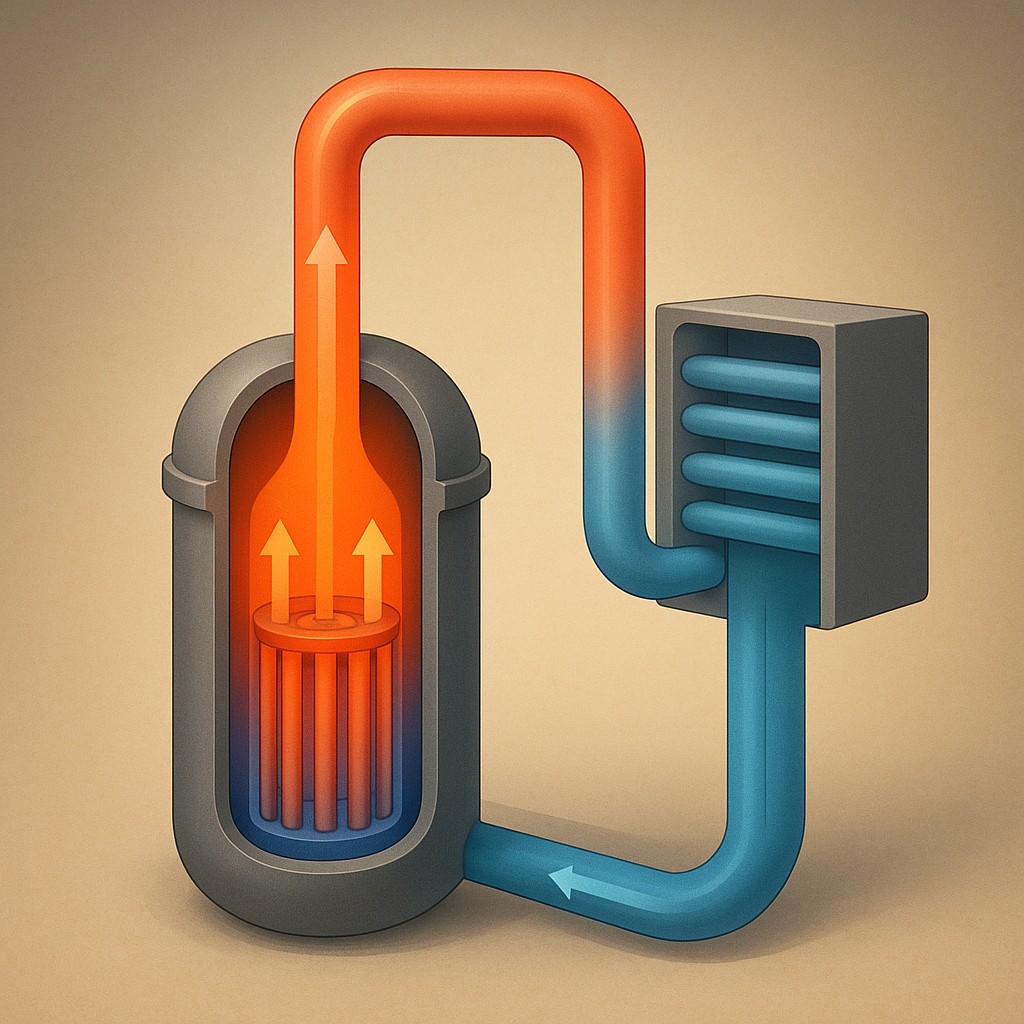
If you have ever stood over a boiling pot of pasta and watched the noodles perform a slow, rhythmic dance, you have witnessed one of the most reliable forces in the universe. Heat makes fluids less dense, causing them to rise, while cooler, heavier fluids sink to take their place. It is a simple, relentless cycle driven by nothing more than the laws of heat movement and the pull of gravity. For decades, this "convection loop" was a charming curiosity of the kitchen, but in the high-stakes world of nuclear engineering, it is becoming the foundation of a quiet revolution.
We are currently moving away from the era of "active" safety, where massive machines and frantic human intervention are required to prevent a crisis, toward an era of "passive" safety. Traditional nuclear power plants are masterpieces of complexity, but they are also deeply dependent on the power grid. They require a constant supply of electricity to drive the pumps that keep cooling water flowing over the radioactive core. If those pumps stop and the backup generators fail, the heat has nowhere to go. Small Modular Reactors, or SMRs, are changing the game by using designs that do not need to be "turned on" because, technically, they are never really turned off. They rely on the fact that gravity never suffers a power outage.
The Burden of the Powered Pump
To understand why the shift to passive cooling is so significant, we have to look at the "heart" of a traditional nuclear plant. A standard large-scale reactor produces an immense amount of heat. This is great for making steam to turn turbines, but it is dangerous if that heat is not constantly carried away. In these older designs, the safety of the entire facility rests on the shoulders of mechanical pumps. These pumps move thousands of gallons of water per second across the fuel rods. If the electricity fails, the pumps stop. This is known as a "station blackout," and it is the nightmare scenario that led to the Fukushima Daiichi accident. When the tsunami knocked out the backup diesel generators, the pumps died, the water stopped moving, and the heat began to build up until the fuel itself started to melt.
The problem with active systems is that they require a "chain of success." For the core to stay cool, the pump must work, the motor must have power, the sensors must detect the heat, and the computer must tell the valves to open. Every link in that chain is a potential point of failure. Engineers have spent half a century making those chains incredibly strong, adding triple backups and battery rooms the size of warehouses, but the fundamental vulnerability remains. Active safety assumes that humans and machines can always outrun a crisis. Passive safety, on the other hand, assumes that the best way to win a race is to never start running in the first place.
Harnessing the Natural Breath of Fluids
Small Modular Reactors use a process known as natural circulation to solve the cooling dilemma. Imagine a large loop of water where the bottom of one side touches the hot reactor core and the top of the other side touches a cold pool of water. As the water near the core heats up, its molecules spread out and it becomes lighter. It naturally floats upward, moving away from the heat source. Once it reaches the top and loses its heat to the cooling pool, it becomes dense and heavy again, plunging back down to the bottom of the loop. This creates a continuous, self-sustaining "convection cell" that carries heat away from the core and releases it into the environment without a single moving part.
This process is fundamentally different from a pump because it is "physics-informed" rather than "mechanically driven." In an SMR, the very heat that poses a risk becomes the engine that drives its own cooling. The hotter the core gets, the faster the water circulates, because the temperature difference between the hot and cold sides of the loop increases. It is a self-regulating system that responds to danger by working harder. Because the cooling relies on gravity and density, it works even if the plant loses all external power, even if the operators are gone, and even if the control room computers go dark. It is the engineering equivalent of a safety switch that saves the world by doing absolutely nothing.
| Feature |
Traditional Active Cooling |
SMR Passive Cooling |
| Primary Mover |
Electric Motor-Driven Pumps |
Gravity and Buoyancy |
| Power Requirement |
Requires Constant Electrical Power |
Zero Power Required |
| Complexity |
High (Valves, Sensors, Pipes) |
Low (Natural Fluid Loops) |
| Human Role |
Operator Intervention Often Needed |
Hands-off "Walk-away" Safety |
| Failure Risk |
Mechanical Breakdown or Blackout |
Flow Stagnation (Physical Blockage) |
| Size/Scale |
Very Large, Built on Site |
Compact, Built in Factories |
Shrinking the Footprint of Fear
One of the most profound benefits of passive cooling is how much it simplifies the architecture of the power plant. In a traditional plant, the safety systems often take up more space than the actual reactor. You need sprawling networks of emergency piping, high-pressure water tanks, massive diesel generators, and hardened bunkers to protect the fuel for those units. All of this complexity adds billions of dollars to the cost of construction and creates thousands of individual parts that must be inspected, maintained, and replaced. When you remove the need for these active systems, the size of the reactor shrinks dramatically.
In an SMR design, like those being developed by companies such as NuScale or GE Hitachi, the entire reactor vessel can be submerged in a giant pool of water located underground. This pool acts as a massive "heat sink," absorbing and dispersing energy. Because the cooling is passive, the reactor doesn't need nearly as many pipes or valves. Fewer pipes mean fewer places where a leak can occur. Furthermore, because the reactor is smaller and carries a lower "source term" (the total amount of radioactive material), the natural circulation loop can manage the heat much more easily than it could in a mammoth 1,000-megawatt plant. This reduction in complexity makes the plants cheaper to build in factories and safer to operate in remote areas where a reliable power grid might not exist.
The Challenge of Stagnation
Lest we think that passive cooling is a magical "get out of physics free" card, there are significant engineering hurdles to overcome. The most prominent of these is "thermal stagnation." In a pumped system, you can force water through any pipe, no matter how twisting the path. In a passive system, the fluid has to want to move. If the temperature difference between the hot and cold sections isn't high enough, or if the pipes are shaped in a way that creates air pockets or "dead zones," the circulation can slow down or stop entirely. If the water stops moving, the heat stays trapped at the core, leading to the very meltdown the system was designed to prevent.
Designing a loop that starts circulating instantly and remains stable at all power levels is a masterclass in fluid dynamics. Engineers must account for "density wave oscillations," which are essentially rhythmic pulses in the fluid that can cause the water to "chatter" or struggle to find a stable flow rate. To prevent stagnation, SMR designers use very specific shapes, placing the cooling equipment at a precise vertical distance above the core to maximize the "chimney effect." They also have to ensure that the system works during "startup" conditions, when the core is relatively cool and the natural drive to circulate is at its weakest. It is a delicate balancing act where the shape of a pipe is just as important as the strength of the steel.
Redefining the Nuclear Safety Model
The transition to passive cooling represents a shift in how we view our relationship with high-stakes technology. For much of the 20th century, we believed that safety was something we "added" to a machine, like a layer of sensors and switches watching over the dangerous part. SMRs represent a move toward "inherent safety," where the danger is neutralized by the very way the machine is built. If you drop a ball, it falls; if you heat water in a loop, it rises. By linking the safety of a nuclear reactor to these undeniable truths, we create a system that is resilient against both mechanical failure and human error.
This "walk-away" safety is crucial for the future of clean energy. If we want to use nuclear power to remove salt from seawater in deserts or provide heat for factories in developing nations, we cannot rely on a constant, perfect supply of electricity and a small army of technicians to keep the pumps running. We need reactors that can look after themselves. While the engineering of natural circulation requires obsessive precision today, the result is a future where the most advanced energy source on the planet is kept safe by the same simple force that helps your pasta dance in the pot. It is a rare moment where progress looks like a return to the basics, proving that sometimes the best way to move forward is to let nature take the wheel.