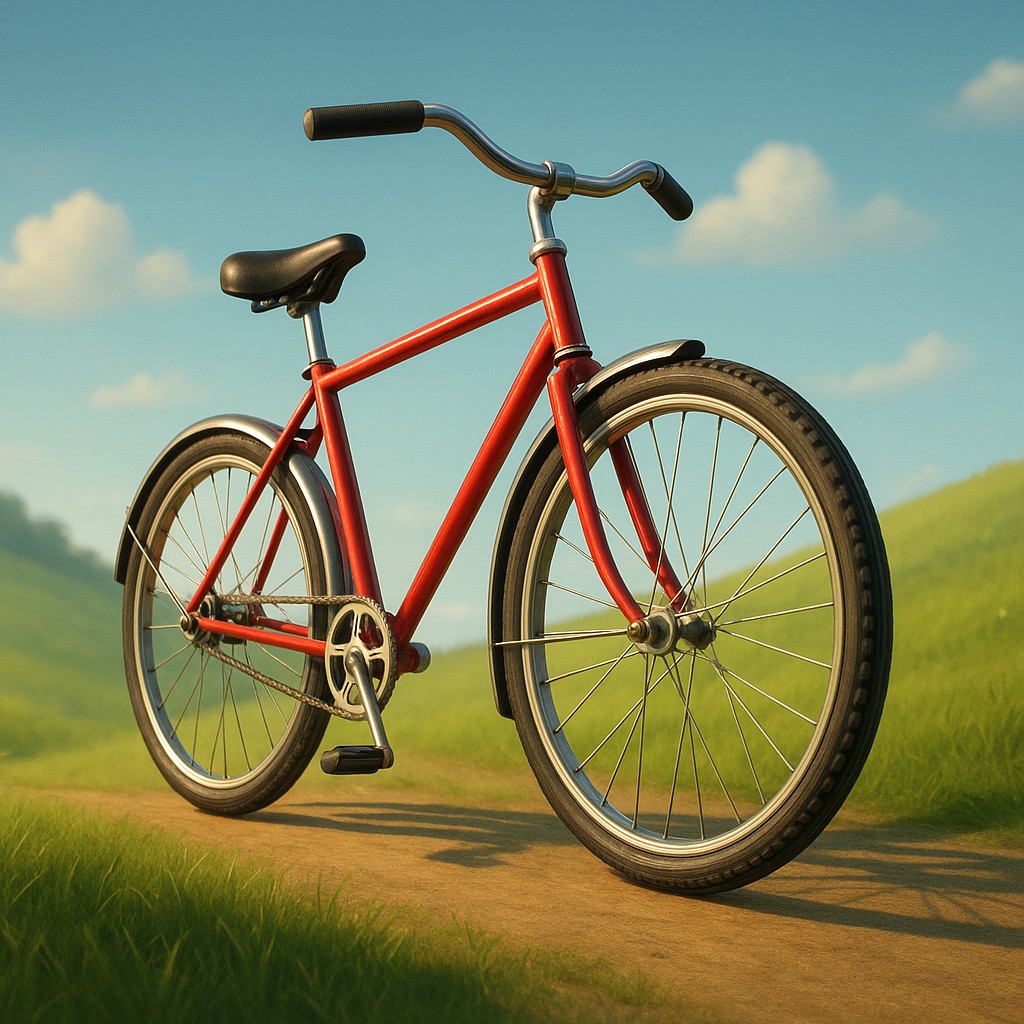
Imagine you are standing at the top of a gentle hill with a standard bicycle. You give it a firm push, sending it rolling down the slope without a rider. You might expect it to wobble for a second and then immediately crash to the pavement, yet that rarely happens. Instead, the bike seems to take on a life of its own, gliding forward with a ghostly grace. It steers itself through bumps and dips as if an invisible person were gripping the handlebars. It stays upright far longer than physics seems to allow, finally toppling over only once it slows down to a crawl.
Most of us grew up believing that staying upright on a bike was a feat of the human inner ear and our ability to shift our weight. We assume that if we take our hands off the bars, we are performing a high-wire act that could fail at any moment. While your core muscles certainly help, the reality is that the bicycle is a masterpiece of engineering designed to save you from yourself. Long before you even think about leaning, the physical shape of the front fork has already calculated the move needed to keep the rubber side down.
The Invisible Lever Beneath the Chrome
To understand why a bicycle wants to stay upright, we have to look past the shiny paint and focus on the geometry of the front wheel. If you draw an imaginary line straight down through the steering axis-the hollow tube the handlebars turn within-you will notice something interesting. That line does not actually hit the ground where the tire touches the dirt. Because of the way the front fork is angled, the steering axis hits the ground a few inches in front of the tire's actual contact point. This gap between the steering line and the tire's footprint is known as the "trail."
This trail acts exactly like the caster wheels on a grocery cart. When you push a shopping cart forward, the wheels automatically swivel to follow the direction of travel because the pivot point is in front of the wheel's center. In a bicycle, this trail creates a mechanical lever. When the bike is perfectly vertical and moving straight, the forces are balanced. However, the moment the bike begins to tilt, those forces shift. The trail provides the leverage needed to turn the wheel automatically toward the lean. It is a built-in feedback loop that requires no electronics and no conscious thought from the rider.
The Physics of the Self-Correcting Loop
The magic of the trail is most obvious when a bike starts to tip. Imagine the bicycle begins to lean toward the left. Because of the trail's geometry, the ground pushes upward and sideways on the tire at a point behind the steering axis. This creates a twisting force, called torque, that pulls the front wheel to the left as well. Because the wheel has now turned into the direction of the fall, the bike follows a curved path. This curve generates centrifugal force, the familiar outward pull that brings the bike back up to a standing position.
This process is essentially a continuous conversation between gravity and geometry. Gravity wants to pull the weight of the bike toward the pavement, but the trail ensures that every inch of "fall" is turned into an inch of "steer." By steering the base of the bike back under its center of gravity, the bicycle effectively outruns its own collapse. This is why a bike moving at fifteen miles per hour feels rock solid, while a bike moving at two miles per hour feels like it is trying to escape from under you. At higher speeds, the steering correction happens faster and with more force, making the upright position the easiest path for the machine to take.
| Feature |
Effect on Stability |
Why it Works |
| Positive Trail |
High Stability |
The tire follows the steering axis like a shopping cart wheel, steering itself into leans. |
| Zero Trail |
Minimal Stability |
The steering has no mechanical leverage to fix itself, making the bike feel twitchy and nervous. |
| Negative Trail |
Active Instability |
The wheel wants to whip around and face backward, making the bike nearly impossible to ride safely. |
| Gyroscopic Effect |
Extra Stability |
Heavy spinning wheels resist changes in direction, helping the bike stay upright at high speeds. |
Debunking the Gyroscope Myth
For decades, the standard scientific explanation for bicycle stability focused almost entirely on the gyroscopic effect. This is the idea that the heavy, spinning wheels of a bicycle act like giant tops, resisting any change in their position. While spinning wheels do contribute to the feeling of stability, they are not the main reason a bike stays up. To prove this, scientists have built "anti-gyroscope" bikes with extra wheels spinning in the opposite direction to cancel out the force. Surprisingly, these bikes remained perfectly stable and easy to ride.
This discovery shifted the focus back to weight distribution and steering shape. While gyroscopic forces help the front wheel turn into a lean at very high speeds, the trail does most of the work at the speeds typical for commuters and hobbyists. Even if you replaced your bike wheels with light, hollow hoops, the mechanical trail would still allow you to ride hands-free. The real secret is the relationship between where the bike leans and where the wheels go to catch it. It is less about resisting the fall and more about steering into it so efficiently that the fall never actually happens.
The Fine Line Between Stability and Agility
Not every bicycle is designed with the same amount of trail, because stability comes at a cost. A bike with a massive amount of trail, like a long-frame chopper motorcycle, feels incredibly stable on a straight highway. You could almost take a nap while riding it, and it would stay centered. However, trying to steer that bike through a tight city corner feels like trying to turn a barge. The same geometry that keeps the bike straight makes it fight the rider when they actually want to turn.
At the other end of the scale, professional racing bicycles are designed with much less trail. This makes them feel "twitchy" or "aggressive." An experienced racer wants a bike that responds to the slightest flick of the wrists or shift in weight. By reducing the trail, designers make the bike more willing to leave its upright state and dive into a corner. If you have ever switched from a heavy mountain bike to a sleek road bike and felt like the handlebars were overly sensitive, you were feeling the direct result of a shorter trail. Finding the perfect balance is the main goal for every frame builder, ensuring the bike is stable enough to be safe but responsive enough to be fun.
When Physics Fails at Low Speed
The beautiful self-correction of the trail has one major enemy: a lack of speed. For the "steer-into-the-lean" trick to work, the bike must be moving fast enough that the turn generates enough force to push the weight back up. When you slow down to a crawl, the trail still tries to turn the wheel, but there is not enough forward momentum to create that righting force. The bike turns, but it just keeps falling over in a slow, awkward arc.
This is why "track standing"-the art of staying still on a bicycle without putting your feet down-is so difficult. At zero speed, the trail is useless. The rider has to manually create stability by making tiny, jerky movements with the handlebars and shifting their weight to mimic what the trail usually does automatically. Understanding this allows you to appreciate just how much work your bike is doing for you every time you cruise down the street. You aren't just a passenger; you are part of a beautifully balanced system where gravity and geometry work together to keep you moving forward.
The next time you find yourself coasting down a hill, perhaps even daring to loosen your grip on the handlebars for a moment, take a second to appreciate the silent genius of your front fork. It is a reminder that some of our most brilliant inventions don't require software or sensors to be "smart." By simply placing the tire's contact point a few inches behind a pivot point, engineers mastered the art of balance over a century ago. This simple physical truth allows us to glide through the world with grace, trusting that the laws of motion are leaning into the wind right alongside us.