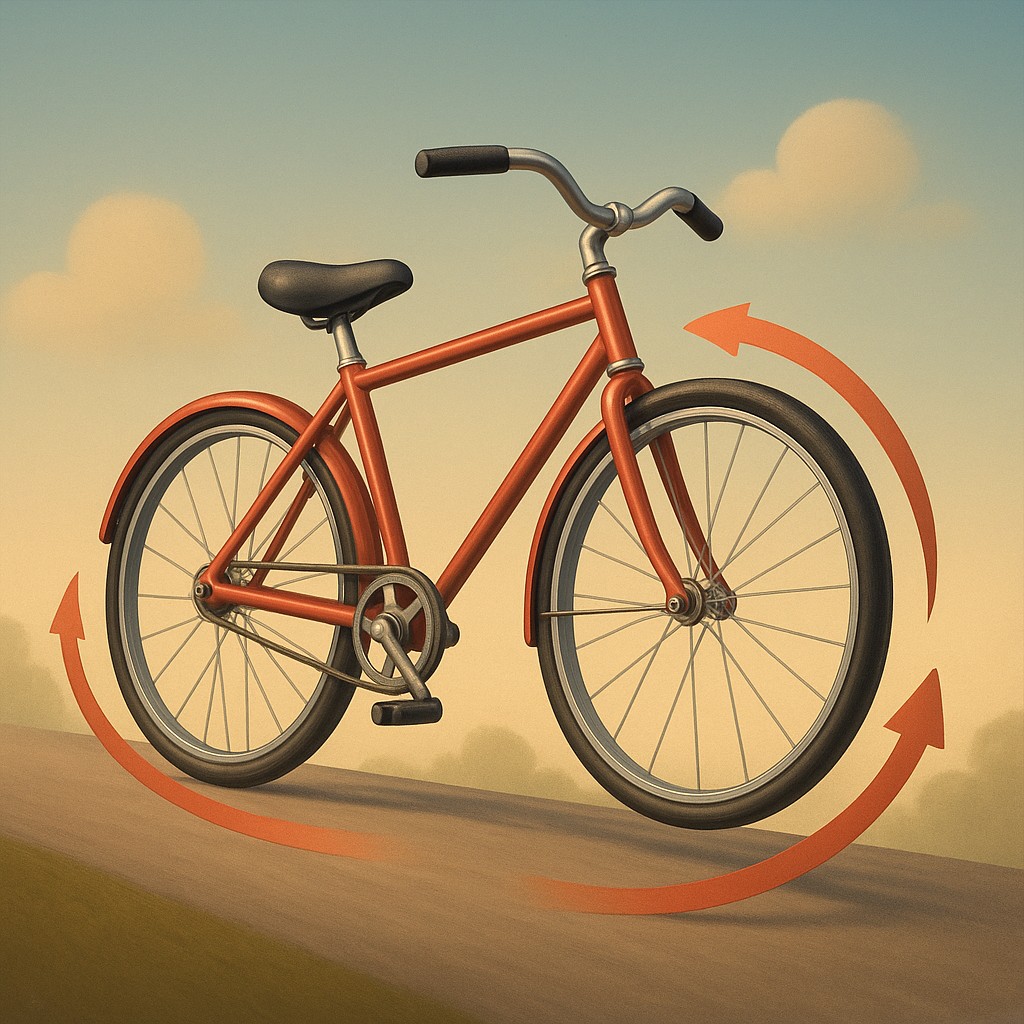
If you ever felt a sudden burst of bravery as a child and let go of the handlebars while pedaling down a quiet street, you likely felt a strange sensation of invisible hands taking over. For a few glorious seconds, the bicycle seemed to have a mind of its own, subtly twitching and adjusting to keep you perfectly upright without any help from you. Gravity was pulling you down and the wind was pushing you sideways, yet the machine refused to fall. Most of us take this for granted, assuming we are simply masters of balance or that the spinning wheels act like heavy tops, keeping us steady through pure momentum.
The reality is far more elegant and mechanical. If you were to give a riderless bicycle a hard shove down a hill, it wouldn't immediately collapse into a heap of metal and rubber. Instead, it would roll along, swaying gently from side to side and correcting its own path until it finally lost enough speed to succumb to gravity. This phenomenon isn't magic, nor is it mostly due to the gyroscopic forces we were all taught about in school. It is the result of a brilliant piece of engineering called steering geometry, a hidden system of angles and offsets that makes a bicycle "want" to stay upright.
Deconstructing the Gyroscope Myth
For decades, the standard explanation for bicycle stability relied almost entirely on the gyroscopic effect. The idea was simple: because the wheels are spinning fast, they act like gyroscopes that resist tilting. While a spinning wheel does have angular momentum (the tendency of a rotating object to keep spinning), the forces generated by a bicycle's wheels are actually quite small compared to the weight of the rider and the frame. If you have ever tried to tilt a spinning bicycle wheel while holding it by the axle, you feel a slight tug, but it is hardly enough to keep a hundred-pound machine from falling over at low speeds.
To prove that gyroscopes weren't the secret, scientists at Cornell University and other institutions built experimental bicycles that used counter-rotating wheels. These bikes had extra sets of wheels spinning in the opposite direction to cancel out any gyroscopic force. If the old myth were true, these bikes should have been impossible to balance. Instead, they stayed upright just fine. This discovery redirected the scientific community's attention back to the physical shape of the bike itself, specifically the front fork and how it interacts with the ground. The gyroscope plays a small part in stability at very high speeds, but the heavy lifting is done by the geometry of the steering axis.
The Secret Geometry of Trail and Caster
To understand why a bike stays upright, we have to look at where the front tire actually touches the pavement. If you look at a bicycle from the side, you will notice that the steering column (the head tube) is not vertical; it is angled back toward the rider. If you were to draw an imaginary line straight down through that steering column all the way to the floor, it would hit the ground a few inches in front of where the tire actually makes contact. This distance between that imaginary point and the real contact patch is known as "trail."
This setup is almost identical to the "caster" wheels you find on grocery carts or office chairs. When you push a grocery cart forward, the wheels automatically swivel to follow the direction of travel because the pivot point is in front of the wheel’s contact point. On a bicycle, this trail acts as a mechanical lever. When the bike begins to lean to the left, the pressure from the ground pushes upward on the tire at a point behind the steering axis. This force creates a twist that pulls the handlebars to the left. In effect, the bike is designed to automatically steer into a fall, which ironically is exactly what prevents the fall from happening.
Steering into the Lean to Save the Day
The reason you don't fall over when you steer into a lean is all about centrifugal force (the outward pull you feel when moving in a curve). Imagine you are riding and you start to tip over to the right. Because of the trail we just discussed, the front wheel automatically pivots to the right. As the bike begins to turn right, it creates a centrifugal force that pushes the bike back toward the left, the opposite direction of the turn. This force pushes the mass of the bike back over the wheels, essentially sliding the base of the vehicle back under its center of gravity.
This is a continuous, microscopic conversation between gravity and geometry. The bike is never perfectly still; it is constantly making tiny, automatic corrections. It tilts a fraction of an inch, the steering geometry triggers a tiny turn, and the resulting force pushes the bike back to the center. This cycle happens so fast and so fluidly that we perceive it as a smooth, straight line. When you ride with no hands, you aren't actually balancing with your inner ear or your core muscles as much as you are simply allowing the bike’s front end to perform its own stabilization math.
Comparing Stability Factors in Bicycle Design
While trail is the primary hero of our story, it isn't the only factor. The weight of the handlebars, the height of the rider, and even the speed of the bike all play roles in how stable a particular frame feels. Different types of bikes prioritize these factors differently depending on whether they need to be "twitchy" for racing or "stable" for long-distance touring.
| Feature |
Low Stability (Race Bike) |
High Stability (Touring/Cruiser) |
| Steering Angle |
Steep (more vertical) |
Slack (more angled) |
| Trail Length |
Short (responsive, quick turning) |
Long (heavy, self-righting feel) |
| Wheelbase |
Short (tight cornering) |
Long (tracks straight easily) |
| Center of Gravity |
Higher (easier to flick side-to-side) |
Lower (more planted and predictable) |
| Gyroscopic Effect |
Low (lightweight wheels) |
Higher (heavy, durable wheels) |
The Role of Mass and the Front-Heavy Advantage
Beyond the angles of the metal, the distribution of weight plays a subtle but vital role in self-stability. Most bicycles are designed so that the center of mass of the front steering assembly (the handlebars, fork, and wheel) is slightly forward of the steering axis. This means that gravity itself is helping the steering. If the bike leans, the weight of the front assembly naturally wants to "fall" in the direction of the lean, which reinforces the steering-into-the-fall mechanism created by the trail.
This is why it is much harder to ride a bike backward or to stay stable if you have a massive weight hanging off one side of your handlebars. When the weight distribution is shifted too far back or becomes unbalanced, the mechanical "desire" of the bike to steer into its lean is ruined. In some experimental designs, researchers found that even if they removed the trail entirely, they could still make a bike stable just by putting a heavy weight very far forward on the front wheel. The bike effectively becomes a "falling" object that pulls its own steering along for the ride.
Why Speed Becomes the Ultimate Stabilizer
If you have ever tried to stand still on a bicycle without putting your feet down, you know it is nearly impossible for more than a few seconds. This is because all the mechanical wonders we have discussed, like trail, the caster effect, and centrifugal force, require forward motion to function. The trail cannot generate a corrective twist if the tire isn't moving against the pavement, and a turn cannot generate centrifugal force if there is no velocity. This is why a bike feels wobbly and unstable at walking speeds but becomes rock-steady as you accelerate.
At high speeds, the self-righting forces become much stronger. This is also where the gyroscopic effect finally joins the party. While minor at low speeds, the momentum of wheels spinning at thirty miles per hour provides a noticeable resistance to tilting. When you combine high-speed gyroscopic stability with the aggressive self-steering of a well-engineered trail, the bicycle becomes a remarkably stubborn object. It actually takes physical effort to force a fast-moving bike to lean into a curve because the machine’s geometry is fighting to return to a vertical, neutral state.
Appreciating the Invisible Mechanics of Motion
The next time you hop on a bike, take a moment to appreciate the silent genius of its construction. We often think of the bicycle as a simple tool, but it is actually a masterclass in passive control systems. It is a machine that uses the very force threatening to topple it, gravity, to fuel the mechanism that keeps it upright. By angling a tube and offsetting a wheel by just a few centimeters, engineers created a device that can solve complex physics equations in real-time without a single computer chip or electronic sensor.
Understanding the mechanics of trail and self-steering doesn't just make you a more informed cyclist; it changes how you perceive balance in the physical world. It reminds us that stability is often not about being rigid and immovable, but about having the right internal logic to respond to change. Whether you are navigating a steep mountain descent or just cruising through a park, you can trust that your bike is working with you, constantly adjusting its path to keep you moving forward. Go out and ride, and perhaps, when the path is clear and your confidence is high, let go of the bars for a second and let the geometry do the heavy lifting.