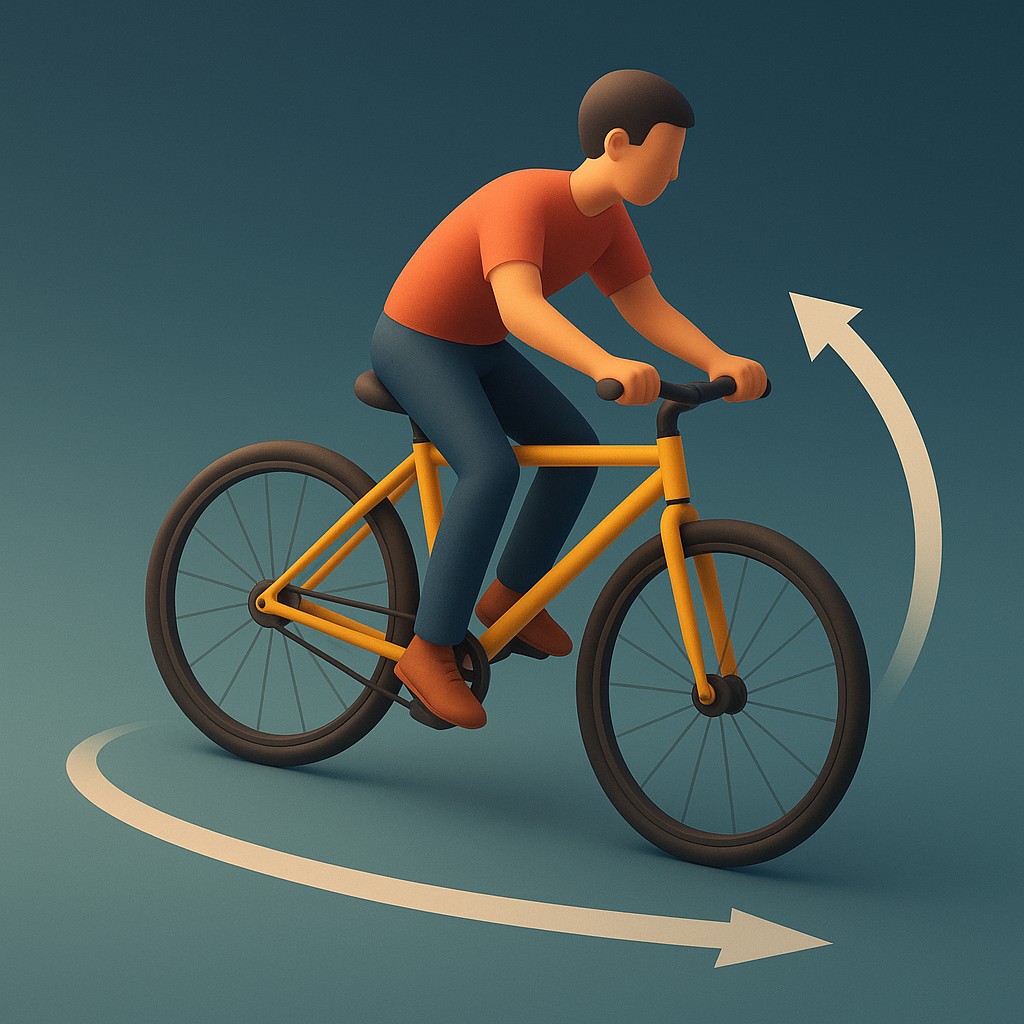
If you have ever tried to ride a bicycle at a snail’s pace, you know the frantic, wobbling dance of the handlebars required to keep from toppling over. Yet, as soon as you pick up speed, the bike seems to take on a life of its own, becoming a steady, cooperative partner that glides forward with mysterious grace. For over a century, the common explanation for this was that the spinning wheels acted like massive gyroscopes - spinning rotors that resist tilting - holding the bike upright through pure physical stubbornness. It is a neat, tidy explanation that scientists and cycling fans alike accepted for decades, but it happens to be fundamentally incomplete.
The reality of how a bicycle stays upright is far more elegant and relies on a clever bit of mechanical "outsourcing." Instead of relying on the brute force of spinning wheels, the bicycle is a masterpiece of passive feedback. It uses its own physical shape to solve the complex problem of balance. By looking at the relationship between gravity, geometry, and movement, we can see that a well-designed bike does not just happen to stay upright. It is essentially a self-correcting machine that interprets a "fall" as an instruction to turn. This shift in perspective shows that the bike is not just a static object we must control, but a dynamic system designed to help us succeed.
The Myth of the Gyroscope and the Two-Wheeled Mystery
The most frequent explanation for bicycle stability is the gyroscopic effect. You may remember playing with toy gyroscopes as a child, feeling that strange, ghostly resistance when you tried to tilt the spinning wheel. In a bicycle, the theory suggests that because the wheels are spinning fast, they want to maintain their momentum, which keeps the bike from leaning. While this effect does exist and adds a tiny bit to the feeling of stability, researchers have proven it is not the main factor. In a famous experiment, scientists built a bicycle with extra wheels spinning in the opposite direction to cancel out any gyroscopic force. To the surprise of many, the bike remained perfectly stable and could even ride itself without a human pilot.
If the wheels are not acting as anchors in the air, what is? The answer lies in how the front half of the bike is built. When a bicycle starts to lean to the left, it needs to move its foundation - the tires - back under its center of mass to prevent a crash. A human rider does this by steering into the fall, but a riderless bike does it through geometry. The bicycle is designed so that when the frame tilts, the front wheel automatically pivots in that same direction. This "automatic steering" is the secret to cycling, transforming a potential disaster into a gentle curve that keeps the bike upright.
Digging into the Geometry of the Trail
The most critical measurement in bicycle physics is something called "trail." To understand trail, imagine a straight line drawn through the center of the bicycle’s steering column, or head tube, all the way down to the ground. This point usually sits several inches in front of where the front tire actually touches the pavement. The distance between where that steering axis hits the ground and where the tire makes contact is the trail. It functions much like the wheels on a grocery store cart. Because the contact point of the wheel lags behind the steering axis, the wheel naturally wants to follow the direction of travel, straightening itself out as it moves.
This "caster effect" is why a bicycle feels stable at high speeds. When the bike leans, the ground pushes up on the tire at that trailing contact point. Because that point is behind the steering axis, the upward force creates enough leverage to twist the handlebars in the direction of the lean. If the bike leans left, the trail causes the wheel to turn left. This movement puts the wheels back under the leaning weight of the bike, effectively "catching" the fall. At high speeds, this happens so quickly and with such force that the bike becomes incredibly difficult to knock over. At low speeds, however, the forces are too weak to overcome the friction of the tires, which is why your bike feels like a nervous tightrope walker when you are barely moving.
How Geometry Outsources the Brain’s Work
In modern technology, we are used to computers doing the heavy lifting. A self-driving car uses cameras, sensors, and millions of lines of code to stay in its lane. A bicycle, however, achieves a similar feat of "self-navigating" using no electricity and no brainpower. It is a physical algorithm. By building the "instructions" for balance directly into the metal frame, the inventors of the modern bicycle effectively moved the mental work of balancing to the geometry of the front fork. This allows the rider to focus on the road or the scenery rather than managing every millimeter of lean.
This concept is known as passive stability. It means the system is designed to return to a neutral state without any outside help. In the table below, we can compare how different design factors contribute to the ride, showing that balance is a cocktail of several ingredients rather than a single magic trick.
| Factor |
Mechanism |
Primary Benefit |
| Trail |
Distance between steering axis and tire contact |
Causes the bike to steer into a lean automatically |
| Head Tube Angle |
The slant of the front fork |
Determines how "twitchy" or "stable" the steering feels |
| Weight Distribution |
How much weight sits over the front wheel |
Influences how quickly the handlebars respond to a tilt |
| Gyroscopic Force |
Momentum from spinning wheels |
Provides a small amount of extra stability at high speeds |
| Wheelbase |
Distance between front and rear wheels |
Longer distances increase stability but make turns wider |
The Center of Mass and the Steering Feedback Loop
While trail is a heavy hitter in the stability game, the distribution of weight, or mass, around the steering axis also plays a vital role. If you look closely at the front fork of a bicycle, you will notice it often curves forward. This placement ensures that the center of weight for the handlebars and fork is usually in front of the steering axis. When the bike leans, gravity pulls on this forward weight, helping to pull the front wheel into the turn. It is a redundant system: both the trail (via ground friction) and the weight distribution (via gravity) work together to force the handlebars to turn when the frame tilts.
This creates a beautiful feedback loop. A lean triggers a turn; the turn creates outward force that pushes the bike back toward an upright position; once the bike is upright or leaning the other way, the steering corrects itself again. This constant micro-correction loop is what makes a bicycle "self-stable." In fact, if you were to push a well-designed bicycle down a hill with no rider, it would likely stay upright for a surprising distance, navigating bumps and cracks by swerving slightly and resetting its balance. It only falls when it slows down so much that these geometric forces can no longer overcome gravity.
Breaking the Rules with New Designs
One of the most fascinating aspects of bicycle science is that there isn't just one way to stay stable. While most bikes on the road rely on positive trail, researchers have experimented with "impossible" designs that challenge our understanding. By carefully balancing the weight of the handlebars and the angle of the fork, engineers have created bicycles with "negative trail" - where the tire contact point is actually in front of the steering axis - that still manage to stay upright. This proves that the bicycle is a "coupled system," where every part affects every other part.
These experiments are not just for fun; they have major implications for how we design everything from wheelchairs to motorcycles to folding commute bikes. By changing the geometry, designers can create bikes that are "invincibly stable" for beginners or "incredibly responsive" for professional racers who need to make split-second turns. The "magic" of the bicycle is actually a sliding scale of geometric variables that can be tuned to the specific needs of the rider. It reminds us that even something as simple as a metal frame can be a sophisticated piece of hardware that calculates the laws of physics in real time.
Lessons from the Riderless Bicycle
What can we learn from the fact that a bicycle can ride itself? Beyond the physics, there is a powerful lesson in the value of system design. Often, when we encounter a problem, we assume we need a "control center" - a brain or a computer - to manage it. The bicycle teaches us that if we design the underlying structure correctly, the system can manage itself. This principle, sometimes called "morphological communication," suggests that the shape of an object can actually do some of the "thinking" for us. It is a concept used in modern robotics to create machines that can walk over uneven ground by relying on mechanical hinges and springs rather than complex software.
Understanding how a bike really works turns every ride into a small celebration of human ingenuity. We have taken a two-wheeled machine that should, by all rights, fall over the moment we let go, and we have turned it into a symbol of freedom and efficiency. The next time you feel that steady, solid sensation as you descend a hill, remember that you aren't just holding the bike up; the bike is actively working to hold you up, too. It is a partnership between human intent and geometric destiny, and it remains one of the most successful design achievements in history.