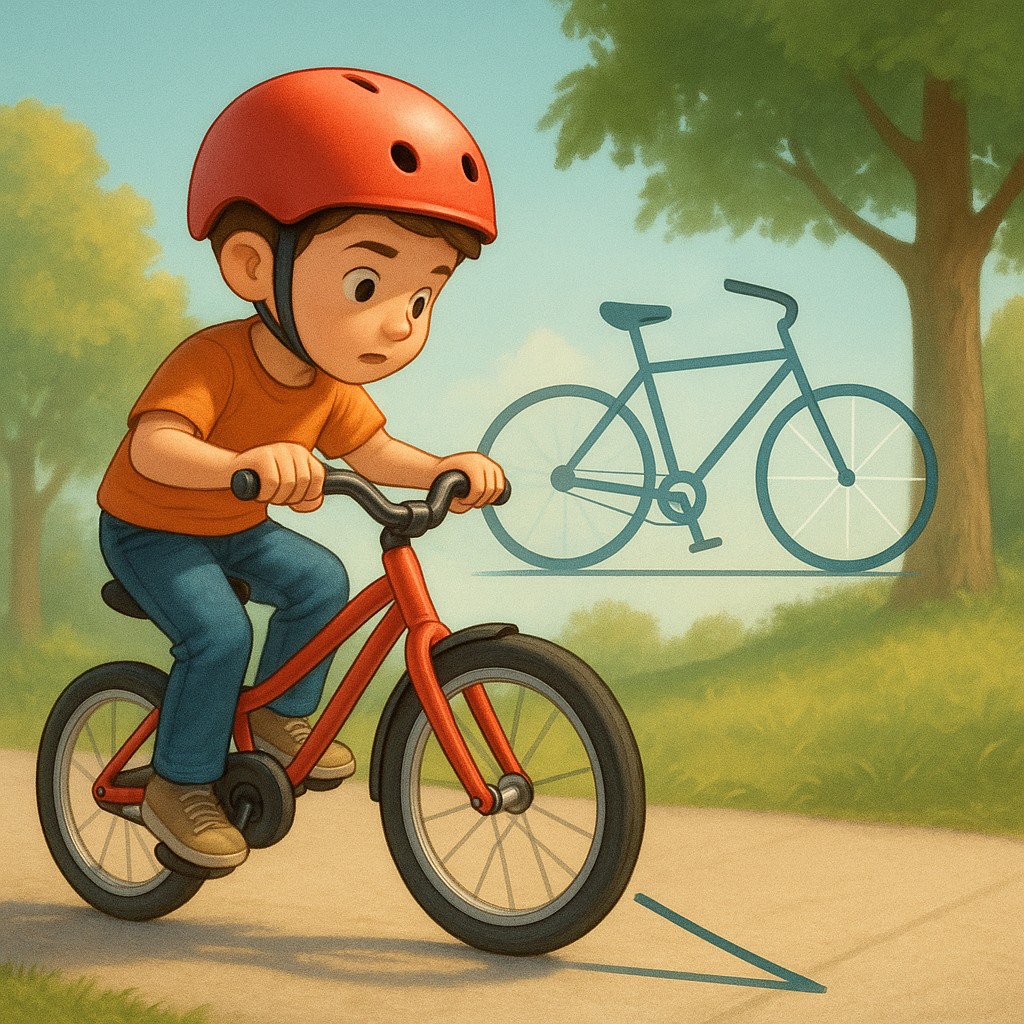
Think about the last time you watched a child learn to ride a bike. There is that heart-stopping moment when the training wheels come off and the parent finally lets go of the seat. For a few frantic seconds, the bike wobbles wildly, but then, like magic, physics takes over. The child finds a rhythm, the bike stops tipping, and suddenly they are gliding down the sidewalk. We usually take this for granted, assuming balance is just a human skill or perhaps some mysterious force within the spinning metal. In reality, a bicycle is an engineering marvel designed to stay upright on its own, even if you take your hands off the bars.
For over a century, even the most brilliant physicists were sure they knew how this worked. They looked at the spinning wheels and pointed to the most obvious culprit: the gyroscopic effect. It makes sense on paper, as spinning objects tend to resist changing their direction, much like a toy top that stays upright as long as it is humming along. However, science has a habit of upending "obvious" explanations. It turns out that if you canceled out that gyroscopic force entirely, the bike would still stay upright. The secret to a bicycle’s grace isn't found in the momentum of the wheels, but in the clever shape of the front fork.
The Myth of the Gyroscopic Savior
The most common mistake people make about bike stability is thinking the wheels act like giant gyroscopes. If you have ever held a spinning bike wheel by the axle and tried to tilt it, you felt that strange, ghostly pull resisting your movement. This is a real physical force, and for a long time, it was the prime suspect for why bikes don't just flop over. People believed that at high speeds, the spinning weight of the wheels became heavy enough to create a "righting" force that kept the frame vertical. It is a tidy explanation that feels right, but it falls apart when put to the test.
In the mid-twentieth century, and again in a famous 2011 study, researchers built "experimental" bicycles designed to fail if the gyroscopic theory were true. They equipped these bikes with extra disks that spun in the opposite direction of the road wheels to cancel out the effect. According to the old way of thinking, these bikes should have been impossible to ride. Instead, they were perfectly stable. This proved that while gyroscopic forces might help slightly at very high speeds, they aren't the reason you can ride "no hands" down a quiet street. The bike has a much deeper mechanical secret hidden in its geometry.
Understanding the Magic of Trail
The real hero of the story is a design feature called "trail." To understand trail, look at where the front wheel touches the ground compared to where the steering axis points. If you draw an imaginary line straight down through the head tube (the part of the frame that holds the handlebars), that line hits the ground a few inches in front of the spot where the tire actually touches the pavement. That gap between the steering line and the tire's contact point is the trail.
This gap works exactly like the swiveling wheel on a shopping cart or an office chair. When you push a shopping cart forward, the wheels automatically turn to follow the direction you're going because the pivot point is in front of the wheel’s contact point with the ground. On a bicycle, trail ensures the front wheel is constantly "trailing" the steering axis. This creates a self-correcting system. If the bike begins to lean to the left, the contact point feels a push from the road that naturally nudges the wheel to turn into the lean. By turning into the fall, the bike moves its support base back under its center of gravity, catching itself before it hits the ground.
The Shopping Cart Connection
To visualize why trail is so effective, imagine the wheel as a stubborn follower. Because the tire touches the ground behind the point where the steering is anchored, the road is constantly "pulling" the wheel into a straight line. If you are riding along and a gust of wind tips the bike to the right, the pressure on that trailing tire point increases. Gravity and friction work together to force the handlebars to turn to the right. The rider doesn't even have to think about it; the bike is "steering into the fall" for you.
This is why it is much easier to ride a bike with no hands at a moderate speed than it is to stay upright while moving at a crawl. The self-correction relies on forward momentum. When you move fast, the forces acting on that "trailing" contact point are strong and immediate, and the bike "fights" to stay centered. At very low speeds, there isn't enough energy to overcome the friction of the parts or the weight of the rider, and the self-righting system fails. This is when you see a cyclist wiggle the bars frantically just to stay vertical.
Comparing Stability Factors
While trail is the main reason a bike stays upright, it isn't the only force at play. Bicycle dynamics are a complex web of interactions. To simplify the difference between what actually keeps us upright and what we only think does, we can look at the different influences on a moving bike.
| Factor |
Description |
Role in Stability |
| Gyroscopic Force |
Forces created by the spinning wheels. |
Minor; helps at high speeds but isn't necessary for balance. |
| Trail (Caster Effect) |
The distance between the steering axis and tire contact point. |
Critical; the main self-centering system for the front wheel. |
| Weight Distribution |
Where the weight of the handlebars and fork sits. |
Important; helps gravity pull the wheel into a turn during a lean. |
| Rider Input |
The conscious or unconscious steering by the human. |
Essential at low speeds; less vital when the bike is stable on its own. |
| Speed |
How fast the bike is moving forward. |
The "fuel" for stability; higher speeds make the trail effect stronger. |
The Role of Weight Distribution
Beyond trail, there is another subtle factor involving the weight of the steering parts. Notice how the front fork of a bike usually curves forward. This is called "rake" or "offset." While rake actually reduces the amount of trail, it serves a second purpose: it moves the weight of the front wheel and handlebars slightly in front of the steering axis. This creates a situation where gravity itself helps the bike stay stable.
When a bike leans to one side, the weight of the front assembly wants to fall toward that same side. Because of the way the fork is angled, this downward pull helps turn the handlebars into the direction of the lean. It is a partnership between geometry and gravity. The trail provides the "pull" from the ground, and the weight distribution provides a "push" from above. Together, they ensure that the moment the bike tips, it immediately begins steering itself back into balance. This is why a well-designed bike can be rolled down a hill with no rider and stay perfectly upright until it loses speed.
Why Some Bikes Feel Twitchy
Not all bikes are created equal when it comes to this self-correction. If you have ever switched from a rugged mountain bike to a high-end road racing bike, you might have felt the road bike was "nervous" or "twitchy." This is because engineers change the trail to adjust how a bike handles. A mountain bike, built for stability over rocks and roots, usually has a "slacker" head tube angle (tilted further back), which creates more trail. This makes the bike very stable and easy to keep in a straight line, but harder to turn quickly.
On the other hand, a racing bike often has a very steep head tube angle and less trail. This reduces the self-centering force, making the bike much more responsive to the rider's slightest touch. While this allows a racer to dive into a sharp corner at forty miles per hour, it also means the bike won't "save" you as easily if you take your eyes off the road. When we talk about how a bike "feels," we are usually just describing the math between the frame's angles and the trail of the front wheel.
The Beauty of Passive Engineering
There is something poetic about the fact that a bicycle is a "passive" stable system. In a world full of electronic sensors and computer-controlled stabilizers, the bicycle remains a masterpiece of pure geometry. It doesn't need a battery, a processor, or a complex code to keep from falling over. It simply uses its own movement and the shape of its frame to interact with the laws of physics.
Understanding the mechanics of trail changes the way you look at a bike. It is no longer just a frame with two wheels; it is a finely tuned instrument designed to dance with gravity. The next time you cruise down a hill, feeling that gentle pressure in the handlebars as they guide you through a curve, remember that you aren't just riding a machine. You are part of a century-old physics experiment where the road, the wheels, and the angles of the steel all work together to keep you heading toward the horizon. Knowing the science doesn't ruin the magic; it only makes the simple act of balancing feel like a more incredible feat of design.