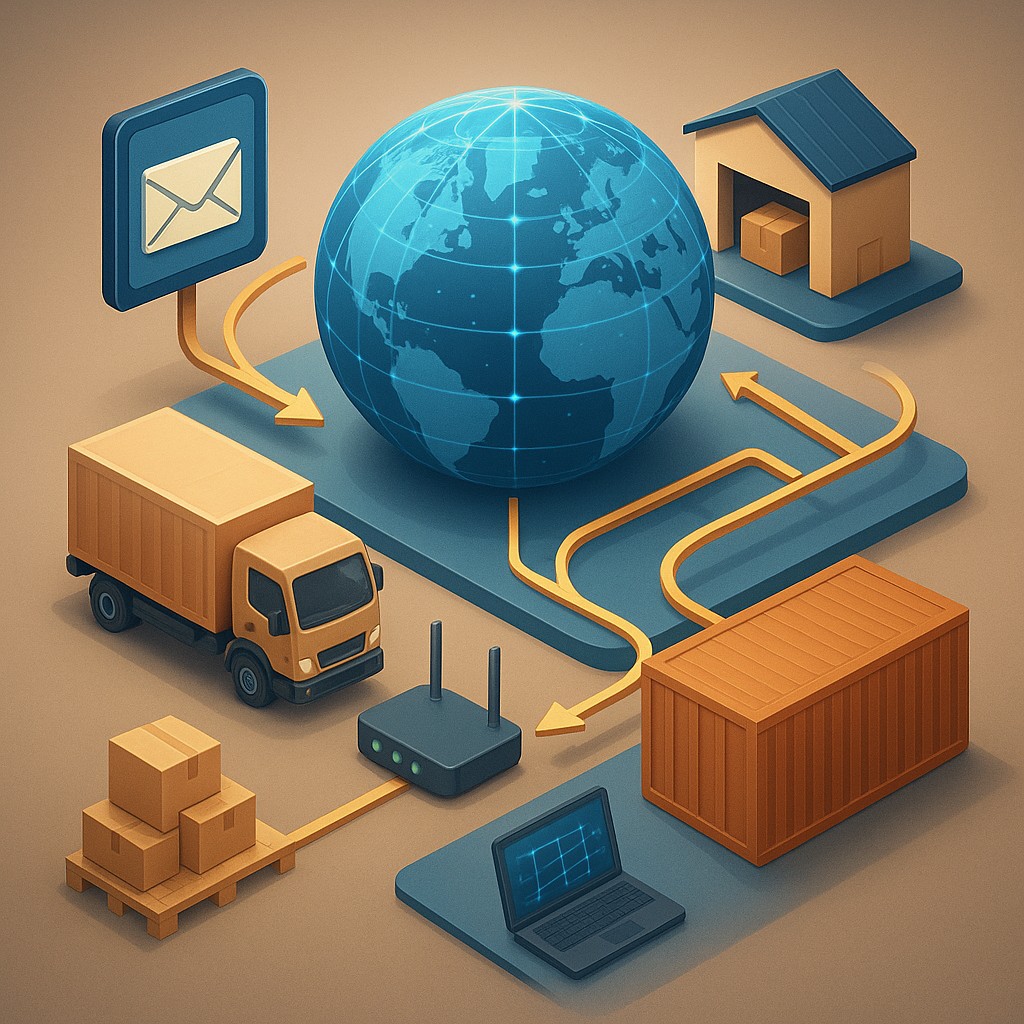
Think for a moment about sending an email. You do not have to worry about whether the person on the other end uses Gmail or Outlook, nor do you need to fret over whether your data travels through an AT&T fiber optic cable or a Starlink satellite. Your message is broken down into tiny, standardized digital packets, each stamped with an address. These packets zip through a vast, interconnected network of routers, taking whichever path is fastest at that exact millisecond. The internet does not care about brand loyalty; it only cares about the destination and efficiency.
In the physical world, however, the way we move goods is surprisingly localized and clunky. If Company A wants to ship a thousand sneakers, they put them in a Company A truck. If that truck is only half full, it makes the trip anyway, burning fuel while hauling a lot of expensive air. Meanwhile, Company B might have a truck going the same way, also half empty. Because these systems are closed and private, the two companies cannot easily work together. This lack of coordination results in "empty miles," massive carbon emissions, and a global supply chain that is essentially a collection of private pipes rather than a shared, efficient web.
The Blueprint for a Physical Internet
The concept of the Physical Internet (PI or $\pi$) is an ambitious attempt to apply the logic of the digital world to the movement of physical goods. In our current model, logistics is "asset-centric," meaning the focus is on who owns the truck, the warehouse, or the ship. In the Physical Internet model, logistics becomes "packet-centric." Every shipment, whether it is a single toothbrush or a pallet of engine parts, is placed into a standardized, modular container called a $\pi$-container. These containers are more than just boxes; they are smart units that can communicate their contents, weight, and destination to the network.
At the heart of this system are the protocols. Just as the digital internet relies on TCP/IP (the basic rules of digital connection) to ensure data arrives correctly, the Physical Internet uses universal routing rules to move goods. When a $\pi$-container enters the network, it does not belong to a specific trucking company’s route. Instead, any participating vehicle with extra space and a heading in the right direction can pick it up. A parcel might travel ten miles in a local delivery van, be handed off to an autonomous electric pod for fifty miles, and then join a high-speed freight train for the long haul. The sender does not manage the route; the network optimizes it in real time based on traffic, weather, and available space.
This shift requires moving away from massive, isolated distribution centers toward a "swarm" of smaller, interconnected hubs. These hubs act like network routers. They are transit points where containers are rapidly sorted and switched between vehicles. Because the containers are modular and standardized, automated robots can move them with incredible speed. In this vision, the logistics network becomes a living, breathing organism that constantly reshapes itself to find the path of least resistance.
Standardization as the Universal Language
The biggest barrier to a seamless global network is the sheer variety of how we pack things today. We use everything from cardboard boxes and wooden pallets to giant 40-foot shipping containers, and these don't always fit well together. To solve this, the Physical Internet proposes a family of $\pi$-containers designed for "encapsulation." This means smaller containers are built to fit perfectly inside larger ones, much like Russian nesting dolls or Lego bricks. By eliminating the gaps and awkward shapes that plague modern shipping, we can use every cubic inch of transport space.
| Feature |
Current Logistics Model |
Physical Internet Model |
| Connectivity |
Fragmented, private networks |
Universal, interconnected web |
| Container Style |
Non-standard, varied sizes |
Modular, $\pi$-standardized |
| Asset Use |
Low (many half-empty trucks) |
High (shared space, full loads) |
| Routing |
Fixed, pre-planned routes |
Dynamic, real-time optimization |
| Control |
Centralized by the owner |
Decentralized and self-organizing |
| Environmental Impact |
High fuel waste and emissions |
Significantly lower carbon footprint |
Beyond physical dimensions, standardization extends to data. For a Physical Internet to work, every player in the supply chain must speak the same digital language. This involves using open-source systems for tracking, billing, and insurance. If a container moves from a Maersk ship to a FedEx truck to a local bike courier, the data trail must be unbroken and transparent. This transparency allows a "trustless" system to function, where companies can collaborate without needing to know every detail of a competitor's internal business.
The Logic of Collaborative Competition
One of the most surprising parts of the Physical Internet is the idea that fierce competitors should share their most valuable assets. In today's economy, a logistics company views its fleet of trucks as a competitive edge. Suggesting they let a rival's package sit on their truck feels like business heresy. However, the Physical Internet changes the math of competition. If the entire network becomes 30 percent more efficient, the cost of doing business drops for everyone. The value of being part of the network outweighs the benefit of owning a private, inefficient silo.
This is often called "co-opetition." In this framework, companies compete on the quality of their products or the speed of their final-mile service, but they cooperate on the "boring" middle-mile infrastructure. Think of it like a shopping mall. Different stores compete for customers, but they all share the same parking lot, security, and air conditioning because it would be absurdly expensive for each store to build its own. By treating long-haul shipping as a shared utility rather than a private weapon, the industry can unlock massive hidden value.
The benefits of this collaboration are not just financial; they are environmental. The logistics industry is a massive contributor to global CO2 emissions, largely because we move so much empty space. By filling every truck and optimizing every route, the Physical Internet could potentially reduce the number of vehicles on the road by a double-digit percentage. This would lead to less traffic, lower road maintenance costs, and a significant step toward hitting international climate goals.
Navigating Hurdles of Trust and Rules
The technology for the Physical Internet largely exists today. We have GPS, smart sensors, automated sorting robots, and sophisticated routing software. The real challenge is not a matter of "how" we move things, but "who" allows it. Establishing a global rulebook for physical goods is a monumental task. This involves creating international standards for liability, so if a package is damaged while being handled by four different companies, there is a clear, automated way to determine who is responsible and how insurance claims are paid.
Security is another major concern. If we move toward a system where any verified driver can pick up a container, we have to ensure the goods stay safe. This is where blockchain technology and advanced encryption come in. A $\pi$-container could be equipped with a digital lock that only opens when it reaches its final destination or a verified sorting hub. The "digital twin" of the container would track every bump, temperature change, or unauthorized access attempt, providing a level of security that current systems can only dream of.
Furthermore, there is the human element. The transition to a decentralized, automated network will fundamentally change the roles of warehouse workers and truck drivers. Instead of being tied to a single company’s rigid route, a driver might act more like an independent node in the network, picking up "packets" of freight based on real-time demand. This shift requires new labor laws, different wage structures, and a rethink of how we value the human labor that keeps the world moving. It is a social and political puzzle just as much as an engineering one.
The Future of the Self-Organizing Supply Chain
As city populations grow and online shopping becomes the default, our old methods of shipping are reaching a breaking point. We simply cannot keep adding more trucks to the road. The Physical Internet offers a way to do more with less, turning our chaotic global shipping lanes into a sophisticated, self-organizing system. Imagine a city where "delivery day" does not exist because goods are constantly flowing through underground tubes or quiet electric transit lanes, arriving exactly when needed because the network predicted the demand.
This vision of the future is not just for wealthy nations. In many ways, emerging economies are the perfect testing grounds for Physical Internet principles. Without the burden of massive, outdated infrastructure, these regions can "leapfrog" directly into a shared, modular logistics model. By adopting these rules now, they can build a supply chain that is naturally sustainable and resilient, capable of weathering economic shocks or global pandemics with the same grace that the digital internet handles a server outage.
The journey toward a fully realized Physical Internet will be slow and will likely happen in stages, starting with "islands" of connectivity like ports or specialized industrial zones. But as the efficiency gains become undeniable, these islands will connect, forming the backbone of a new global economy. We are standing at the threshold of a world where geography matters less, and the movement of atoms becomes as effortless as the movement of bits. It is a future where the things we need find our doorstep not through brute force, but through the elegant, invisible dance of a global, physical web.