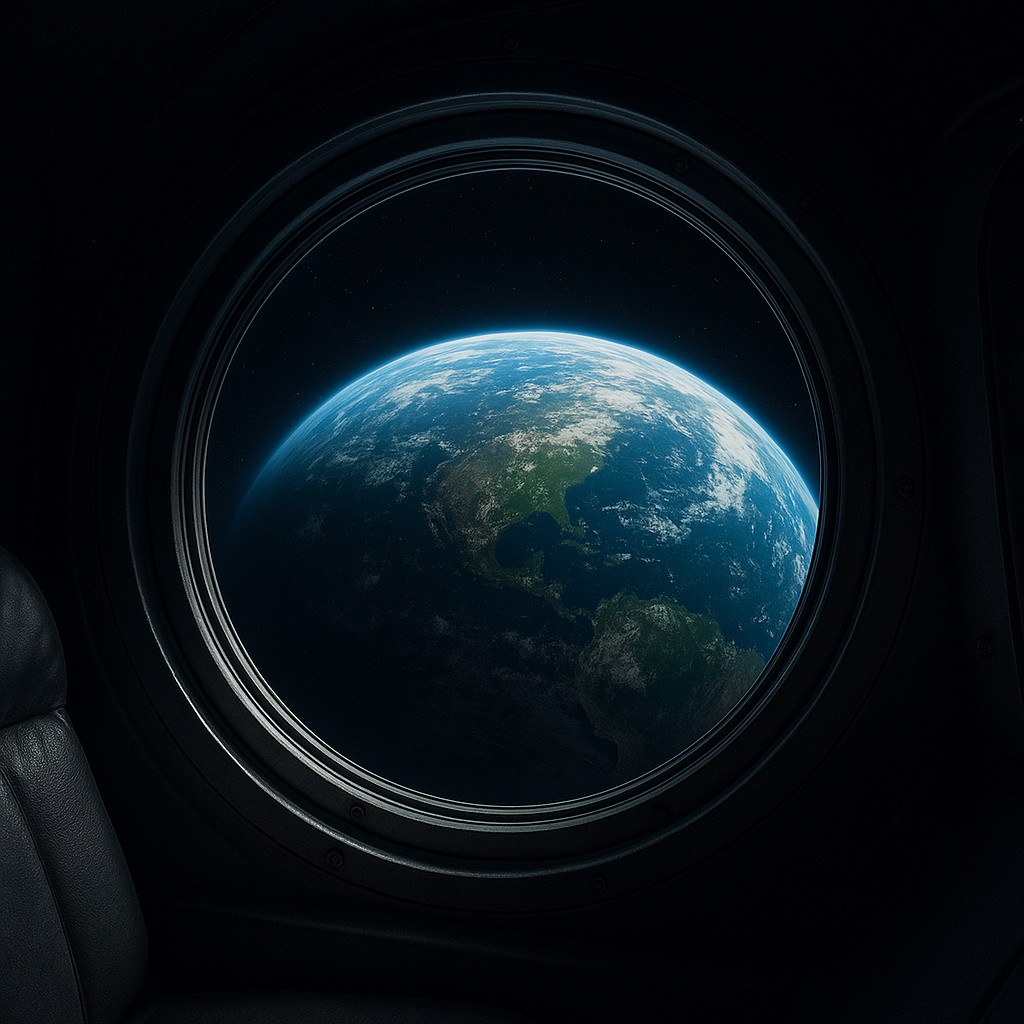
Imagine for a moment that you are strapped into a seat on top of a controlled explosion, hurtling away from the only home you have ever known at seventeen thousand miles per hour. As the roar of the engines fades into the eerie silence of a vacuum, you float toward a small, reinforced window. Outside, the blackness is deeper than any night on Earth, but nestled within that void is a pulsing, glowing marble of sapphire, white, and emerald. It looks impossibly bright, strikingly beautiful, and terrifyingly thin. At this moment, your heart does not just beat faster; your entire understanding of reality begins to shift under the weight of a single, massive realization: that is us, and it is all we have.
This psychological phenomenon is known as the Overview Effect, and it is far more than just a great view. It is a profound mental shift reported by almost every traveler who has ventured beyond the atmosphere. Since the dawn of the Space Age, astronauts from vastly different political, religious, and cultural backgrounds have returned to Earth with nearly identical stories of a sudden, overwhelming sense of universal connection. This is not just a poetic feeling; it is a fundamental rewiring of the brain that occurs when the human mind is forced to weigh the scale of the cosmos against the fragility of our planet’s life-support system. Understanding this effect offers a masterclass in psychology, systems thinking, and the future of human cooperation.
Viewing the World Without Scars
When we are on the ground, the world feels massive and fragmented. We live our lives within the context of neighborhoods, cities, and nations. These divisions are reinforced by maps filled with colorful lines and thick borders, teaching us from childhood that "here" is fundamentally different from "there." However, from two hundred miles up, those lines simply do not exist. There are no dotted lines separating territories, no fences visible from orbit, and no bold labels identifying where one group of people ends and another begins. Astronauts frequently remark on how strange it is to see a continent they once thought of as a collection of rival states appearing instead as a single, continuous landmass.
This lack of visible boundaries helps shift our identity from "local" to "planetary." In psychology, we often talk about "in-groups" and "out-groups," referring to the biological drive to favor our own tribe and distrust others. The Overview Effect essentially stretches the definition of the in-group until it covers every living thing on the planet. When you see the Earth against the backdrop of an infinite, cold vacuum, you realize that everyone you have ever loved, everyone you have ever disagreed with, and every historical figure who ever lived shared that same tiny speck of dust. The petty squabbles of politics suddenly look like people fighting over a single grain of sand in a vast desert. It becomes clear that the atmosphere, which looks like a thick protective blanket from the ground, is actually as thin as a coat of varnish on a globe, protecting us all from the harshness of space.
The Mental Map of a Global System
To understand why this happens, we have to look at how our brains process scale and systems. Humans are naturally wired to focus on our immediate surroundings because, for most of our history, that is what kept us alive. We are great at spotting a predator in the bushes but terrible at grasping how global weather patterns are linked or how the human species is biologically one. The Overview Effect acts as a shortcut for our brains, allowing us to see the Earth as a complete, closed system. It is the difference between looking at a single gear and seeing the whole clockwork mechanism moving in harmony.
This systemic view leads to what researchers call a "transcendental" experience. It is often described in terms usually reserved for religious or deeply spiritual moments. Astronauts talk about a feeling of "oneness," not as a vague metaphor, but as a literal biological fact. They see clouds moving across oceans, dust from Africa feeding the rainforests of South America, and the lights of cities glowing like a single nervous system. This perspective makes it impossible to ignore the reality that whatever happens to one part of the system inevitably affects the whole. If the Earth is a spaceship, we are all the crew, and we are currently living in a cabin where eight billion people share the same life support.
Why a View from Space Changes Our Behavior
It is one thing to feel a sense of awe, but the Overview Effect has a lasting impact on how people act once they return home. Many astronauts return with a renewed, almost frantic desire to protect the environment. They become the planet's most vocal advocates, not because they read a convincing brochure, but because they witnessed the Earth’s vulnerability firsthand. This shift is driven by a mix of empathy and a heightened sense of responsibility. When you see how lonely our planet looks in the dark, the impulse to protect it becomes an instinctual drive rather than a political choice.
| Component of Experience |
Psychological Shift |
Long-term Impact |
| Loss of Borders |
Moves from "Us vs. Them" to "Humanity" |
Increased cooperation and global empathy |
| Visual Fragility |
Realization of how thin the atmosphere is |
Stronger commitment to environmentalism |
| Cosmic Perspective |
Personal problems feel smaller |
Decreased stress and more mindfulness |
| Interconnectedness |
Seeing Earth as a single living system |
Better understanding of complex global issues |
This table shows that the effect is not just one emotion, but a cluster of realizations that work together to change a person's worldview. It is a shift in "salience," meaning the things that used to feel important, like status, wealth, or tribal conflicts, lose their power. Meanwhile, things that once felt abstract, like the health of the oceans or the unity of mankind, become the most pressing realities. It is a total reset of human values, triggered by the simple act of stepping back and looking at the big picture.
Debunking the Myths of Space Awe
A common misconception is that the Overview Effect is just a fancy term for "being impressed by a view." While most of us have felt wonder looking at a sunset or standing at the edge of the Grand Canyon, those experiences are usually grounded in our relationship to the Earth. You are looking at a mountain while standing on the floor. The Overview Effect is unique because it removes the floor. It is a "top-down" reappraisal of your entire existence. Another myth is that you have to be a scientist or a trained pilot to feel it. In reality, the effect seems to be universal; whether the observer is a stoic military test pilot or a civilian space tourist, the impact on the mind remains remarkably consistent.
There is also a belief that this effect is only about "peace and love," but it can also be quite haunting. Some astronauts describe a sense of "cosmic loneliness," a realization that if anything happens to this blue marble, there is no "Plan B" nearby. This is not necessarily a negative feeling, but it is a heavy one. It adds a layer of seriousness to the experience that simple sightseeing lacks. It is a moment of total clarity where the stakes of being human are finally laid bare. We realize we are a tiny, fragile miracle in a silent universe, a thought that is both beautiful and deeply sobering.
Bringing the Heavens Down to Earth
The most important question for the 99.9% of us who will never orbit the planet is: can we experience the Overview Effect without a rocket? While we may not get the full "gut-punch" of seeing the Earth from space, we can cultivate a "Virtual Overview Effect." Scientists have used high-definition satellite imagery, virtual reality, and even large-scale art installations to mimic the experience. By spending time truly contemplating the Earth through these lenses, we can begin to spark that same sense of global kinship.
Even something as simple as looking at the "Pale Blue Dot" photograph, taken by the Voyager 1 spacecraft from nearly four billion miles away, can serve as a meditative tool. In that photo, Earth is a mere pixel, a tiny speck of light caught in a sunbeam. Looking at it forces a mental reset. It reminds us that every war ever fought, every empire ever built, and every "important" person in history existed on that one tiny dot. This practice of "zooming out" is a mental model we can apply to our daily lives. When we are overwhelmed by local stress or divided by politics, intentionally adopting a "Planetary Perspective" can help us regain our balance and focus on what truly connects us.
As we move further into a century defined by global challenges that no single nation can solve alone, the wisdom of the Overview Effect becomes more essential than ever. We are slowly beginning to understand that we do not live on the Earth; we are a part of the Earth. The air we breathe was once part of a cloud over the Pacific, and the water in our bodies has traveled through every ocean on the globe. We are a single, interconnected species living on a very small, very beautiful, and very fragile home. By embracing the lessons of those who have seen our world from the stars, we can begin to treat our planet, and each other, with the profound care and unity that this perspective demands. Though our feet may be on the ground, our minds are perfectly capable of reaching for the stars and bringing that sense of wonder back home to stay.