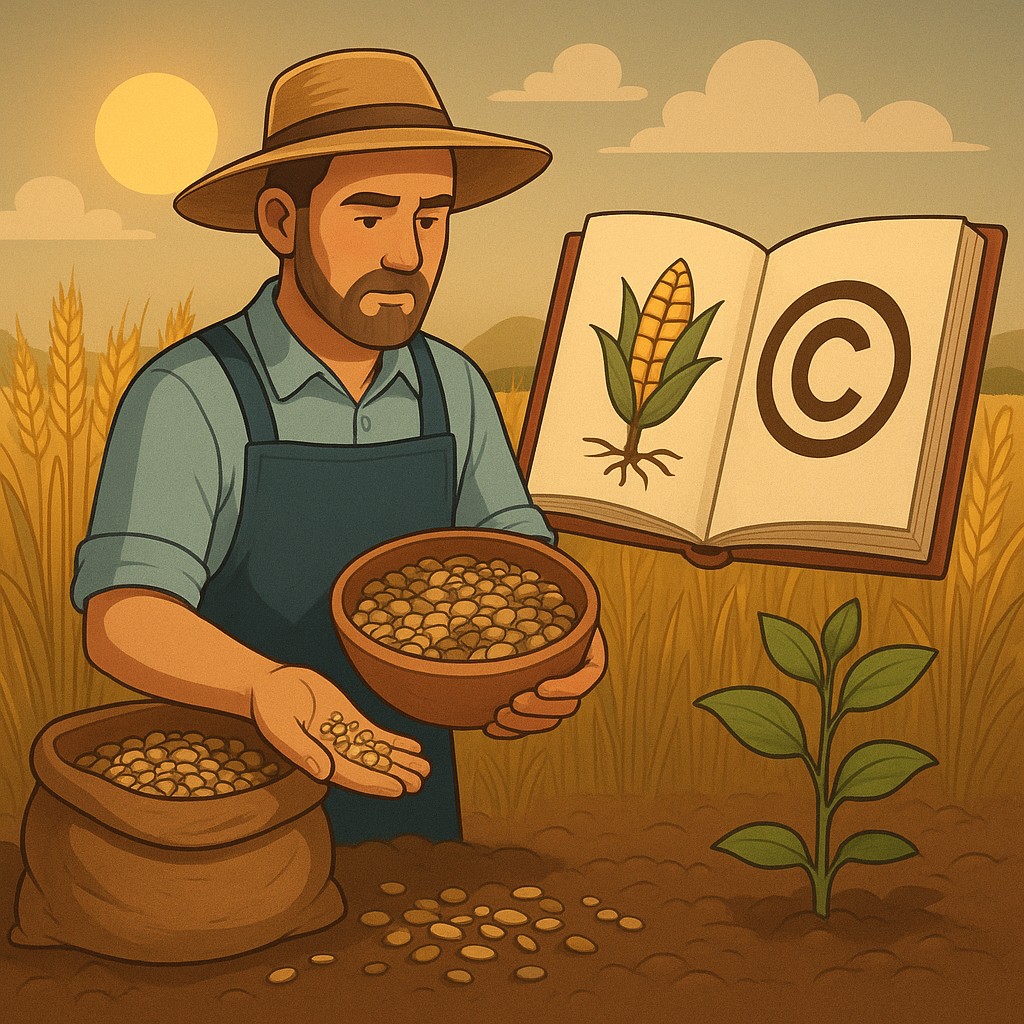
Imagine you are a baker in a world where you are allowed to buy a loaf of bread, but you are legally banned from using a single crumb to start your own sourdough culture. If you try to bake a second loaf using the biology of the first, you could be sued for stealing intellectual property. For most of human history, this would have sounded like a fever dream or a bizarre, bureaucratic fairy tale. For ten thousand years, the "source code" of our food - the seeds - belonged to everyone and no one. Farmers saved the best seeds from every harvest and traded them with neighbors. Over centuries, they turned wild grasses into the towering corn and hardy wheat that fuel our world today. This constant, community-led tinkering was the original open-source project, giving us a massive, colorful library of genetic diversity.
In the last century, however, the legal rules of the garden have changed. As industrial farming took over, seeds were transformed from a shared heritage into private technology. Today, a handful of giant corporations own the patents to most of the world’s commercial seeds. While these "protected" varieties often produce high yields under perfect conditions, they come with strings attached. Farmers are often forced to sign contracts promising not to save seeds for the next year, which makes them buy new stock every single season. In an era of climate change, where a once-in-a-century flood might happen every ten years, this legal bottleneck is a serious risk to our survival. We are realizing that we need a different kind of "operating system" for our fields - one that treats seeds as evolving public goods rather than static products.
The Digital Architecture of a Living Seed
To understand how we can "open source" a tomato, we first have to understand the legal cage surrounding it. In the plant world, intellectual property usually takes two forms: Plant Variety Protection (PVP) and utility patents. A PVP is a bit like a copyright for a book; it protects a specific version of a plant but usually lets researchers use that plant to breed something new. Patents, on the other hand, are much stricter. They can cover specific genetic traits, such as a "drought-resistance gene." If a breeder finds that same trait through their own independent research, they might still be infringing on a corporation’s patent. This creates a "patent thicket" where small-scale breeders are too afraid of legal trouble to experiment with the genetic material needed to adapt to a changing climate.
The open-source movement in farming takes its inspiration from the software world, specifically the concept of "copyleft." In software, if you write code and release it under a General Public License (GPL), anyone can use, study, and change it. However, there is a catch: if they share a modified version of that code, they must also release it under the same open-source license. They cannot take your work, tweak one line, and then claim exclusive ownership of the result. When applied to seeds, this ensures that the "source code" of our food stays in the public domain, even as it is improved and adapted for new environments. It turns the seed from a locked box into a shared toolbox.
The Viral Guardrail of the Seed Pledge
In practice, this system is remarkably simple, though it relies more on social contracts and creative licensing than on high-tech encryption. Organizations like the Open Source Seed Initiative (OSSI) in the United States or OpenSourceSeeds in Europe use a "Pledge" or specific licenses. When a breeder releases a new variety under an open-source model, the packaging includes a clear statement. By opening the packet or planting the seed, the user agrees to a set of conditions. These include the freedom to save the seed, grow it, study it, and - most importantly - breed new varieties from it.
The "viral" nature of this license is its secret weapon. If a breeder takes an open-source "Climate-Resilient Kale" and crosses it with a local variety to make it more frost-tolerant, that new "Frost-Proof Kale" is automatically open-source as well. This builds a growing, protected library of plants that cannot be turned back into private property. It effectively creates a legal shield around genetic diversity. While a corporation can still develop its own private seeds from scratch (an expensive task), they cannot take a trait from the open-source library and slap a patent on it for their own profit. This ensures that as we develop crops that can survive the heatwaves of 2050, those survival traits remain available to every farmer on Earth.
| Feature |
Patented Seeds |
Open-Source Seeds |
| Ownership |
Corporate/Private |
Public Domain/Shared |
| Seed Saving |
Usually banned by contract |
Encouraged and protected |
| Breeding |
Needs permission or royalties |
Freely allowed for any purpose |
| New Versions |
Can be patented further |
Must stay open-source (Copyleft) |
| Innovation |
Limited to big labs |
Spread among all farmers |
Opening the Bottleneck for the Future of Food
Why is this decentralized approach so critical right now? Think of it as a massive, global stress test. If three companies control the genetic designs for 70% of the world’s corn, and those designs were all built for a climate that no longer exists, we have a single point of failure. A specific pest or a new type of heat stress could wipe out a crop that lacks the genetic "vocabulary" to fight back. By contrast, open-source models empower thousands of "citizen breeders" to run local experiments. A farmer in a dry part of Colorado can breed for drought tolerance, while a farmer in a humid part of Bangladesh breeds for rot resistance. Both can share their successes without a legal department getting in the way.
This shift also addresses a major myth about innovation. Many people believe that without the "reward" of a 20-year patent, no one would bother to invent anything new. But history proves the opposite in biology. Most of our staple crops were developed through the shared innovation of indigenous farmers over thousands of years. Open-source models don't remove the incentive to create; they simply change how the reward works. Breeders can still sell their seeds and profit from their hard work and expertise. What they cannot do is collect "rent" on the biology itself for decades, stopping others from building on their work. It shifts the focus from "who owns this trait" to "how well does this plant grow."
Navigating the Legal Soil
Of course, moving toward open-source seeds has its hurdles. One of the biggest challenges is the sheer power of the existing legal system. International treaties, such as UPOV (a global group that protects new plant varieties), have historically favored the rights of commercial breeders over the rights of farmers to save seed. In many countries, the "farmer's privilege" to replant their own harvest is being limited or removed to match global trade rules. Open-source advocates are essentially trying to build a parallel track. They are using the tools of the current legal system - contracts and licenses - to bypass its most restrictive parts.
There is also the issue of "Digital Sequence Information," or DSI. Today, a seed isn't just physical material; it is a digital map of data. Scientists can sequence a plant's genome and upload it to a database. There is a heated global debate about whether companies should be allowed to patent a sequence of DNA found in a public database, even if they never touched the physical plant. Open-source models are evolving to include these digital footprints, ensuring that the genetic information stays as free as the physical seeds. This is the new front line of agricultural law: ensuring that both the physical seed and its digital ghost are protected from being fenced off by a few powerful groups.
Reclaiming Our Role in Nature
At its heart, the open-source seed movement is a shift back to the roots of farming. It treats the farmer not as a mere customer of a pre-packaged industrial product, but as an active partner in the process of evolution. For the last century, we have treated plants like machines, trying to standardize them and protect them like private software. But plants are not machines; they are vibrant, adapting organisms that need to change along with the Earth. When we lock a seed behind a patent, we are effectively telling the plant to stop evolving - or to only evolve in ways that make money for a specific company.
As we face the task of feeding ten billion people on a warming planet, the open-source model offers a path that puts resilience ahead of control. It acknowledges that the genius of nature is far more complex than anything we can map in a lab, and the best way to use that genius is to let everyone work with the "code." By freeing the seed, we are not just protecting a product; we are ensuring that the fundamental building blocks of life remain a shared legacy. When you hold an open-source seed, you aren't just holding a tiny plant; you are holding a piece of freedom, ready to be planted, shared, and adapted for the generations to come.