Imagine the global power grid as a giant, high-stakes game of Tetris. To keep the lights on, the amount of electricity we produce must perfectly match the amount we use at every single millisecond. If we generate too much, the system becomes unstable; if we generate too little, we get blackouts. This wasn't such a headache when we relied only on coal or gas, because we could simply toss another shovel of fuel into the furnace whenever people turned on their air conditioners. But as we shift toward wind and solar, we have hit a snag. The wind blows hardest at 3:00 AM while everyone is asleep, and the sun shines brightest at noon when people are away at work. We are producing massive amounts of "extra" energy that we currently have no way to save for later.
Traditional batteries, like the lithium-ion ones in your phone or car, are incredible for short bursts of power. However, they are expensive, wear out over time, and require rare minerals that are difficult to mine. To truly stabilize the grid, we need something bigger, cheaper, and more durable. This has led scientists and engineers to look toward the deepest parts of our oceans for a solution that sounds like something out of a science fiction novel. By using the immense, crushing weight of the sea, we are beginning to build "underwater batteries" that do not use chemicals at all. Instead, they use something much simpler: air. This concept, known as Underwater Compressed Air Energy Storage (UCAES), is turning the seafloor into a massive, invisible warehouse for the world's excess green energy.
The Crushing Logic of the Deep
To understand why the ocean floor is the perfect place for a battery, you first have to appreciate how heavy water actually is. If you have ever dived to the bottom of a deep swimming pool, you have felt that uncomfortable squeeze on your eardrums. That is the weight of the water above you pressing down. In the open ocean, for every ten meters you descend, the pressure increases by one "atmosphere," which is roughly the same amount of pressure we feel from the air at sea level. By the time you reach a depth of 500 or 600 meters, the pressure is staggering. This environment is usually a hurdle for explorers, but for energy engineers, it offers a massive, free mechanical advantage.
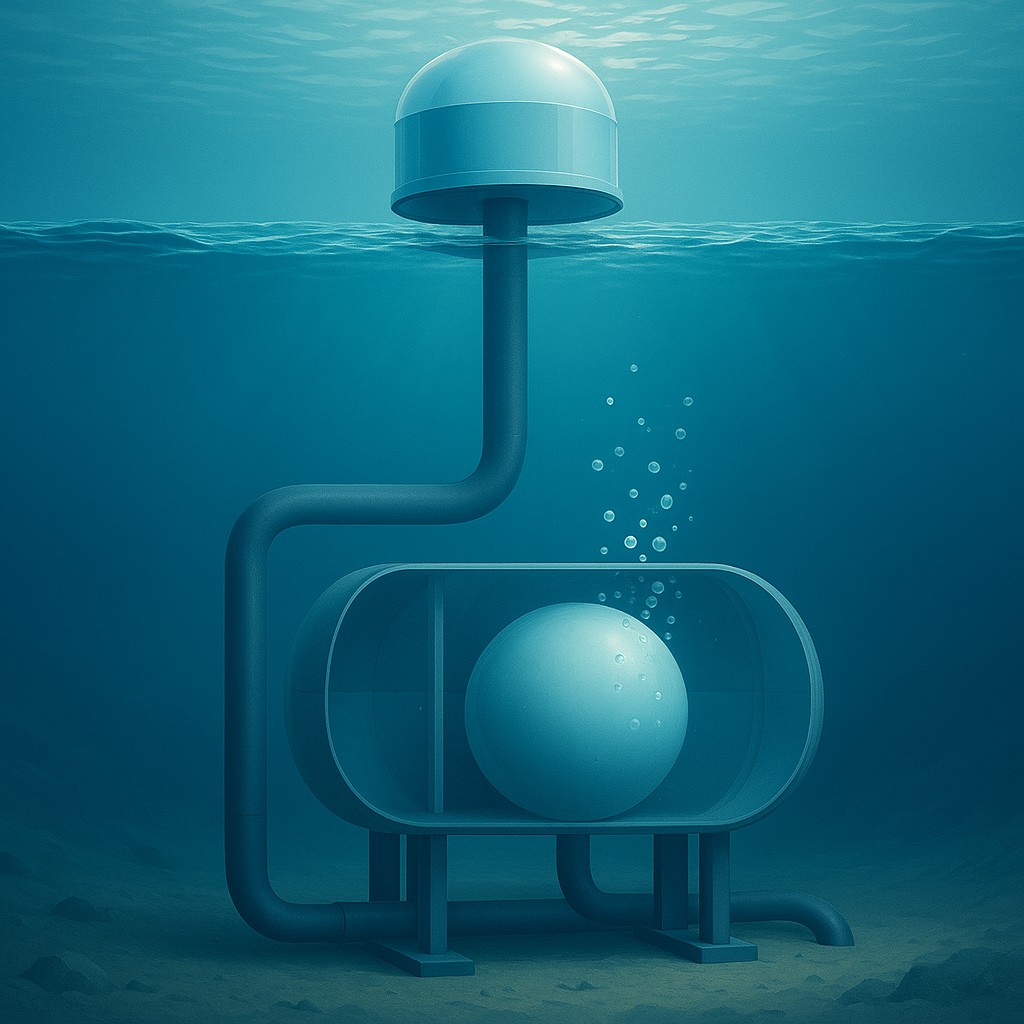
In a typical land-based system, you have to build enormous steel tanks with thick walls or find perfectly sealed underground salt caves to hold high-pressure air. These tanks are incredibly expensive because they must be strong enough to keep the air from exploding outward. However, when you move the operation to the bottom of the ocean, the water does the work for you. By pumping air into flexible, balloon-like structures called "energy bags" anchored to the seabed, the surrounding ocean provides a constant, external squeeze. This means the air stays compressed naturally, keeping it at a steady pressure without the need for high-tech, reinforced metal containers.
From Excess Wind to Balloons at Sea
The mechanics of this process are elegantly simple, following a sequence that mimics how a lung functions. When a nearby offshore wind farm produces more electricity than the grid needs, that surplus power is sent to a platform or a coastal station. This power drives a high-efficiency compressor that sucks in air from the surface and shoves it down a long pipe leading to the seafloor. As the air travels down, it fills up giant, reinforced fabric balloons or rigid domes. These containers expand as they fill, pushing back against the massive weight of the ocean. In physics terms, we are converting electrical energy into potential energy by fighting against the natural pressure of the sea.
The air stays down there, held in place by the weight of the water, for hours or even days. When the sun goes down or the wind stops blowing and the demand for electricity spikes, the process reverses. The weight of the ocean squeezes the air back up the pipe with immense force. As this high-pressure air rushes toward the surface, it spins an expansion turbine. This turbine is connected to a generator, which converts the rushing air back into electricity and sends it onto the grid. It is essentially a giant cycle of inhaling during times of plenty and exhaling during times of scarcity.
The Secret Ingredient: Managing Heat
While the concept of squeezing air seems straightforward, there is a major problem to solve: heat. Physics dictates that when you compress a gas quickly, it gets very hot. If you have ever used a hand pump to inflate a bicycle tire, you probably noticed the nozzle felt warm after a few minutes. On an industrial scale, the heat generated by compressing air to seafloor pressures is intense enough to melt equipment or cause significant energy loss. If we simply let that heat escape into the water, we lose a huge chunk of the energy we just spent compressing the air.
To make this system efficient, engineers use a "catch and release" strategy for heat. As the air is compressed on the surface, it passes through a heat exchanger where the thermal energy is stripped away and stored in a separate tank of specialized fluid or thermal gravel. The air that goes down to the seafloor is relatively cool and dense. Then, when it is time to generate electricity, the cold air coming back up passes through that same heat storage. The air "picks up" the saved heat, which causes it to expand even more forcefully before it hits the turbine. This re-heating process dramatically increases the amount of power we get back, making the system competitive with traditional chemical batteries.
| Feature |
Lithium-Ion Batteries |
Underwater Compressed Air (UCAES) |
| Lifespan |
10 to 15 years (Wears out over time) |
30 to 50+ years (Mechanical parts) |
| Environmental Impact |
High (Mining for Cobalt and Lithium) |
Low (Mainly air, steel, and fabric) |
| Storage Duration |
Short-term (Minutes to hours) |
Long-term (Hours to days) |
| Scalability |
Expensive to scale up |
Cheaper as the volume increases |
| Material Risks |
Fire or chemical leakage risks |
Pressure-related mechanical risks |
| Response Time |
Near-instantaneous |
Slightly slower (Mechanical startup) |
Balancing the Weights and the Costs
One might wonder why we don't just put these balloons anywhere. To make the physics work in our favor, the depth is non-negotiable. If the water is too shallow, there isn't enough pressure to store a meaningful amount of energy. If it is too deep, the engineering challenges of laying pipes and anchoring bags become far too expensive. This creates a "Goldilocks zone" along continental shelves. Fortunately, many of the world's most productive offshore wind farms are located near these coastal drops, allowing the storage facility and the wind farm to share the same underwater power cables.
The cost advantage of this technology becomes clear when you look at the materials. To double the capacity of a lithium battery bank, you essentially have to buy more of the expensive battery itself. To double the capacity of an underwater air system, you just need a bigger balloon. The air is free, and the container (the ocean) is already there. Furthermore, because the air is kept at a constant pressure regardless of how much is in the bag, the electricity produced is remarkably stable. Unlike a battery that might lose voltage as it drains, the ocean provides a steady, relentless push until the very last puff of air is gone.
Overcoming the Challenges of the Deep
Placing equipment on the seafloor is never easy. The ocean is a hostile environment, full of salt that eats away at metal and tiny organisms that love to grow on artificial structures. Engineers have to design the flexible storage bags to be incredibly tough, often using advanced plastics and high-strength fabrics that can survive decades of being squeezed and stretched without tearing. There is also the challenge of buoyancy. When those bags are full of air, they want to float to the surface with the force of a sinking ship. Securing them to the seafloor requires massive concrete weights or specialized piles that use suction to hold firm in the silt.
We must also consider the local ecosystem. While these systems are generally much cleaner than oil rigs, we have to ensure that the noise of the compressors or the presence of giant balloons doesn't disrupt whale migrations or the homes of bottom-dwelling creatures. Early studies suggest that these structures may actually act as artificial reefs, providing a hard surface for corals and sponges to grow on in areas that were previously just barren sand. If managed correctly, our energy storage solutions could double as marine sanctuaries, creating a rare win-win for both the power grid and the planet.
The Future of Long-Term Storage
As we look toward a future where "net zero" carbon emissions is the goal, we have to stop thinking of energy as something we just "use or lose." We are moving toward a more sophisticated, mechanical grid where the earth's natural features become part of our technology. Underwater compressed air is a perfect example of this shift. It shows that we don't always need to invent a new chemical compound to solve our problems; sometimes, we just need to use the physical constants of our planet, like gravity and water pressure, in a more clever way.
Imagine a world where the vast, dark plains of our oceans are dotted with these invisible lungs, breathing in the midday sun and breathing out the midnight wind. This technology bridges the gap between the chaotic rhythm of the weather and the steady pulse of human civilization. It offers a way to store energy that is as durable as the ocean itself. By turning the seafloor into a natural battery, we are not just solving a technical problem; we are learning how to live in harmony with the natural cycles of our world.