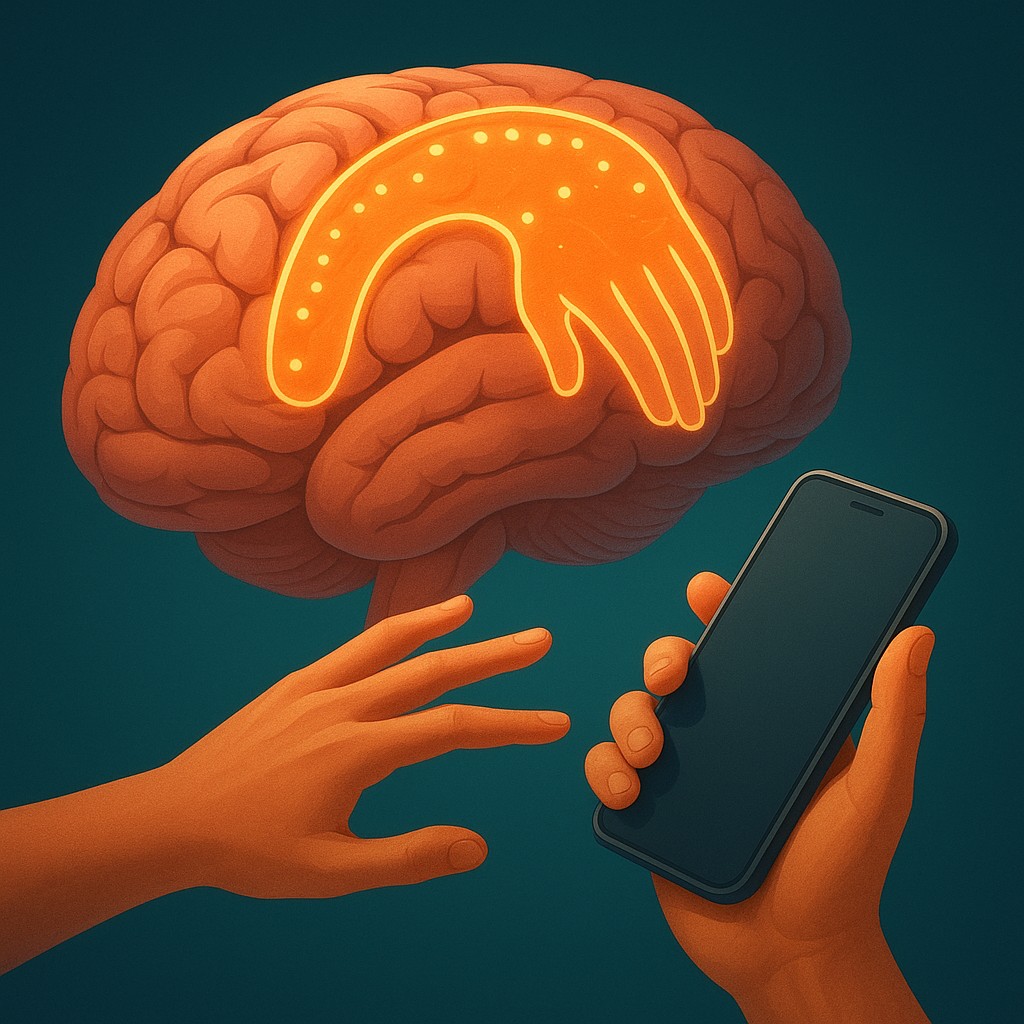
Imagine for a moment that you are standing in a crowded subway station, scrolling through your phone. Suddenly, a stranger reaches out and swats the device right out of your hand. In that split second, you do not just feel worried about the cost of a new screen or annoyed by a rude gesture. Instead, you likely experience a jolt of pure, automatic panic, a rush of adrenaline that feels exactly like being physically struck. Your heart races, your breath catches, and your muscles tense to either fight or run. This reaction is far more intense than what you would feel if that same stranger had kicked your backpack while it sat three feet away from you on a bench.
The reason for this gut reaction lies deep within the structure of your brain. To your nervous system, that phone was not just a piece of glass and silicon you happened to be holding; for all practical purposes, it was a part of your arm. Your brain has a remarkable, fluid ability to redraw the boundaries of your physical self to include the objects you use. This phenomenon is why a carpenter can "feel" the grain of wood through the handle of a tool and why a professional driver views a car’s fender as an outer layer of skin. We are not just biological beings trapped in "bags of meat"; we are masters of neural integration who treat the tools of our life as extra limbs.
The Living Map of the Body
To understand how a wrench becomes an arm, we first have to look at the somatosensory cortex. This is a strip of brain tissue that acts as a real-time map of your body. Every square inch of your skin corresponds to a specific "neighborhood" in this map. When someone touches your left pinky, that specific spot in your brain lights up. This map, often called a homunculus, is the reason you know exactly where your feet are in the dark without looking. It is your internal sense of where you end and the world begins.
For a long time, scientists thought this map was fixed once you became an adult. We assumed the brain had a permanent, hard-coded outline of the human form. However, research into neuroplasticity (the brain's ability to change and adapt) has shown that this map is actually very stretchy. It is less like a printed atlas and more like a high-tech GPS that updates its layout based on what you are doing. When you pick up a tool and use it with purpose, your brain begins to rewrite its own geography. It expands the reach of your nerve cells to cover the tool, effectively pulling the object inside your "body schema," or your internal model of your physical self.
This merger happens with surprising speed. Studies on primates have shown that within minutes of a monkey using a rake to reach for food, the brain cells that normally respond only to the monkey's hand begin to fire when the end of the rake is touched. The brain stops seeing "hand plus rake" and starts seeing a "very long, thin hand." This is the miracle of the body schema. It is a survival mechanism that allows us to operate complex machinery with the same natural grace we use to scratch an itch. We do not have to calculate the physics of the tool because, inside our heads, the tool has become us.
The Difference Between Owning and Embodying
There is a vital distinction in psychology between legal ownership and neural embodiment. You might "own" an apartment in another city, but your brain does not treat those walls as part of your body. Physical contact and functional use are the two keys that unlock this mental transformation. For an object to enter your body schema, you generally need to touch it, move it, or wear it. This is why losing a ring you have worn for twenty years feels much more painful than losing a digital stock certificate stored in a vault.
When we hold an object, our brain uses sensory feedback, such as the vibration through a tennis racket or the resistance of a steering wheel, to steady our movements. This loop is what allows the brain to merge the object into our self-image. The process is so effective that it can even create illusions. In the famous "rubber hand illusion," a participant’s real hand is hidden while they watch a fake rubber hand being stroked with a brush. Within seconds, the participant begins to feel that the rubber hand is their own. If the researcher then swings a hammer at the rubber hand, the participant’s brain reacts with a massive stress response. The brain has adopted the plastic hand as part of the body and treats the threat as a direct physical attack.
| Connection Type |
Psychological Ownership |
Neural Embodiment (Body Schema) |
| Primary Trigger |
Legal rights or digital titles. |
Direct physical contact and active use. |
| Brain Region |
Prefrontal cortex (logic and reasoning). |
Somatosensory cortex (touch and spatial maps). |
| Sensation |
Mental frustration or a sense of unfairness. |
A physical "jolt" or threat response. |
| Objects Involved |
Houses, bank accounts, digital files, ideas. |
Tools, jewelry, prosthetics, cars, clothing. |
| Main Purpose |
Social status and managing resources. |
Better motor skills and survival through tools. |
Why Tossing Old Items Feels Like Losing a Limb
If tools are temporary extensions of our bodies, then getting rid of them is not just a chore; it is a way of losing a piece of ourselves. This explains why many of us struggle to throw away worn-out boots or a childhood toy. Over years of use, these objects have been woven into our neural maps. Our brain has linked the weight of those boots and the texture of that toy with our own physical history. Letting them go feels like losing a piece of our story or, more accurately, a piece of our physical presence in the world.
This "extended self" theory suggests that we use our possessions to define who we are. Because the brain blurs the line between the tool and the limb, the tool becomes a home for our identity. When a craftsman retires and gives away his tools, he often faces a deep identity crisis. It is not just about losing a job; it is about the literal shrinking of his physical reach. His body schema, which once included saws and hammers, must now pull back to the edges of his skin. This contraction is mentally exhausting and emotionally painful.
Furthermore, this neural blurring is a major reason why property crimes involving personal items feel so invasive. When someone steals a purse while you are carrying it, the trauma is often much worse than the value of the cash inside. Your brain processes the grab as an act of violence because the purse was within your body’s protective zone. The thief did not just take "stuff"; they broke through your perimeter and snatched a piece of your "neural self." This is why we feel violated after a home burglary even if nothing expensive was taken. Intruders moved through a space our brain had mapped as part of our own safety, touching objects that were part of our daily physical rituals.
The Digital Divide and the Future of Self
While our brains are magnificent at absorbing physical tools, they are currently quite poor at doing the same for digital ones. You might spend ten hours a day on your laptop, but your brain does not treat the files in your "Documents" folder as part of your body. You cannot "feel" the weight of a heavy PDF, nor can you sense if a digital file is being moved the way you feel a physical jolt when someone grabs your mouse. Because digital assets lack the touch and feel of the physical world, they remain "outside" of us.
This creates a fascinating gap in the modern world. We are surrounding ourselves with digital wealth, from crypto to e-books, yet we do not feel the same biological connection to them. This is why people are often willing to pay five times more for a physical book than its digital version. The physical book can be held, its pages can be felt, and it can eventually be integrated into the body as we carry it around. The digital version is just a flickering image on a screen that our brain keeps at arm's length. We own it, but we do not embody it.
As technology advances, however, this may change. We are entering an era of sophisticated haptic feedback (technology that recreates the sense of touch) and neural interfaces. If a future computer allows you to "feel" digital objects through your fingertips using vibrations or direct brain stimulation, your brain might begin to treat those bits and bytes as part of your body too. We are moving toward a future where the line between "me" and "my data" could become as blurry as the line between a carpenter and his hammer. This could change how we interact with the world, but it also raises scary questions about what happens when our digital "limbs" are hacked or deleted.
Mastering the Mechanics of the Human Instrument
Knowing that your brain treats tools as body parts can change how you learn new skills. When you start learning the guitar or driving a car, you feel clumsy because the object is still "external." You are thinking about it with your conscious brain, which is slow and analytical. But with enough practice and physical contact, the object moves. It migrates into the areas of the brain responsible for touch and automatic movement. It becomes part of your schema. Once that shift happens, you stop "playing the guitar" and simply start "playing."
This neurological reality is also a powerful reason to keep up physical hobbies. Working with our hands, whether it is gardening, baking, or fixing a bike, forces our brain to expand its maps. It keeps our neural pathways flexible and grounded in the physical reality we evolved to master. By engaging with the world, we are literally "expanding" ourselves, pushing the boundaries of our nervous systems to include the beauty and use of the objects around us.
Next time you pick up your favorite pen or lace up your most comfortable sneakers, take a second to appreciate the silent genius of your brain. It is quietly working behind the scenes to stitch those inanimate objects into the fabric of your being. You are not just a spectator watching the world from behind your eyes; you are a dynamic, ever-growing system of skin, bone, and tools. This ability to make the world part of ourselves is one of our greatest strengths, turning us from simple primates into creators, artists, and builders who can reach far beyond the tips of our fingers.