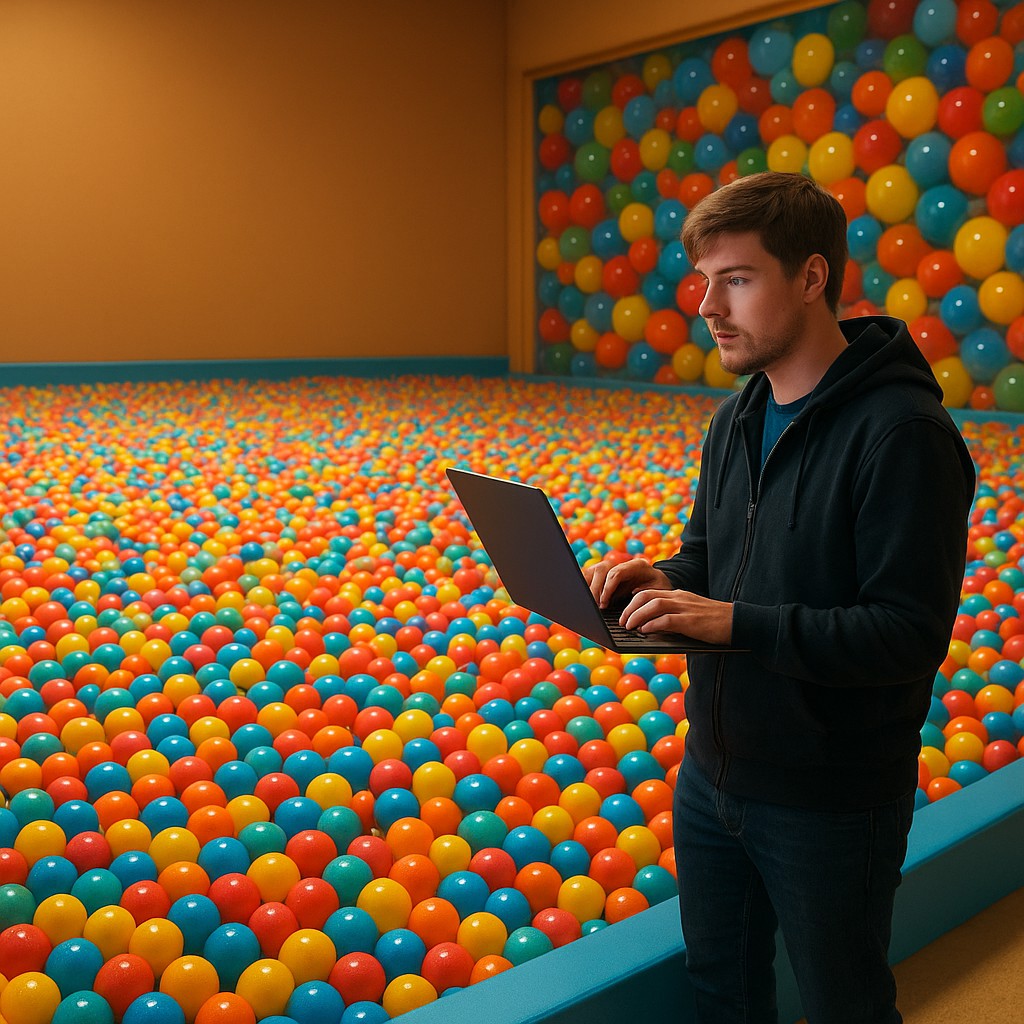
Picture yourself standing at the edge of a massive swimming pool filled to the brim with colorful plastic balls, or perhaps in a room packed with a hundred million Orbeez (small, water-absorbent polymer beads). For most, this looks like a chaotic mess. For Jimmy Donaldson, known to the world as MrBeast, it is a laboratory for human psychology.
Many people dismiss his success as a stroke of luck with the YouTube algorithm or assume he won the "internet lottery" simply by being the loudest voice in the room. In reality, the MrBeast brand is built on a fanatical, almost scientific obsession with what drives a human being to click a mouse and stay glued to a screen for twenty minutes straight.
The philosophy behind his empire has nothing to do with vanity. Instead, it is a relentless loop of reinvestment and hyper-optimization. Jimmy famously spent years on Skype calls with other creators, dissecting viral videos frame by frame to figure out why specific colors, words, or facial expressions kept people watching. He never treated YouTube as a hobby. To him, it was a complex machine that could be decoded through data and experimentation. By moving away from the casual "vlog" style of the early 2010s and toward high-stakes spectacles, he turned the platform into a digital stadium with himself as the head architect.
The Architecture of the Irresistible Click
The first pillar of this strategy is the "Irresistible Hook." In our digital age, attention is the most valuable currency, and Jimmy acts as its world-class central banker. He knows a video succeeds or fails before anyone even hits play. This is why he might spend tens of thousands of dollars on a single thumbnail image or debate a three-word title for days. The goal is to create a "curiosity gap" in the viewer's mind that only the video can fill. If a title says "I Built a House Out of Lego," the brain immediately wants to know if it will stand, if it actually works, and how long it took to build.
Once the viewer clicks, the "Retention Game" begins. Many people believe the algorithm is a mysterious, sentient force that picks favorites, but Jimmy argues it is simply a mirror of the audience. If people watch a video to the end, the system shows it to more people. To keep them there, he uses "fast-cutting" and "constant payoff." He eliminates every dull moment or transition that might cause a viewer to get bored and leave. Every thirty seconds, something new happens, the stakes rise, or the visuals shift. This creates a dopamine loop that makes his videos feel much shorter than they are.
Crucially, his content uses a "Universal Language." He avoids niche topics or local references that only Americans would understand. Whether you are a ten-year-old in Ohio or a thirty-year-old in Tokyo, you can instantly grasp the concept of "Last Person to Leave the Circle Wins $500,000." By stripping away complexity and focusing on basic human emotions like greed, endurance, kindness, and wonder, he expanded his potential audience to every person on Earth with an internet connection. This global mindset allowed him to scale faster than traditional television networks ever could.
The Reinvestment Cycle and the Risk of Ruin
One of the biggest differences between MrBeast and traditional creators is his refusal to pocket his early earnings. Most influencers buy a luxury car or a new house the moment they make their first hundred thousand dollars. Jimmy spent his on a single video. This is what he calls the "Flywheel of Scale." By spending more on a video than his competitors, he created a higher-quality product that attracted more views. Those views brought in more ad revenue, which he then funneled into even more expensive videos. This created a barrier to entry that is almost impossible for others to cross.
This "burn the boats" philosophy meant that for years, he was often on the verge of having zero dollars in his bank account despite earning millions. This comfort with risk is core to his success. He realized that in the attention economy, standing still is the same as moving backward. By constantly raising the stakes, from giving away $1,000 to giving away a private island, he kept his audience in a state of constant excitement. They weren't just fans of a person; they were fans of a journey that seemed to have no limit.
The table below shows how this reinvestment strategy differs from the traditional content model, explaining how he outpaced creators who had years of a head start.
| Feature |
Traditional Content Creator |
MrBeast Strategy |
| Handling Profits |
Personal wealth and lifestyle upgrades |
100% reinvested into production |
| Team Size |
1-3 people (self-edited) |
50+ specialists, writers, and engineers |
| Content Scope |
Relatable, daily activities |
Massive stunts and "bucket list" events |
| Primary Goal |
Sustainable career and hobby |
Dominating the global attention market |
| Risk Profile |
Low (protecting the brand) |
High (gambling on every video's success) |
From Content Creator to Industrialist
Once MrBeast secured a massive, loyal audience, he moved into the next phase: vertical integration. This means owning the entire supply chain of his business. He realized that if he could convince millions of people to watch a video for free, he could also convince some of them to buy a physical product. Unlike many who just slap their logo on a cheap T-shirt, Jimmy applied his perfectionist streak to his businesses, Feastables (a chocolate brand) and MrBeast Burger. He knew the "Beast" name was a seal of quality. If the product didn't live up to the hype, it would hurt his main engine: the YouTube channel.
The genius of these ventures is how they solve the "Sponsorship Problem." Usually, creators rely on outside brands like VPNs or mobile games to pay them. Jimmy realized he was leaving money on the table. By owning the products he advertised, he kept all the profits and had total control over the marketing. This turned his channel from a media outlet into a massive sales funnel for his own company, Beast Industries. He was no longer just a YouTuber; he was a CEO using video as a weapon to capture the market.
Beyond snacks and burgers, he has expanded into financial technology. By acquiring apps like Step, a banking platform for teens, he is positioning himself to be a part of his audience’s entire life. He provides the entertainment, the food, and now the financial tools they use. This ecosystem is similar to how Disney operates, using movies to drive people to theme parks and toy stores. He has essentially built a "closed-loop" economy where the attention he generates on YouTube flows directly into his other businesses, making him less dependent on the changing whims of advertisers.
Philanthropy as a Viral Catalyst
A common mistake is thinking Jimmy’s charity work is just a PR stunt. While it certainly helps his image, the philosophy behind "Beast Philanthropy" is more strategic. He discovered that kindness and massive-scale giving are actually "high-retention" content. People love seeing lives changed. By turning charity into a spectacle, such as building 100 wells in Africa or paying for 1,000 people to receive eye surgery (a procedure to restore vision), he created a new genre of content that satisfies both the algorithm and the human soul.
This "Philanthropy-Powered Growth" creates a positive cycle. The more good he does, the more people watch. The more people watch, the more money he makes from ads. The more money he makes, the more good he can do. This transformed his brand from just another "prankster" into a figure of cultural importance. It is a win-win scenario that traditional charities struggle to match because they don't have his massive reach.
Furthermore, his charity work acts as a shield. In an era where influencers are often "canceled" or criticized, it is hard to maintain a negative story about someone who consistently provides clean water and housing to people in need. He has turned altruism into a game that feels authentic to younger generations, proving that you don't have to choose between being a successful businessman and a dedicated philanthropist. In his world, the two are parts of the same whole.
The Scientific Method of Creativity
One of the most important lessons from the MrBeast story is his use of "A/B Testing" (comparing two versions of something to see which performs better) and data-driven decisions. He doesn't guess what people like; he proves it. For example, he might film three different endings to a video and show them to a small test group to see which one is most satisfying. He analyzes "heat maps" of his videos to see exactly which second viewers start to click away. If viewership drops at the four-minute mark, he finds out why. Was the pace too slow? Was the joke flat? Was the lighting bad?
This level of detail extends to his hiring. He scouts for people who have a "Beast-like" obsession with their craft rather than just looking at fancy degrees. He wants people willing to try, fail, and try again. This "Startup Culture" allows his team to move faster and take bigger risks than a traditional Hollywood studio. They treat every video like a software launch, looking for "bugs" in the viewer experience and fixing them for the next release.
He also understands the power of "Multi-Language Integration." Recognizing that English speakers are only a small part of the world, he pioneered the use of dubbed channels. By hiring professional voice actors to translate his videos into Spanish, French, Arabic, and dozens of other languages, he multiplied his audience without having to film anything new. This move showed a level of foresight most creators lack, treating his content as a global brand rather than a local show.
Mastering the New Economy
To apply the MrBeast philosophy to your own life or career, you must accept that capturing attention is a skill that can be studied and mastered. It starts with a commitment to extreme quality over high quantity. It requires a willingness to fail publicly and to treat those failures as data points rather than personal defeats. Above all, it requires a "Long-Term Greedy" mindset: the ability to give up a small paycheck today for a world-changing empire tomorrow.
You don't need a million dollars to start, but you do need the curiosity to ask why things work. Whether you are building a business, a social media following, or a traditional career, the principles of hyper-optimization, focusing on the audience, and constant reinvestment are universal. Jimmy Donaldson proved that a kid from North Carolina with a webcam could outmaneuver billion-dollar corporations simply by understanding the "human" behind the "user." The digital world is a game with visible rules. If you study the board as closely as he does, there is no limit to what you can build.