You have looked up at the Moon a thousand times and felt something - calm, awe, curiosity, maybe a little wonder at how that bright disc quietly changes shape every night. The Moon is not just a pretty face in the sky. It is a record of violent beginnings, an active player in Earth’s rhythms, and a nearby laboratory that helped us learn how planets form and change. Understanding the Moon connects geology, orbital mechanics, climate, biology, culture, and our plans for space travel.
This text will take you from the Moon’s origin story to the dust under your hypothetical lunar boot, while clearing up the myths people love to tell. I will build concepts step by step, using clear language, a few surprises, and some humor to keep things light. By the end you will be able to explain why the Moon is where it is, what it does to Earth, what scientists have actually learned from telescopes and missions, and why the Moon still matters for our future.
A dramatic birth and the evidence that supports it
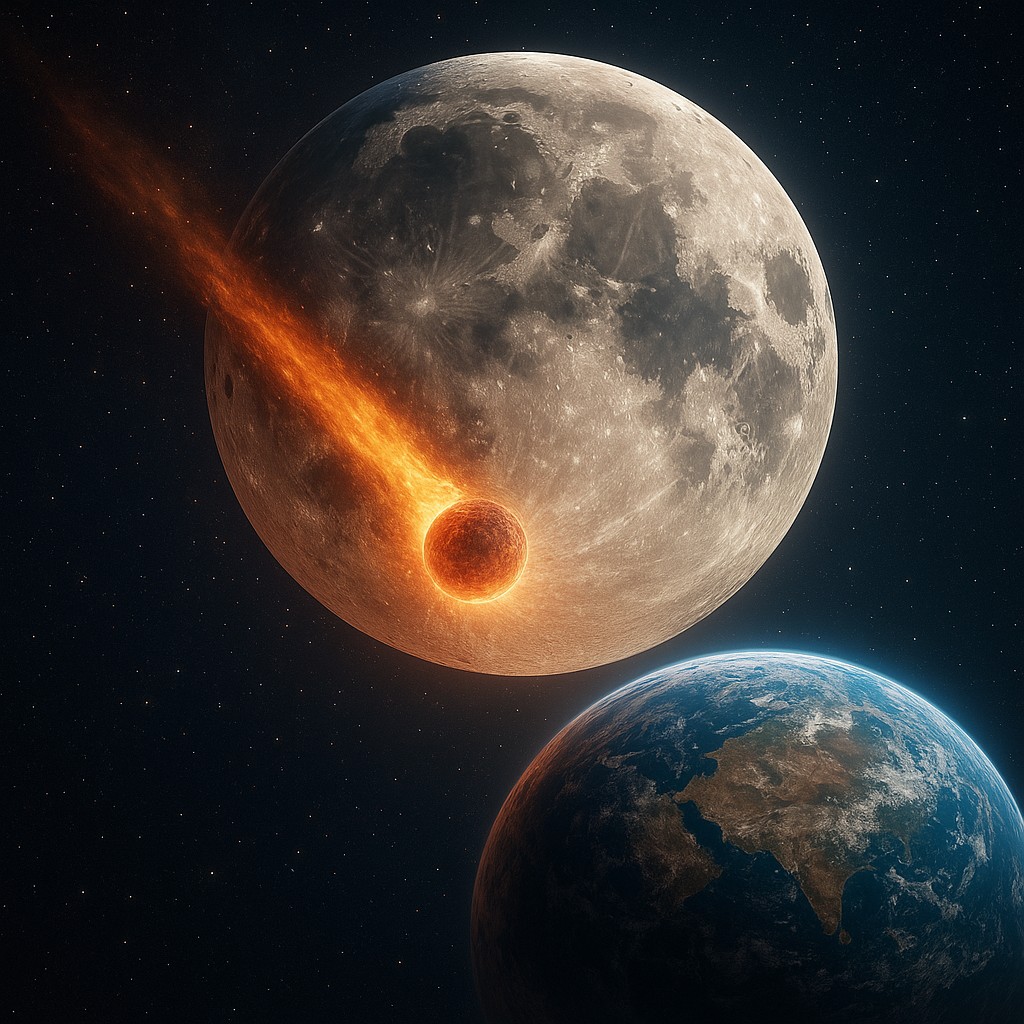
Today’s leading explanation for the Moon’s origin is the Giant Impact hypothesis. Roughly 4.5 billion years ago Earth was young and molten, and a Mars-sized body sometimes called Theia slammed into it at an oblique angle. The collision blasted material into orbit around Earth, and over thousands to millions of years that debris coalesced to form the Moon. This model explains why the Moon is made of rock similar to Earth's mantle and why it has a relatively low iron core compared with Earth.
Several lines of evidence support the Giant Impact story. Lunar rocks returned by the Apollo missions carry isotopic fingerprints, such as oxygen isotopes, that match Earth’s more closely than any other solar system body. The Moon’s small metallic core and its depletion in volatile elements are consistent with formation from the outer layers of a melted Earth and impactor, followed by loss of lighter materials to space. Computer simulations show how an oblique collision could yield a Moon with the observed mass, orbit, and angular momentum. Alternative ideas - capture of a passing body, or simultaneous formation from the same disk - fail to match one or more key observations, which is why the Giant Impact model dominates.
How big is the Moon, and what is its anatomy
The Moon is about one quarter of Earth’s diameter - roughly 3,474 kilometers across - and its surface area is comparable to the continent of Africa. It has only about one sixth of Earth’s surface gravity, so a 90 kilogram person on Earth would weigh about 15 kilograms on the Moon. Internally, the Moon has a crust, a mantle, and a small iron-rich core that is partially molten in places. Unlike Earth, the Moon lacks a global magnetic field today, although lunar rocks preserve evidence that it once had a stronger field billions of years ago.
The surface is blanketed by a fine, powdery layer called regolith. This dust formed over billions of years as micrometeorites and larger impacts pulverized surface rocks. The visible face shows bright highlands and darker plains called maria, which are basaltic lava flows from ancient volcanic activity. The maria are concentrated on the near side and give the Moon the patched look most people recognize.
Why we always see the same face, and what phases actually mean
The Moon is tidally locked to Earth, meaning it rotates on its axis in the same time it takes to orbit us. That synchronous rotation is why we always see the same hemisphere - the near side. Tidal locking happens because gravitational interactions raise bulges, and over long timescales those interactions dissipate rotational energy until the Moon’s rotation matches its orbit. The so-called far side is not permanently dark, despite the popular myth. Both sides experience day and night as the Moon moves around Earth.
Phases are about geometry. As the Moon orbits, sunlight illuminates changing fractions of the hemisphere that faces us. New Moon occurs when the Moon is between the Sun and Earth, and Full Moon when Earth sits between the Moon and Sun. Phases repeat every synodic month, about 29.5 days, which is why many cultures used the Moon to track time. Eclipses happen when geometry lines up: a lunar eclipse occurs when Earth’s shadow falls on the Moon, and a solar eclipse when the Moon blocks sunlight from reaching part of Earth.
Tides, tilt, and the slow waltz that affects life on Earth
The Moon’s gravity tugs on Earth. That pull, with help from the Sun, produces ocean tides - two bulges on the planet that move as Earth rotates. Tides help shape coastlines, influence marine ecosystems, and assist the transport of nutrients. Tidal heating and friction in oceans and the crust dissipate energy, slowly altering the Earth-Moon system. Because of tidal friction, Earth’s rotation is gradually slowing, lengthening days by about 1.7 milliseconds per century, and the Moon is drifting away at roughly 3.8 centimeters per year.
The Moon also stabilizes Earth’s axial tilt. Without the Moon, Earth’s tilt would vary more chaotically under the gravitational influence of other planets, producing large climate swings over geological timescales. This relative stability has likely helped produce a climate favorable to complex life. The Moon’s regular rhythms of light and tides may have aided early biochemical pathways and the evolution of coastal ecosystems, though those ideas remain active areas of research and debate.
What lunar samples and missions revealed that telescopes could not
Apollo astronauts and robotic missions returned rocks and data that transformed our understanding. Lunar samples revealed a history of intense early impacts, volcanic activity, and a crust formed from a global magma ocean. Radiometric dating of those rocks fixed ages for major events, including the timing of heavy impacts and volcanic episodes. Analyses also showed water exists on the Moon - not as liquid lakes, but as hydrogen-bearing minerals and ice trapped in permanently shadowed craters near the poles.
Instruments left on the surface recorded seismic activity known as moonquakes, which are generally weaker than most terrestrial quakes but useful for probing the lunar interior. Retroreflectors installed during Apollo still allow laser ranging experiments to track the Moon’s orbit with centimeter accuracy. Robotic missions in recent decades - such as the Lunar Reconnaissance Orbiter and the Chang’e program - have mapped the surface in high definition, found water ice in polar regions, and begun scouting sites for future exploration.
The Moon as a resource and stepping stone for humans
The Moon is more than a scientific specimen - it is also a practical destination. Water ice near the poles could be processed into drinking water, oxygen for breathing, and hydrogen and oxygen for rocket fuel. Lunar regolith contains oxygen bound in minerals, and it could be used as building material for habitats or radiation shielding. The Moon’s low gravity and proximity to Earth make it an ideal place to test life support systems and technologies needed for deeper missions, such as crewed travel to Mars.
Economic and scientific possibilities include harvesting resources like potential deposits of helium-3, a rare isotope sometimes suggested as fuel for future fusion reactors, though practical fusion and extraction methods remain speculative. The far side could host radio telescopes shielded from Earth’s radio noise, enabling unique astronomy. Any long-term presence will need to solve engineering challenges around dust, radiation, thermal extremes, and sustainable life support, but incremental missions are making those challenges clearer and more solvable.
Common myths, corrected with a friendly nudge
The Moon is not made of cheese. Lunar geology is basaltic and anorthositic rock, not anything edible. The phrase "dark side of the Moon" is misleading; every part of the Moon has about 14 Earth days of daylight and 14 days of night. The near side’s different appearance is not because it is older or specially formed to face us on purpose - it results from asymmetric heating, crust thickness differences, and impact history. The Moon does not cause tides single-handedly - the Sun contributes too, and the interplay produces spring and neap tides. Finally, the Moon did not form as an afterthought; it was central to Earth’s early evolution and continues to shape planetary processes today.
A quick list of key facts to remember
- Size and gravity: About 27 percent of Earth’s diameter and one sixth the surface gravity.
- Orbit and phases: Tidally locked, synodic month about 29.5 days, causes eclipses and phases.
- Origin: Best explained by a Giant Impact about 4.5 billion years ago.
- Surface: Highlands, maria, craters, and a fine regolith created by impacts.
- Influence: Stabilizes Earth’s tilt, drives tides, affects rotation rate, and may have aided life.
- Resources and future: Polar ice, building materials, potential fuel and scientific sites.
A compact comparison table for quick reference
| Property |
Moon |
Earth |
| Mean diameter |
3,474 km |
12,742 km |
| Surface gravity |
1.62 m/s2 (about 0.165 g) |
9.81 m/s2 (1 g) |
| Atmosphere |
Extremely thin, mostly negligible |
Thick, nitrogen-oxygen rich |
| Average surface temperature |
-53°C (wide range: about -173°C to 127°C) |
~14°C globally average |
| Age |
~4.51 billion years |
~4.54 billion years |
| Orbital period (sidereal) |
27.3 days |
N/A |
| Synodic month (phases) |
29.5 days |
N/A |
| Magnetic field |
No global field today |
Strong global field |
| Water presence |
Ice in polar shadowed craters, hydrated minerals |
Oceans, rivers, atmosphere |
What the Moon still hides and where science is heading
Open questions keep lunar scientists busy. The exact details of the Giant Impact - the size, speed, and composition of the impactor - are still being refined by modeling and new isotopic studies. The timing and intensity of the late heavy bombardment, a hypothesized spike in early impacts, remain debated. We are also trying to quantify exactly how much volatiles like water ice exist, how accessible they are, and how best to extract and use them. Moon-based astronomy, radio observatories on the far side, and long-term human habitats are now realistic goals being planned and tested.
Robotic scouts and crewed return missions will expand our knowledge. New sample-return missions can bring back material from unvisited regions, including the far side and polar areas. Seismometers and heat-flow experiments can probe the deep interior to reveal the Moon’s core. International and commercial partnerships will likely establish steady logistics, science bases, and technologies that can be practiced on the Moon and used for missions deeper into the Solar System.
Why the Moon belongs in our story — and yours
The Moon is a storyteller: it preserves the scars from when planets were young, it keeps a rhythmic influence on Earth’s oceans and climate, and it stands as a nearby testbed for our ambitions in space. Knowing the Moon connects you to many branches of science, from chemistry to celestial mechanics to ecology and engineering. It is also a cultural mirror: poetry, calendars, religions, and art have all been shaped by humans looking up at that changing face.
Go outside tonight and find the Moon. Notice its phase, imagine the billions of years it has witnessed, and perhaps think of the Apollo footprints that still rest undisturbed. The Moon invites curiosity and invites action - whether your next step is reading about orbital mechanics, tracking a lunar eclipse, or supporting the next mission that will return humans to its surface. You now have the scaffolding to explain how the Moon formed, why it matters, what we have learned from it, and where future discoveries will come from. Keep asking questions, and let the Moon keep lighting the way.