When you sit down for a meal, you likely think of food as fuel. You track calories, look for protein to build muscle, or perhaps load up on carbohydrates to power through a long afternoon. In this mental model, food consists of the logs you throw onto a fire to keep the engine humming. It is a logical way to look at nutrition, but it leaves out a crucial set of characters. These silent partners do not provide any energy at all, yet without them, the fire would go out regardless of how many logs you pile on. They are vitamins, and despite what marketing campaigns suggest, they are not "fuel" in any sense of the word.
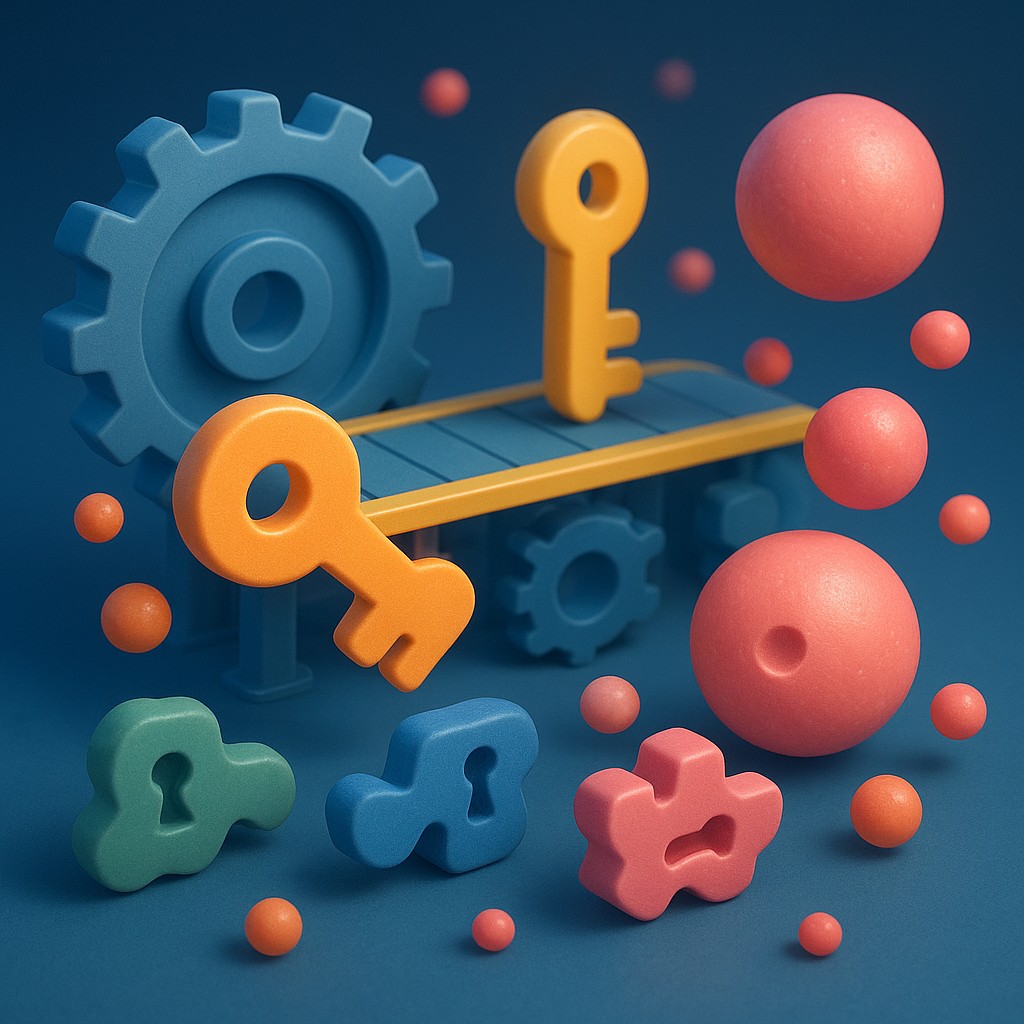
If you were to zoom in on your cells, you would not see vitamins being burned for energy. Instead, you would see a bustling, microscopic assembly line staffed by workers called enzymes. These enzymes are specialized machines designed to build complex proteins, repair DNA, and break down sugar molecules to release power. However, many of these chemical machines are currently "off." They are shaped like locks that require a specific, oddly shaped key to start turning. Vitamins serve as these molecular keys, technically known as coenzymes. Without the key, the machine sits idle. You can eat all the calories in the world, but if the keys are missing, the assembly line grinds to a halt, leaving your body unable to process the very fuel you have provided.
The Assembly Line and Its Idle Workers
To understand the difference between fuel and a catalyst (a substance that starts a reaction), we need to look at how biological work actually gets done. Every single thing your body does, from flexing a muscle to forming a new thought, is the result of a chemical reaction. These reactions do not always happen on their own; they often need a nudge. This is where enzymes come in. Enzymes are large, complex proteins that act as biological facilitators. They bring molecules together, twist them into the right shapes, and help them bond or break apart. However, an enzyme is often incomplete on its own. It has a "gap" in its structure that must be filled before it can do its job.
This is the precise moment when a vitamin enters the story. When we talk about B vitamins, for instance, we are talking about a group of coenzymes that specialize in energy metabolism. Vitamin B1, or thiamin, does not contain calories itself, but it sits inside an enzyme that breaks down glucose (blood sugar). If thiamin isn't there, that enzyme cannot grab the sugar molecule. The "lock" remains empty, and the sugar stays in your bloodstream instead of being turned into the energy that allows you to walk or breathe. This is why someone suffering from a severe B vitamin deficiency can feel exhausted even if they eat thousands of calories a day. The fuel is in the warehouse, but the foreman has lost the keys to the machinery.
Architecture without the Arches
One of the most persistent myths about vitamins is that they are the raw materials from which we are built. We often think of Vitamin C as a "building block" for our skin or immune system, but that isn't quite right. Your skin and connective tissues are largely made of a protein called collagen. Your body builds collagen out of amino acids derived from the protein you eat. However, as those collagen strands are being braided together, they need to be reinforced. There is a specific enzyme responsible for "crimping" these protein fibers into a strong, stable triple helix. This enzyme is entirely dependent on Vitamin C to function.
Without Vitamin C, the enzyme cannot perform its crimping duty. The result isn't just a "weak" immune system; it is a literal structural failure of the body. This is why the historical disease scurvy was so horrifying. Because the "keys" (Vitamin C) were missing, the body could no longer maintain its existing collagen structures. Old scars would spontaneously reopen, teeth would fall out because the ligaments holding them in place vanished, and blood vessels would leak because their walls were no longer reinforced. The body had plenty of "fuel" and plenty of "lumber" (amino acids), but because one specific key was missing from the assembly line, the entire physical integrity of the human frame began to dissolve.
Why More Keys Don't Equal More Speed
Because vitamins are so essential, it is common to assume that taking more of them will make the body’s "assembly line" run faster. This is the logic behind "mega-dose" supplements that offer 2,000% of your daily recommended intake. However, biological systems are governed by the law of saturation. Imagine a small workshop with ten machines and ten workers. If you have only five keys, only five machines can run. If you find five more keys, you reach peak productivity. But what happens if you bring 500 keys into a shop that only has ten machines? The extra 490 keys just sit in a pile on the floor, taking up space and potentially creating a hazard.
The human body is exactly like that workshop. You have a finite number of enzymes available at any given time. Once every enzyme has its vitamin "key" tucked into its structure, your metabolic rate has reached its current capacity. Adding more vitamins won't make the enzymes work double-time. For water-soluble vitamins like Vitamin C and the B-complex family, your body simply filters the excess through the kidneys and flushes them out in urine. For fat-soluble vitamins like A, D, E, and K, the "extra keys" are shoved into storage in your liver and fat cells. In high enough quantities, these stored extras can actually become toxic, proving that in the world of nutrition, balance is better than abundance.
The Specificity of the Biological Toolbelt
Vitamins are not interchangeable. Because they must fit into very specific pockets on very specific enzymes, you cannot replace a lack of Vitamin A with an abundance of Vitamin D. Each one manages a different wing of the body’s chemical factory. This explains why deficiencies show up as very specific health problems rather than a general, uniform decline. To better understand these roles, we can look at how different vitamins act as keys for different biological departments.
| Vitamin |
Primary "Department" |
Specific Key Function |
Deficiency Consequence |
| Vitamin A |
Visual Processing |
Helps the retina convert light into nerve signals. |
Night blindness and vision loss. |
| Vitamin B12 |
Nerve Maintenance |
Needed for the enzyme that builds the fatty coating on nerves. |
Burning sensations, numbness, or confusion. |
| Vitamin C |
Structural Integrity |
Enables enzymes to cross-link and strengthen collagen fibers. |
Bruising, bleeding gums, and poor healing. |
| Vitamin K |
Safety & Repair |
Activates the enzymes responsible for making blood clot. |
Excessive bleeding from minor scratches. |
This table shows that vitamins are highly specialized. Vitamin K is essentially the "safety inspector" of the blood. It doesn't build the blood cells, but it activates the proteins that allow blood to turn from a liquid to a gel when you have a papercut. If that key is missing, the entire "repair department" of the body sits idle while the blood continues to flow. This specificity is why nutritionists emphasize a varied diet; you need a full set of keys to ensure every department in your body's vast chemical factory can open for business each morning.
The Misconception of the Instant Energy Boost
If you walk into any health food store, you will see rows of "energy shots" and B-vitamin complexes marketed as instant pick-me-ups. This marketing plays on a fundamental misunderstanding of the "vitamin as a key" mechanism. While it is true that B vitamins are necessary for the energy-creation process, they are not a stimulant. Taking a B12 supplement when you already have enough is like trying to make your car go faster by carrying twenty extra sets of car keys in your pocket. Unless you were actually missing the key to start the ignition, the extras provide no benefit.
Real energy comes from macronutrients (fats, proteins, and carbohydrates) and the "fire" is controlled by hormones like adrenaline and cortisol. Vitamins simply ensure that the infrastructure is ready for those inputs. If you feel a sudden "rush" after taking a liquid vitamin supplement, it is usually because the manufacturer has added caffeine, taurine, or large amounts of sugar. The vitamin itself is a quiet, diligent worker, not a spark of lightning. Understanding this helps us move away from a "magic pill" mentality and toward a view of nutrition that values the steady, daily maintenance of our internal machinery.
The Delicate Dance of Micro and Macro
The relationship between the food we eat and the vitamins we consume is a delicate dance of scale. We need grams of protein and fat, but we often only need micrograms (tiny fractions of a gram) of vitamins. It is a testament to the efficiency of evolution that such tiny amounts of these substances can control such massive systems. A single molecule of a coenzyme can be used over and over again. Once an enzyme finishes a reaction, it releases the product, but it often keeps the vitamin key tucked inside, ready for the next molecule to arrive. This reusability is why we don't need to eat our weight in vitamins every day.
However, these keys are not permanent. They eventually wear out, are broken down by heat, or are washed out of the system. This is why consistency is far more important than intensity. The goal of a healthy diet isn't to "supercharge" your enzymes, but to ensure that the "key rack" is always full. When you eat a varied diet of whole foods, you are performing a daily audit of your body’s toolbelt, making sure that when an enzyme needs to braid a strand of collagen or fire a neuron, the necessary key is within reach.
The next time you look at a plate of food, try to see beyond the calories and the "fuel." Imagine the hidden world of enzymes waiting for their specific triggers. Recognizing that vitamins are coenzymes transforms the act of eating from a simple refueling stop into the sophisticated management of a biological masterpiece. You are not just a furnace burning wood; you are a high-speed, automated assembly line of incredible complexity. By providing the right keys, you ensure the line never stalls, the structures remain strong, and the chemistry of life continues its elegant, uninterrupted flow.