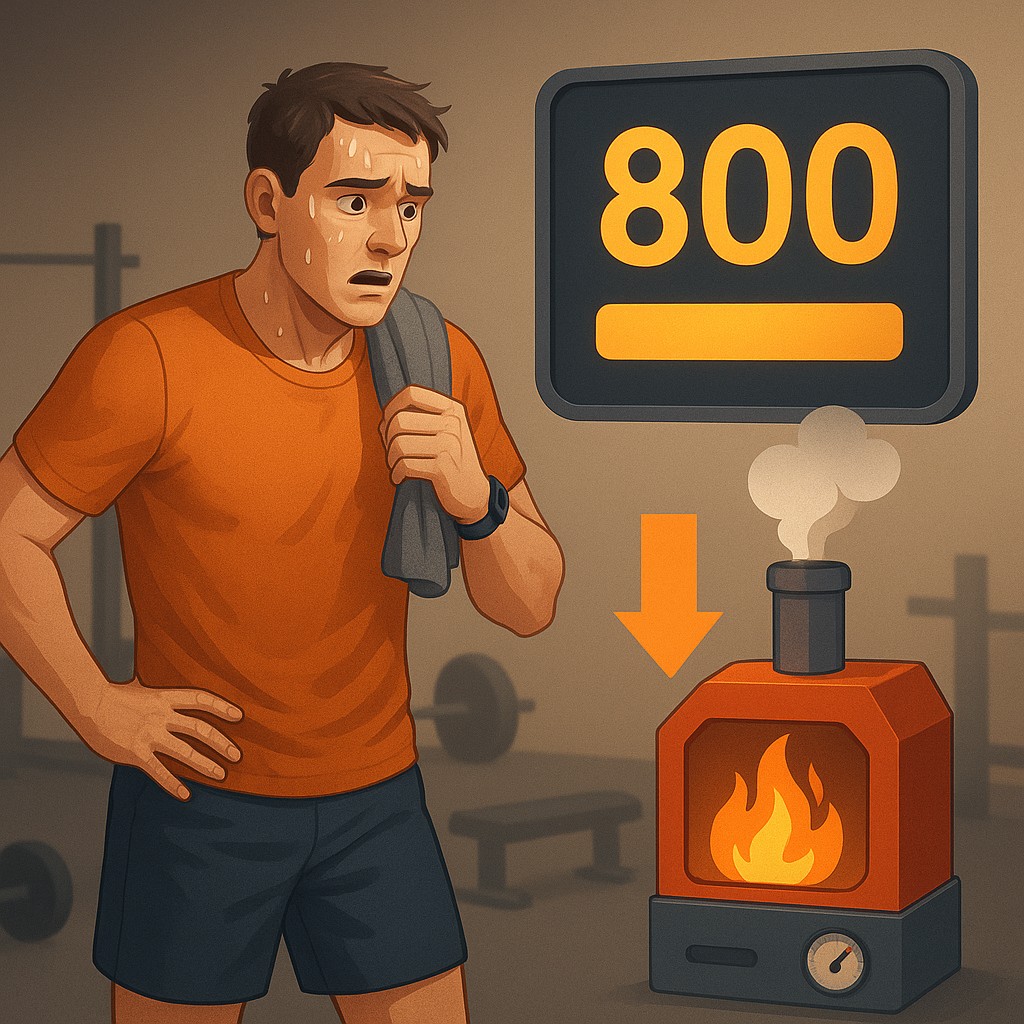
Imagine you have just finished the most grueling workout of your life. Your heart is pounding, your clothes are soaked through, and your fitness tracker flashes a satisfying number: 800 calories burned in sixty minutes. Walking out of the gym, you feel like a human furnace, convinced your body will be melting fat at a high rate for the rest of the day. You might even treat yourself to a large lunch, reasoning that you earned the extra fuel through sheer grit and sweat. It is a logical assumption, based on the idea that our bodies work like simple steam engines where more coal always equals more fire.
However, as the afternoon rolls on, something subtle begins to change. You find yourself taking the elevator instead of the stairs without even thinking about it. While sitting at your desk, the nervous foot-tapping that usually accompanies your work mysteriously vanishes. You realize you have been staring at your computer screen in a daze for twenty minutes, moving as little as possible. This is not just laziness or a lack of willpower. It is your biology launching a clever counter-offensive. Your brain has detected a massive withdrawal from your energy bank and is now frantically closing every other department to balance the books.
The Myth of the Open Furnace
Most of us grew up believing in the additive model of energy use. In this traditional view, your body has a "basal" metabolic rate to keep your heart beating and organs functioning, and every bit of movement you do simply piles on top of that base. If you burn 2,000 calories just existing and then burn 500 at the gym, the math should result in a clean 2,500. Under this model, the body is an open furnace where you can keep tossing in logs of activity to make the fire hotter indefinitely. This perspective drives the multi-billion dollar fitness industry, promising that if we just push harder, we can hit any caloric target we desire.
Recent research suggests this math is fundamentally flawed. Instead of an open furnace, our bodies behave more like a strictly managed corporate budget. This concept, known as the Constrained Total Energy Expenditure model, suggests that the body has a hidden "ceiling" for how many calories it is willing to spend in a day. When you spend a massive amount on a high-intensity workout, the body does not just accept the loss. It looks elsewhere in the budget, cutting back on "discretionary" spending like fidgeting, posture maintenance, and even immune function to keep total daily spending within a narrow, safe range.
This evolutionary safeguard exists because our ancestors did not have the luxury of a post-workout protein shake. For most of human history, calories were scarce and physical effort was a requirement for survival, not a hobby. If a hunter-gatherer spent 1,000 calories chasing a gazelle, their body had to ensure they did not burn through their entire fat store before the next successful hunt. We have inherited a physical system that treats exercise not as a way to lose weight, but as a signal to go into "saving mode" for the rest of the day. This is why many people find that despite hitting the gym more often, their weight remains stuck at a plateau.
The Invisible Levers of Daily Burn
To understand how the body "cheats" us out of our hard-earned calorie deficit, we have to look at Non-Exercise Activity Thermogenesis, or NEAT. This term covers every movement we make that isn't intentional exercise: walking to the mailbox, gesturing while speaking, standing up to stretch, or even keeping enough tension in our neck muscles to hold our heads up. While these movements seem trivial, they can account for a massive portion of our daily energy use, sometimes as much as 15 to 30 percent of our total daily burn.
When you finish a high-intensity workout, your body subconsciously pulls the lever on NEAT to compensate for the sudden energy spike. This is the "rebound effect" in action. You might feel "wiped out" and choose to sit for four hours in the evening instead of your usual routine of tidying the house or walking the dog. Even more sneakily, your body might lower its core temperature slightly or slow your heart rate during sleep to shave off a few dozen calories here and there. By the time midnight rolls around, the 800-calorie "win" from the gym might have been eroded by 600 calories of subconscious inactivity.
| Expenditure Component |
Additive Model View |
Constrained Model (Reality) |
| Basal Metabolic Rate |
Stays the same regardless of exercise |
Can decrease to offset high activity |
| Exercise Calories |
Added directly to the daily total |
"Crowds out" other calorie burning |
| NEAT (Fidgeting/Walking) |
Stays consistent |
Decreases noticeably after hard workouts |
| Total Daily Burn |
Increases steadily with more gym time |
Levels off even as exercise intensity rises |
| Long-term Result |
Consistent weight loss |
Metabolic adjustment and weight plateaus |
The Evolutionary Survival Brake
The reason this happens is deeply rooted in our biology, specifically in a phenomenon called metabolic adaptation. In a fascinating study of the Hadza people, a modern hunter-gatherer society in Tanzania, researchers expected to find that these highly active individuals burned significantly more calories than sedentary Westerners. To their surprise, they found that even though the Hadza walk miles every day and do heavy labor, their total daily energy expenditure was nearly identical to that of an office worker in the United States. Their bodies had simply become incredibly efficient, cutting back on internal "overhead" costs to accommodate their high activity levels.
This suggests that our bodies have a "set point" for energy use. When we try to kick the doors down with high-intensity exercise, the brain's hypothalamus acts like a thermostat, turning down the heat in other rooms. For those trying to shed weight, this is a frustrating reality. The harder you push the "exercise" button, the harder the body pushes the "rest" button. This is why you often see "weekend warriors" who spend three hours on a bike on Saturday but spend the rest of the weekend practically glued to the couch, wondering why they aren't reaching their goals.
Furthermore, intense exercise can trigger hormonal shifts that increase appetite. Not only is your body trying to spend less, but it is also screaming at you to eat more. The combination of decreased NEAT and increased hunger creates a "perfect storm" that often cancels out the benefits of a workout. This is not to say that high-intensity exercise is bad for you, it is excellent for heart health, muscle strength, and mental clarity, but it is an incredibly inefficient tool if your primary goal is simply manipulating the calorie balance.
Strategies for a Cooperative Metabolism
If the body is designed to compensate for high-intensity bursts, the solution is not to stop moving, but to move differently. The most effective way to "trick" the metabolism into staying high is to focus on low-intensity, frequent movement that doesn't trigger the body's survival alarm. Low-intensity activities, like leisurely walking or standing at a desk, don't register as "emergencies" to the brain. Because they don't cause the massive energy spikes associated with sprinting or heavy lifting, the body is less likely to respond by shutting down NEAT later in the day.
Consistency is more powerful than intensity when it comes to the metabolic budget. A person who walks 12,000 steps evenly throughout the day often burns more total calories than someone who sits for eight hours and then does a brutal 45-minute spin class. The reason is that the walker stays in a steady state of energy use, never triggering the massive compensations that follow extreme exhaustion. By keeping the activity level moderate, you prevent the subconscious lethargy that follows a "rebound" workout.
To avoid the rebound effect, it helps to rethink the structure of your day. Instead of viewing movement as a single "event" at the gym, view it as a background process. If you do enjoy high-intensity workouts, the key is to stay aware of your behavior in the hours after the session. Intentionally staying on your feet, avoiding the temptation to lounge for hours, and maintaining a normal level of light activity can help preserve the calorie deficit you created. You essentially have to manually override your body's "power-save" mode.
Redefining the Purpose of the Gym
We must shift our perspective away from the idea that the gym is a place to "earn" food or "burn" fat through suffering. If we rely on exercise as our primary weight-loss tool, we are fighting a losing battle against millions of years of evolution. Instead, we should view high-intensity exercise as a way to build a more resilient "machine." Lifting weights and running intervals builds muscle, improves how the body handles sugar, and strengthens the heart. These are foundational health benefits that make your body more efficient and capable, even if they don't result in the massive calorie burn that machines claim.
When you stop treating the gym as a calorie furnace, you free yourself from the cycle of exhaustion and compensation. You start to listen to your body's signals of genuine fatigue versus the subconscious "slumping" that follows a workout. You begin to value the 10-minute walk after dinner as much as the 10-minute sprint on the treadmill, perhaps even more so because the walk doesn't leave you in a metabolic coma for the rest of the evening.
The "rebound effect" isn't a flaw in your biology, it is a masterpiece of survival engineering. It is your body's way of saying it wants to keep you alive and functioning no matter how much stress you put on it. By understanding this "managed budget" approach to energy, you can stop fighting your biology and start working with it. Focus on keeping your "baseline" activity high, treat intense exercise as a tool for strength and health, and remember that when it comes to the complex math of metabolism, sometimes doing less at once actually results in doing more in the long run.
Embrace the reality that your body is a brilliant guardian of its own resources. Instead of trying to bankrupt your energy stores with a single hour of agony, aim to be a person who simply lives an active life. By spreading your movement throughout the day and respecting your body's need for balance, you can bypass the metabolic brakes and find a sustainable, energized way to reach your goals. You are not a simple machine, but a complex, adaptive system, and once you learn the rules of that system, you can finally stop spinning your wheels and start moving forward.