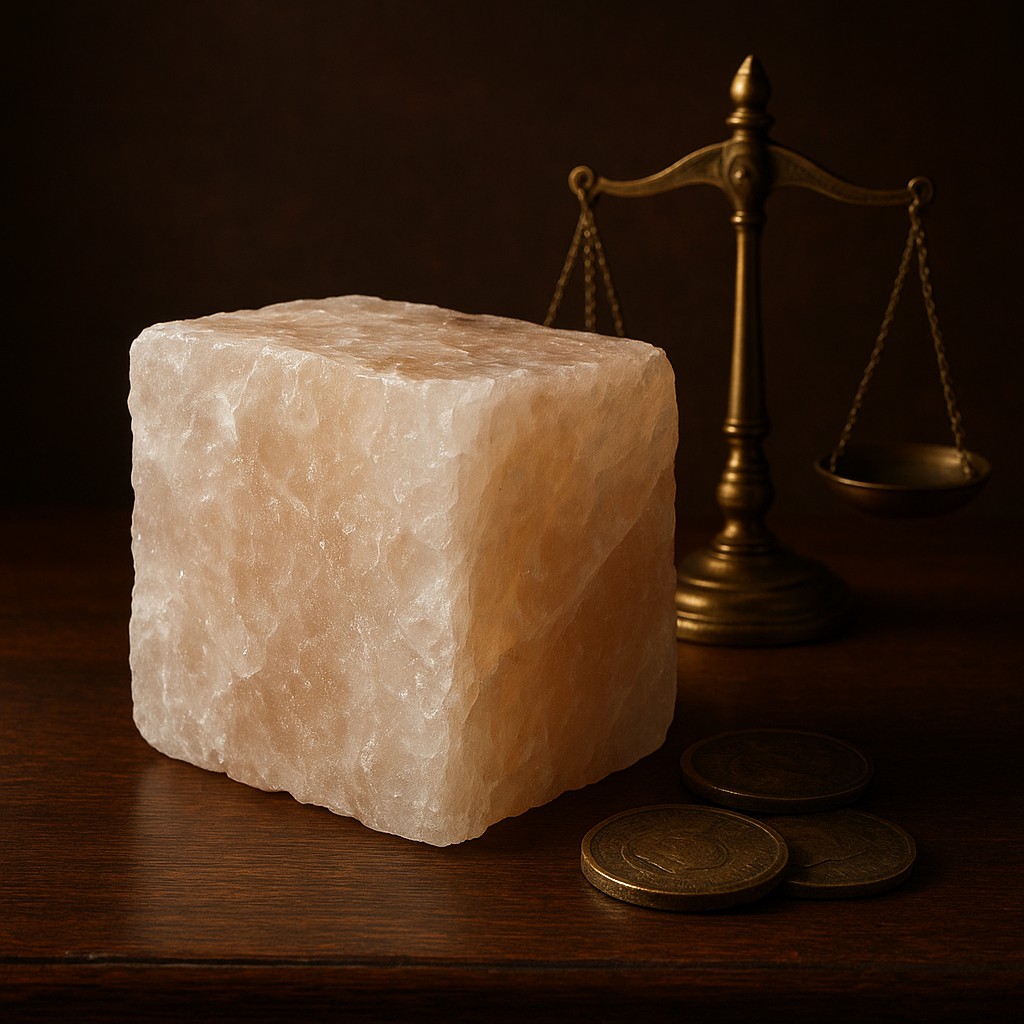
Imagine walking into a high-end electronics store today to pick out the latest smartphone. Instead of tapping a plastic card or scanning a QR code, you heave a heavy, crystalline slab of rock salt onto the counter. While a modern cashier would likely call security, your ancestors in ancient Rome or Ethiopia would have simply checked the block’s weight and purity before handing over your goods. For thousands of years, salt was not just a seasoning kept in a kitchen cabinet; it was a high-stakes financial tool. It was the "lithic bitcoin" of its era - a substance so vital to survival that it bridged the gap between a simple commodity and a sophisticated form of money.
The shift from bartering sheep for grain to using standardized currency is often described as a move toward abstract ideas. However, salt reminds us that money must first solve a very physical problem. Before refrigeration, the ability to store food was the difference between life and death. Salt was the magical mineral that stopped rot, allowing armies to march, sailors to cross oceans, and cities to survive long winters. Because everyone needed it, everyone accepted it as payment. To understand how salt functioned as money is to understand the very DNA of value, scarcity, and the global financial systems we use today.
The Chemistry of Universal Desire
To work as money, an object needs to be more than just valuable; it needs to be practical. Economists generally agree that for something to be "good" money, it must be portable, easy to divide, durable, and scarce. Interestingly, salt checked almost all of these boxes in the pre-industrial world. While we might think of it as fragile because it dissolves in water, it is remarkably tough in its rock form. A block of salt can sit in a dry warehouse for decades without rotting, rusting, or losing its chemical strength. This longevity allowed ancient societies to use it as a "store of value" - a way to save the results of today’s hard work for use five years down the road.
Divisibility was another secret weapon of the salt trade. Unlike a cow, which is difficult to "spend" in small amounts without killing it, salt can be chipped away. In Ethiopia, traditional "amole" salt blocks were carved into standard rectangular shapes. If you wanted to buy something cheaper than a whole block, you could literally break off a piece. This granular nature allowed for a precise pricing system that made daily business easy. Whether you were paying a tax to a king or buying a handful of olives at a market, salt provided a scale of measurement that worked across vast distances.
The chemistry of salt also provided a built-in security feature against fakes. Today, governments use holograms and watermarks to stop counterfeiting, but the salt currency of the past relied on the fact that salt is a specific chemical compound. You cannot simply "make" salt in a backyard shed without a brine spring or a mine. If a merchant tried to pass off a block of carved limestone as salt, a quick lick would immediately reveal the fraud. This natural authenticity made it a trusted medium of exchange long before the first coins were ever struck from gold or silver.
From Roman Pay to Ethiopian Salt Bars
The history of salt money is hidden in the very language we speak. The word "salary" famously comes from the Latin salarium, which was the allowance given to Roman soldiers specifically to buy salt. While historians debate whether soldiers were paid directly in bags of salt or given coins to purchase it, the linguistic link shows how central the mineral was to the Roman economy. The Roman state even controlled the price of salt, making sure it stayed affordable for the public while using its distribution as a political tool. By controlling the salt pans along the Tiber River, the early Roman Republic controlled the flow of "cash" throughout its territory.
In sub-Saharan Africa, the salt trade was even more structural. In the ancient empires of Ghana and Mali, salt was often traded for gold at an equal weight. To us, this sounds like a terrible deal, but to a merchant in the blistering heat of the Sahel desert, gold was just a decorative metal, while salt was a life-preserving necessity. The "Trans-Saharan trade" acted like a giant mechanical lung: breathing salt from the northern mines of Taoudenni down into the heart of the continent, and exhaling gold and ivory back toward the Mediterranean. Salt was so precious that it was moved in massive caravans of thousands of camels, each carrying the equivalent of several thousand dollars in modern purchasing power.
In Ethiopia, the use of salt as money lasted much longer than in the West, continuing well into the 20th century. The "amole" salt bars were the official currency, used to pay for everything from wedding dowries to legal fines. These bars were carefully wrapped in plant fibers to protect the edges, because a chipped block would lose value just like a torn banknote does today. This is a fascinating example of how a society can maintain a stable economy using a natural resource, as long as the supply of that resource is hard to increase suddenly.
The Brutal Logic of Scarcity
The eventual downfall of salt as a currency serves as a warning for modern central banks and cryptocurrency fans alike. Money only stays "hard" (valuable) if the cost of producing more of it remains high. For centuries, harvesting salt was a grueling, labor-intensive process involving solar evaporation or dangerous underground mining. This high "cost of production" acted as a natural brake on inflation. If a king wanted more money, he couldn't just print it; he had to find another salt mine and hundreds of laborers to work it. This kept the amount of salt in circulation relatively stable.
However, the Industrial Revolution broke this balance. With the arrival of geological surveys, steam-powered drills, and massive processing plants, the ability to extract salt exploded. What was once a rare treasure became a cheap industrial byproduct. As the markets were flooded with salt, its value compared to other goods crashed. This is a process known as "debasement." When a currency becomes easy to produce, it stops being a reliable way to store wealth because tomorrow’s supply will always be larger and cheaper than today’s.
This shift highlights the difference between "soft" money and "hard" money. Salt was hard money for a thousand years because it was hard to get. Once it became easy to find, it turned into "soft" money and was quickly abandoned for gold and silver, which remained difficult to mine even with industrial tools. This pattern of moving toward "harder" assets is a recurring theme in human history. We are always looking for an item that is difficult to fake or mass-produce, ensuring our hard work today won't be made worthless by someone else’s easy production tomorrow.
| Feature of Money |
Salt (Ancient Context) |
Gold (Historical Standard) |
Digital Currency (Modern) |
| Durability |
High in dry areas; low in rain. |
Extremely high; never rusts. |
High (stored as data). |
| Portability |
Moderate; heavy for its value. |
High; very valuable for its weight. |
Near-infinite; moves instantly. |
| Physical Use |
Essential for health and food. |
Limited (jewelry, electronics). |
None (purely computer code). |
| Inflation Resistance |
High until industrial mining. |
High due to geological rarity. |
High (if limited by code). |
| Divisibility |
High; can be ground into powder. |
Moderate; requires melting. |
Infinite; can use tiny decimals. |
The Social Cost of Salt Economics
While salt money was a brilliant solution for trade, it had dark social consequences. Because salt is a physical necessity for life, whoever controlled the mines held absolute power over the people. In ancient China, the salt monopoly was one of the government's most effective ways to collect money. By taxing salt, the state was essentially taxing human biology. You could choose not to buy luxury fabrics, but you could not choose to stop eating salt. This made salt "money" an unavoidable tax and, sometimes, a reason for revolution.
Relying on salt also created strange geographic dependencies. Regions without salt deposits were forced to build complex trade routes and diplomatic ties with distant, often hostile, powers just to survive. This meant that having plenty of gold or fertile land didn't matter if you didn't have the salt to preserve your harvest. The economic history of salt is a history of war and fortresses. The Great Wall of China and various Roman forts were often built specifically to protect the flow of salt, proving that our ancestors guarded their "money" as fiercely as we guard our bank servers today.
Interestingly, salt currency had a unique "disappearing" treasury. Unlike gold, which stays in circulation almost forever, salt currency was eventually eaten. This created a constant, natural demand that kept the wheels of trade turning. Every time someone seasoned a piece of meat with their "money," they were removing that currency from circulation. This helped balance out the new salt being mined. It was a self-regulating system that tied the economy directly to the physical needs of the people.
Redefining Value Today
Looking back at the salt caravans of the Sahara or the Roman legions counting their crystalline pay, we see a reflection of our own economic struggles. Today, we argue over whether digital entries or pieces of paper are "real" money. The lesson of salt is that value is subjective; it is found where usefulness meets scarcity. If people believe an object is necessary and know it cannot be easily copied, they will treat it as money, whether it is a rock, a metal, or a string of code.
The story of salt reminds us that the "form" of money always reflects a civilization’s technology. Salt was perfect for an era of regional trade. Gold was perfect for an era of global exploration. Today, digital assets are becoming the money of a connected, computerized world. However, the basic goal remains the same: we are all looking for a way to capture the energy of our work and store it in something that won’t rot, won't be stolen, and won't be made worthless by a sudden oversupply.
The next time you see a salt shaker on a restaurant table, don't just see a condiment. See a relic of a time when that white powder moved empires and paid the world's soldiers. Understanding our past with salt helps us navigate the future of finance, reminding us that money is, and always has been, a tool for human survival.