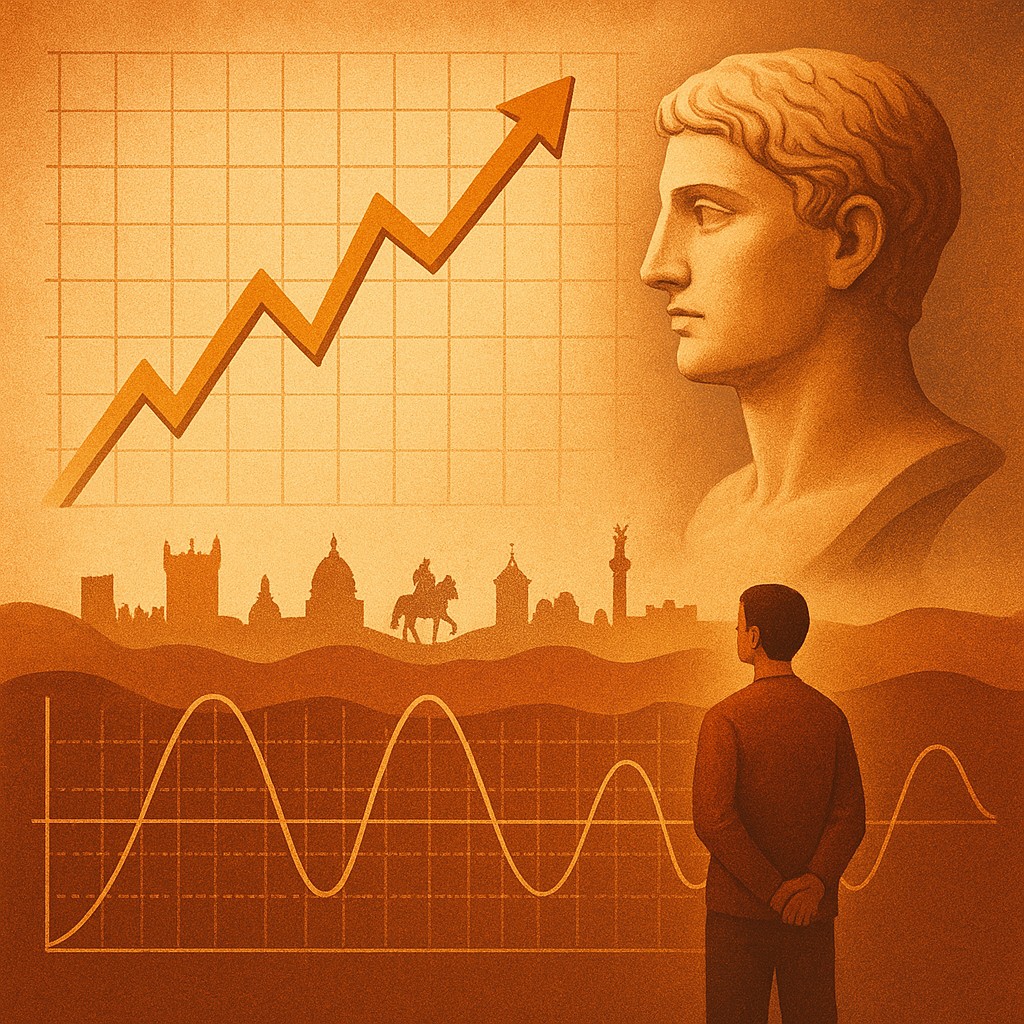
We often imagine history as a chaotic string of accidents - a messy tapestry woven by the whims of kings, eccentric inventors, and the occasional strategic blunder. In this traditional view, the rise and fall of civilizations are as unpredictable as a coin toss, driven entirely by the unique choices of individuals. We watch the news and feel the tremors of social unrest, wondering if we are just living through a streak of bad luck or if there is a deeper, invisible logic at play. It is easy to feel like we are trapped inside a car careening down a mountain road with no one at the wheel. But what if the road itself was mapped out centuries ago?
A growing field of research known as cliodynamics is challenging our perception of the past. It treats human history not as a collection of stories, but as a complex physical system. By applying the rigorous language of mathematics and the power of big data to historical records, researchers are discovering that societies behave much like weather systems or ecosystems. They are prone to cycles, pressures, and tipping points that can be identified long before a crisis hits. Instead of guessing what a specific leader might do next, cliodynamicists look at the structural forces - like economic inequality and competition among the wealthy - that hem those leaders in and determine the statistical probability of a breakdown.
Beyond the Great Man and Toward the System
For a long time, the dominant way to teach history was through the lens of individuals. We learned about the brilliance of Napoleon, the determination of Lincoln, or the madness of Nero. This approach assumes that if you swapped one person for another, the entire trajectory of the world would change. Cliodynamics, named after Clio, the Greek muse of history, flips this script entirely. It suggests that while individuals certainly matter in the short term, the long term is governed by massive, slow-moving gears that grind away beneath the surface of culture. It is a shift from biological storytelling to a "mechanics-first" view of how we live together.
Think of a forest fire. To understand why a fire started, you could look at the specific spark - perhaps someone dropped a match or a lightning bolt hit a tree. That is how traditional history often operates. But cliodynamics is more interested in why the forest was dry enough to burn in the first place. It looks at the accumulation of dead wood, the lack of rainfall, and the density of the trees. If the conditions are right, a fire is almost inevitable; if you do not get a spark from a match, you will eventually get one from a cigarette or a sunbeam. By measuring the "fuel" of social instability, scientists can estimate when a society is entering a high-risk season.
This systemic view allows us to move away from the noise of the daily news cycle. While a specific protest or a controversial law might dominate the headlines, cliodynamics treats these as symptoms rather than causes. The real work happens in the data, tracing how resources flow through a population and how much pressure a government can withstand before its foundations begin to crack. It is a sobering but deeply empowering way to view our world. It suggests that if we can model these pressures, we might eventually learn how to vent them safely.
The Pillars of Social Pressure
To build a mathematical model of a society, you need to identify the variables that actually drive change. Researchers have distilled these into a framework often called Structural-Demographic Theory. This theory focuses on three main actors: the general population, the elites, and the state. When these three groups are in balance, a society tends to be stable. When they fall out of alignment, the risk of a "societal blowup" increases significantly. It is not a matter of if a crisis will happen, but when the mathematical pressure becomes too great for the structure to hold.
The first major variable is the well-being of the common citizen. When wages are high relative to the cost of living and people feel they can support their families, the "social glue" is strong. However, when the standard of living stagnates or drops while the overall economy grows, wealth begins to concentrate at the top. This creates a "wealth pump" that effectively transfers resources from the many to the few. As the general population becomes more stressed and desperate, the legitimacy of the government begins to erode, creating fertile ground for radical ideas and movements.
The second variable, and perhaps the most counterintuitive, is elite overproduction. In this context, "elites" refers to the segment of society that holds power, wealth, or advanced degrees. As a society becomes wealthier, it produces more and more people who expect to hold high-status positions in government, law, or business. However, the number of top-tier positions is usually fixed. You only have one president, a set number of legislative seats, and a limited number of CEO roles. When too many aspirants chase too few spots, the elites begin to turn on each other. This leads to intense polarization and internal conflict as they compete for dominance.
| Factor |
Stable State |
Unstable State |
| Popular Well-being |
Rising real wages and high social mobility |
Declining real wages and stagnant mobility |
| Elite Competition |
Cooperation and shared norms among leaders |
Elite overproduction and fierce factionalism |
| State Capacity |
Balanced budgets and high public trust |
Massive debt and crumbling institutional trust |
| Social Sentiment |
General consensus on national direction |
Deep polarization and radicalization |
The Mathematics of the Wealth Pump
When we talk about the "wealth pump" in cliodynamics, we are describing a mathematical feedback loop. In many historical cases, such as the period leading up to the French Revolution or the American Civil War, we see a specific pattern. Population growth leads to an oversupply of labor, which naturally drives down wages. At the same time, the cost of land and basic goods tends to rise. This is great for the people who already own land and capital; they get richer very quickly. But for the average worker, the slice of the economic pie gets smaller and smaller.
This isn't just an economic problem; it is a structural one. As the wealthy get wealthier, they often use their influence to ensure the state keeps policies in place that favor them, such as lower taxes on capital or deregulation. This starves the government of the revenue it needs to maintain infrastructure and social services. Eventually, the state faces a fiscal crisis. It is forced to choose between raising taxes on the elites, who have the power to resist, or cutting services for the commoners, who have the numbers to revolt. This creates a "vicious cycle" where every attempt to fix the problem seems to make it worse for one of the powerful groups involved.
The data for these patterns comes from sources like the Seshat Global History Databank, which catalogs thousands of facts from hundreds of societies over the last 10,000 years. By looking at these historical "dry runs," mathematicians can see how frequently the combination of elite overproduction and fiscal distress leads to a collapse. The results are startlingly consistent. Whether it is the Roman Empire or the Qing Dynasty, the math of instability looks remarkably similar. The specific players and the technology change, but the underlying arithmetic of social friction remains constant.
Why Prediction Is Not Prophecy
One of the biggest misconceptions about cliodynamics is that it is a crystal ball. People often ask, "If this is so scientific, tell me exactly when the next revolution will start." But that is not how complex systems work. Think back to the weather forecast. A meteorologist can tell you there is an 80 percent chance of rain tomorrow because the atmospheric pressure is low and a moist air mass is moving in. They cannot, however, tell you exactly where the third raindrop will land on your windshield. Cliodynamics provides a "structural forecast" rather than a precise prediction of events.
This distinction is vital because human agency still exists within the system. While structural pressures might make a crisis likely, the way a society responds to that crisis can vary. A wise government might see the "weather report" and decide to invest in social safety nets or reform tax codes to reduce elite competition. By doing so, they are effectively releasing the pressure before the boiler explodes. Cliodynamics doesn't say that we are doomed; it says that we are currently in a high-pressure environment where the probability of "spark" events causing a massive fire is much higher than usual.
Furthermore, we must account for the "observer effect." If a society becomes aware of its own structural weaknesses through this kind of analysis, it might change its behavior to avoid the predicted outcome. This makes historical modeling different from physics. A planet doesn't care if you predict its orbit, but a human society might react to a forecast of instability. This feedback loop between the model and the people in it is something researchers are still grappling with, but it offers a glimmer of hope. If we can see the patterns, we are no longer just victims of them.
The Role of Elite Overproduction in Modern Times
If we look at the modern era through the lens of cliodynamics, the concept of elite overproduction becomes particularly illuminating. In many developed nations, we have seen a massive surge in the number of people obtaining advanced degrees and seeking influential roles. While an educated population is generally a good thing, a structural problem arises when the economy and political system cannot absorb these highly ambitious individuals into the ranks of the established elite. These "surplus" elites do not just disappear; they often become "counter-elites."
Counter-elites are people with the skills, connections, and education to lead, but who feel shut out of the current system. They are often the ones who provide the leadership and intellectual framework for revolutionary movements or radical political shifts. When you pair a frustrated, underpaid general population with a highly capable group of counter-elites who feel the system is rigged against them, you have the classic ingredients for intense social turbulence. This is the mechanism that transforms a quiet period of history into a "secular cycle" of upheaval.
It is also important to note that this is not a partisan issue. Elite overproduction happens across the political spectrum. It isn't about whether the ideas being promoted are right or wrong; it is about the fact that there are too many people fighting for a limited amount of social power. This internal competition often manifests as extreme polarization. If you cannot win through the standard rules of the game because there are too many players, you are more likely to try and change the rules entirely, or even flip the board.
Building a More Resilient Future
The ultimate goal of cliodynamics isn't just to watch the world burn and record the temperature; it is to provide a framework for building more resilient societies. By understanding the stress points in our social structures, we can start to have more honest conversations about how to fix them. Instead of shouting about which political figure we dislike the most, we could focus on the underlying math. How do we ensure that the "wealth pump" doesn't create a permanent underclass? How do we create enough meaningful paths for ambitious people so they don't feel the need to tear down institutions?
Resilience often comes from flexibility. Historically, the societies that survived long periods of structural pressure were those capable of "top-down" reform. This involves the existing elites recognizing that their long-term survival depends on making concessions to the rest of the population. It is a difficult pill to swallow, as it usually requires giving up some wealth or power in the short term to avoid losing everything in a systemic collapse. However, the data shows that this is the most effective way to "reset" the cycle without violence or total state failure.
As we move into an era of rapid technological change and shifting global dynamics, the tools of cliodynamics will likely become even more essential. We are living through a period where data is more abundant than ever, allowing these models to become increasingly sophisticated. While we may never be able to predict the future with 100 percent certainty, we can certainly get better at reading the room. If we treat our civilization as the precious, complex system that it is, we might just find the wisdom to keep the gears turning smoothly for generations to come.
Learning about cliodynamics shifts your entire worldview from one of reactive anxiety to one of proactive observation. It allows you to look at the chaos of the morning news and see the ghost of the Roman Republic or the echoes of the French Revolution - not as a reason for despair, but as a reminder that we are part of a grand, measurable process. By understanding the invisible forces of economic pressure, elite competition, and institutional capacity, you gain the "superpower" of historical perspective. This knowledge empowers you to look past the surface noise and focus on the deep, structural changes that actually determine our collective destiny. This, in turn, makes you a more informed, calm, and strategic participant in the unfolding story of humanity.