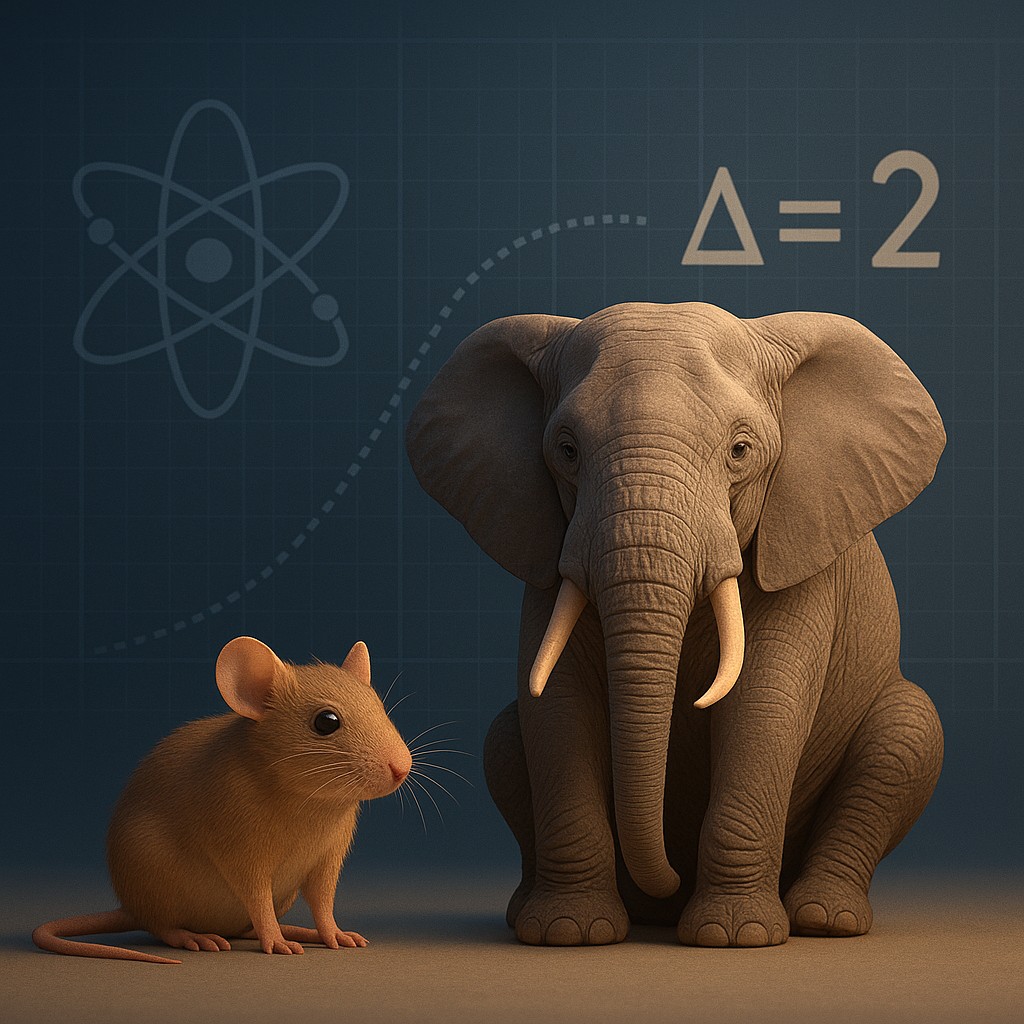
Imagine a mouse and an elephant sitting side by side. On the surface, they are simply different versions of the same biological blueprint: mammals with four limbs, warm blood, and beating hearts. Yet, if you were to swap their lifestyles, both would be dead in minutes. The mouse lives at a feverish intensity, its heart rattling against its ribs like a trapped bird, while the elephant moves with a slow, heavy grace. It feels natural to think that an elephant, being roughly 200,000 times heavier than a mouse, would need 200,000 times more energy to stay alive. However, biology does not work in a straight line. If an elephant actually burned energy as fast as a mouse, it would effectively cook itself from the inside out, reaching internal temperatures high enough to melt its own organs.
Nature follows a hidden set of rules that govern how life scales up. These rules, known as metabolic scaling laws, dictate that as organisms get larger, they become much more efficient. It is a strange mathematical reality where growing bigger allows a creature to do much more with much less. This efficiency does not just change how much an animal eats; it changes how that animal experiences time itself. While we measure our lives in years and months, biology measures life in heartbeats and energy cycles. When seen this way, a mouse’s three-year life and an elephant’s seventy-year life are actually quite similar, because they are both granted roughly the same number of heartbeats to spend before their biological clocks run out.
The Mathematical Mastery of Kleiber’s Law
In the 1930s, an agricultural scientist named Max Kleiber spent much of his time measuring exactly how much oxygen different animals consumed. He was looking for the fundamental link between an animal's weight and its basal metabolic rate, which is the amount of energy it burns while doing absolutely nothing. At the time, conventional wisdom suggested that metabolic rate should grow at the same rate as skin surface area. Since heat escapes through the skin, scientists assumed the energy needed to stay warm would be proportional to the square of an animal's size. Kleiber, however, discovered something far more elegant. He found that the metabolic rate scales to the power of 0.75, or 3/4, of an animal's mass.
This 3/4 power scaling, now called Kleiber’s Law, is the universal ledger of life. It tells us that for every 100 percent increase in body mass, an organism only needs about 75 percent more energy. To put this in perspective, if you double the size of a creature, you don't double its food requirements; you only need about 1.75 times as much fuel. This "sub-linear scaling" means that larger organisms are essentially the most energy-efficient machines on the planet. A single pound of elephant tissue requires significantly less energy to maintain than a single pound of mouse tissue. This law holds true across nearly every form of life, from the smallest bacteria to the massive blue whale.
This efficiency explains why a mouse must eat nearly its own body weight in food every single day just to avoid starving, while an elephant can survive on a tiny fraction of its weight. If a mouse stops moving and eating for even a few hours, its internal furnace can flicker out. The elephant, on the other hand, possesses a biological momentum that allows it to operate at a much more leisurely pace. This mathematical reality changes how we understand nature. It explains why large predators are rare compared to small ones, and why a forest floor is teeming with hyperactive rodents while the giants of the animal kingdom are few and far between.
The Surface Area Dilemma and Thermal Inertia
To understand why this scaling happens, we have to look at the relationship between volume and surface area. Imagine a small wooden cube. If you double the length of one side, you increase the surface area four times, but you increase the volume eight times. As an object grows, its "inside" grows much faster than its "outside." For a mammal, this is a life-or-death problem. We generate heat throughout the entire volume of our bodies, but we lose that heat through the surface area of our skin. Small animals have a massive amount of skin compared to their tiny volume. They are essentially leaky buckets of heat, constantly losing warmth to the air.
Because small animals lose heat so rapidly, they must maintain an incredibly high metabolic rate to keep their core temperature stable. This is why a hummingbird’s heart beats 1,200 times per minute and why a shrew must eat every few hours or die. They are ruled by the limits of their skin. As animals get larger, they gain "thermal inertia," or the ability to hold onto heat. An elephant has a vast internal volume that stores warmth, and relatively very little surface area from which that heat can escape. In fact, large animals often have the opposite problem: they struggle to cool down. This is why elephants have developed massive, thin ears that act as radiators, providing extra surface area to dump the heat generated by their enormous bodies.
This ratio also affects how nutrients and oxygen move through the body. In a small organism, the distance from the lungs to the furthest cell is tiny. In a large animal, that distance can be several yards long. To solve this, nature uses networks that look like branching trees, such as our blood vessels and the air tubes in our lungs. These networks are built to pack as much surface area as possible into a fixed space, ensuring that every cell receives the resources it needs. Many scientists believe the physics of these plumbing systems is what leads directly to the 3/4 power law, as these branching pipes must follow strict geometric rules to move fluids with the least amount of effort.
The Universal Currency of Heartbeats
One of the most poetic results of metabolic scaling is the "constant heartbeat" theory. If you look at the resting heart rate of a mouse (about 600 beats per minute) and compare it to its lifespan (about 2 years), you can calculate the total number of times its heart will beat in a lifetime. If you do the same for a whale or a giraffe, a startling pattern emerges. Despite the massive differences in their sizes and lifespans, almost every mammal experiences roughly 1.5 billion heartbeats before it dies. We can think of this as a biological bank account; nature gives every species a similar starting balance, but some spend it at a frantic pace while others draw it out slowly over decades.
This suggests that time is not a fixed constant in biology, but is relative to the speed of your metabolism. From the perspective of a mouse, a single second might feel much longer than it does to us, because so much more "biological work" is happening in that second. Their neurons fire faster, their lungs cycle quicker, and their cells process energy at breakneck speed. To a mouse, an elephant might look like a slow-motion statue, moving through a world where time has practically stood still. To an elephant, the mouse is a blur of frantic energy, living out an entire dynasty in the time it takes the elephant to reach adulthood.
| Animal |
Average Weight |
Heart Rate (BPM) |
Lifespan (Years) |
Total Lifetime Heartbeats |
| Mouse |
25 grams |
600 |
2 |
~630 million |
| Cat |
4 kilograms |
150 |
15 |
~1.1 billion |
| Human |
70 kilograms |
70 |
80 |
~2.9 billion |
| Horse |
500 kilograms |
40 |
30 |
~630 million |
| Elephant |
5,000 kilograms |
30 |
70 |
~1.1 billion |
While humans appear to be an outlier in this table, living much longer than our metabolism would suggest, this is largely due to modern medicine, stable food supplies, and our unique evolutionary path. However, even for us, the trend is clear: there is a tight link between how fast we burn energy and how long our biological machinery can last. The larger the organism, the slower its internal clock ticks, allowing it to stretch its 1.5 billion heartbeats over a much longer period.
The Strict Limits of Being Small or Large
Metabolic scaling laws don't just explain why animals look the way they do; they also set the "no-go zones" for biology. There is a hard lower limit on how small a mammal can be. If a mammal were much smaller than the tiniest shrew (about 1.8 grams), it would lose heat so fast that it could not physically eat enough to stay warm. It would be a biological impossibility-a creature that burns fuel faster than it can be swallowed. This is why the smallest warm-blooded animals, like the Etruscan shrew or the bumblebee bat, must spend nearly every waking hour hunting for high-calorie food.
At the other end of the scale, there is a limit to how large a land animal can grow. As an animal gets bigger, its weight increases much faster than the strength of its bones. This is known as the "square-cube law." If you took an elephant and scaled it up to ten times its size, its legs would snap under its own weight because its mass would have increased 1,000 times while its bone strength only increased 100 times. Furthermore, the heat generated by such a massive creature would be impossible to get rid of without impossibly large ears or a way to drastically slow down its cellular energy use.
The blue whale only escapes these limits by living in the ocean. The water supports its massive weight, removing the need for legs to carry the load, and the cold water acts as a "heat sink" to soak up the immense warmth generated by its house-sized heart. Even so, the whale must still obey Kleiber’s Law. Its heart beats as slowly as 2 to 10 times per minute when diving. It is the ultimate example of the "slow road" of biology, a creature so massive and efficient that it moves with the confidence of a mountain, even as its heart slowly counts out its final billionth beat.
The Evolutionary Gamble: Speed vs. Stability
We often view evolution as a race to be the "best," but scaling laws show us that it is actually a series of trade-offs between speed and stability. The "mouse strategy" is one of high-speed risk. By living fast and burning energy quickly, small animals can reproduce at a staggering rate. A mouse can have dozens of babies in a single year, allowing the species to adapt quickly to new environments through sheer numbers. They spend their energy in a frantic burst, prioritizing the survival of the species over the life of the individual. They are the drag racers of the animal kingdom, built for acceleration.
Large animals, like elephants or whales, use a "stability strategy." Because they live longer and burn energy more slowly, they invest heavily in the survival of the individual. They have fewer offspring and spend years raising them. They are the freight trains of the world: slow to start, hard to stop, and incredibly efficient over long distances. Their survival depends on their ability to withstand droughts or food shortages that would instantly kill a mouse. Their large mass acts as a fuel and heat battery, protecting them from the whims of nature. This is why, after major disasters, it is often the small, fast-living animals that survive, while the slow-moving giants find themselves unable to adapt to a collapsing environment.
The beauty of Kleiber’s Law and metabolic scaling is that it provides a single framework for all of life. It suggests that whether you are an ant, a human, or a redwood tree, you are part of the same physical conversation. We are all trying to balance the need for energy with the reality of our size. Understanding these laws helps us realize that our lifespan is not just a random number, but a result of our place in the grand hierarchy of energy. It is humbling to think that our eighty years of life are just a different way of spending the same 1.5 billion heartbeats that a kitten or a whale receives.
Next time you see a small bird flitting about with nervous energy, or a large dog lumbering down the street, remember that they are experiencing a different version of "now" than you are. Life's diversity is not just about shapes and colors; it is about the tempo of existence. We are all dancing to the same rhythm of physics, just at different speeds. This realization allows us to view the natural world with more empathy, recognizing that every creature is working through its own unique biological budget, trying to make its heartbeats last as long as the laws of physics will allow.