Recall the last time you thought back to a childhood moment, like the aroma of your grandmother’s kitchen or the bright blue paint on your first bike. It feels as solid as a photograph kept in a drawer. Yet, biologically, that memory is a minor miracle. Your brain is not a static piece of hardware; it is a wet, messy, and loud environment where cells die, connections are trimmed, and chemical signals constantly shift. If a computer hard drive were as unstable as your biology, your files would likely turn into digital static within a week.
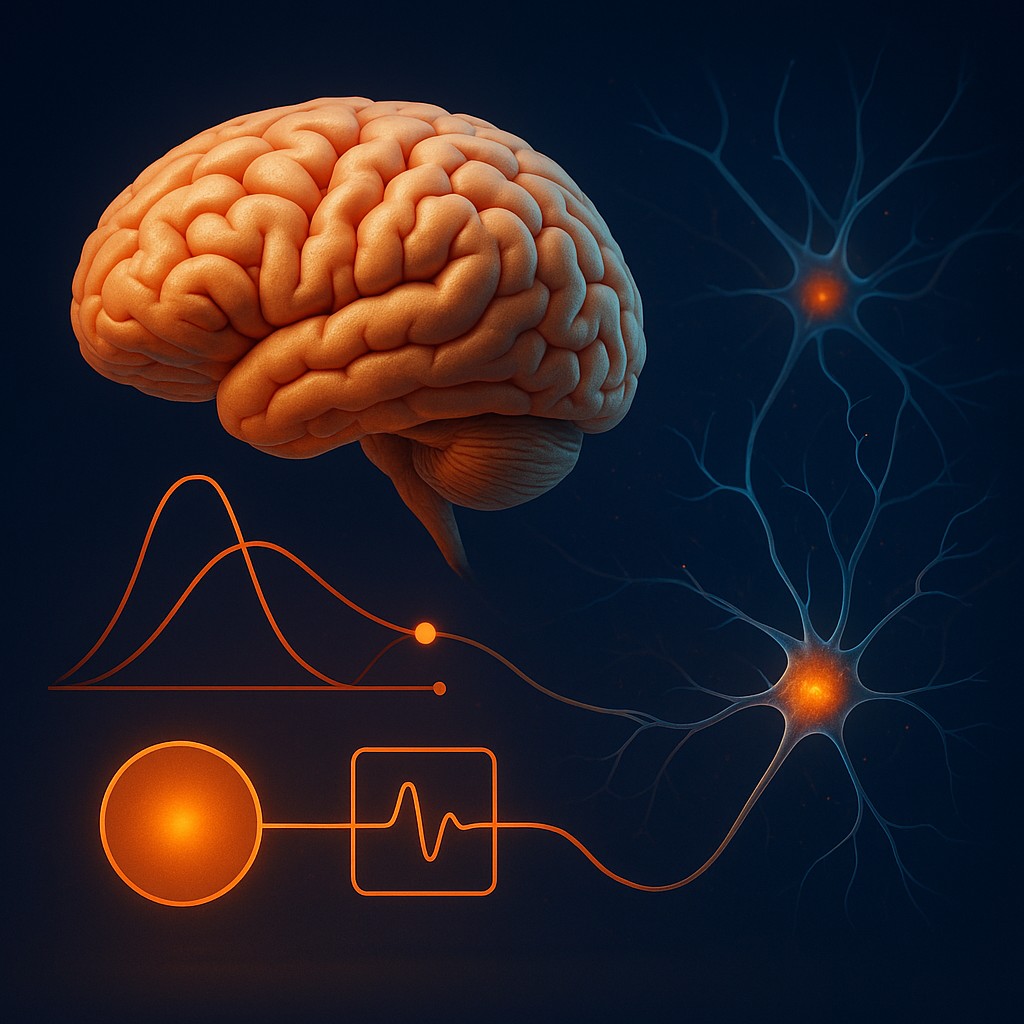
The paradox of human memory is that while our "hardware" is unreliable, our "software" is incredibly tough. We can keep a consistent sense of identity and recall specific events for eighty years or more, even though almost none of the original molecules that formed those memories are still there. This stability is possible because the brain does not store information in a single spot or a single cell. Instead, it uses a clever mathematical strategy called manifold coding, a biological version of the error-correcting codes NASA uses to beam images back from deep space.
The Fragility of the Lone Neuron
To understand how the brain protects information, we first have to recognize how easily a single neuron can fail. In a standard computer, a "bit" is either a one or a zero. If a transistor flips by accident, the data breaks. Neurons are much more temperamental than transistors. They might fire when they shouldn't because of a nearby chemical spike, or they might fail to fire because they are exhausted. If our memories relied on "grandmother cells" (a hypothetical single neuron responsible for remembering your grandmother), a single stray molecule or a microscopic stroke could erase your family history forever.
Evolution solved this problem by using redundancy, but not by simply making ten copies of the same memory. Instead, the brain uses distributed representation. When you learn something new, the information is spread across a massive population of neurons. No single cell holds the "truth" of the memory. Instead, the memory exists in the collective pattern of activity. Think of a choir singing a long, steady note. If one singer stops to take a breath, the note doesn't vanish. The rest of the group keeps the sound going, and the listener never notices the gap.
In computer science, this is often compared to "RAID" setups in hard drives or the codes used on CDs. When a CD gets a light scratch, the laser doesn't just "guess" the missing music. The disc contains extra, mathematically related data that allows the player to perfectly rebuild the missing parts. Your brain performs a biological version of this math every time you remember your tenth birthday. It looks at the noisy, incomplete firing of a thousand neurons and "calculates" the original signal based on the surrounding context.
Geometric Landscapes of the Mind
Neuroscientists describe this collective activity as a "manifold." Imagine a sheet of paper representing every possible way a group of neurons could fire. If you have 100 neurons, the "space" of possible patterns is unimaginably huge. However, the brain doesn't use all those possibilities. It restricts the activity to a specific shape or surface within that space, called a manifold. This is the "correct" version of the memory.
When neurons start misfiring due to age, stress, or simple biological noise, the activity pattern drifts away from that manifold. It is like a ball rolling off a paved road into the grass. However, because the network is trained to recognize the manifold, it exerts a kind of "gravitational pull" on the wandering signals. The surrounding neurons communicate with each other, comparing notes until they pull the activity back onto the paved road. This self-correcting geometry allows the brain to maintain a stable signal even when individual parts are failing.
This system is remarkably tough. Research shows that you can remove a large percentage of neurons in a specific network and the overall "meaning" of the signal stays intact. The remaining cells simply work harder to fill in the gaps. This is why human thinking fades so "gracefully." We don't usually experience a sudden "file not found" error in our minds; instead, our memories just become slightly fuzzier or less detailed over many decades.
Comparing Biological and Digital Storage
While the brain and your laptop both use error correction, they have different goals. A computer demands 100 percent accuracy, while the brain prioritizes the "gist" and patterns that help us survive. The following table shows how these two systems handle the natural breakdown of data over time.
| Feature |
Digital Error Correction (ECC) |
Biological Manifold Coding |
| Main Method |
Parity bits and checksums |
Distributed neural manifolds |
| Type of Backup |
Exact duplication of data bits |
Overlapping firing patterns |
| Failure Mode |
Total system crash or "blue screen" |
Graceful fading and "fuzziness" |
| Update Method |
Overwrites old data with new |
Merges new info into old patterns |
| Power Efficiency |
Constant high energy for precision |
Highly efficient, uses "noisy" signals |
| Reliability |
Absolute until a hard failure |
High for the big picture, low for details |
As the table shows, the brain's approach is far more flexible. It does not mind if the exact "checksum" of a memory is slightly off, as long as the meaning remains clear. This is why you can remember the emotional impact of a conversation perfectly while completely forgetting the exact words spoken or the color of the other person's shirt.
The High Cost of Reconstruction
There is a fascinating side effect to this constant rebuilding process. Every time your brain uses its "error-correction" math to pull a memory back onto the manifold, it is technically rebuilding it from scratch. You aren't playing a video file; you are running a simulation based on surviving fragments. This explains one of the most frustrating parts of human psychology: the "vividly false" memory.
Because the brain is so good at smoothing over gaps and correcting "errors," it often fills in missing information with whatever seems most likely based on your current beliefs. If a piece of a memory is missing, the correction mechanism does not leave a hole. It reaches for the nearest "likely" data point and weaves it into the fabric of the memory. This is why two people can have perfectly clear, incredibly vivid memories of the same event that totally contradict each other. Both brains have "corrected" the signal to make it make sense, but they used different internal blueprints to do it.
Over time, this can lead to "memory creep." Each time you recall an event, you are essentially saving a new version of the file. If there was a small error in the reconstruction last time, the system might treat that error as the "correct" fact next time. This is how a small fish you caught twenty years ago slowly grows into a whale in your mind. The manifold is still stable, but the shape of the manifold itself has been subtly warped by repeated use.
The Architecture of Identity
This system of distributed coding and mathematical correction is ultimately what allows "you" to exist. Your identity is not a physical object; it is the specific shape of these manifolds. Even as your cells are replaced and your connections are remodeled, the "shape" of your neural activity remains consistent. It is a dynamic stability, like a whirlpool in a river. The water is always changing, but the shape of the vortex stays the same because of the way the currents interact.
Understanding this biological "error correction" changes how we think about aging and learning. It suggests that keeping a memory sharp isn't just about repetition; it's about maintaining the "health" of the manifold. Trying new activities, learning skills, and exposing yourself to different perspectives provides your brain with more "reference points" to use when it needs to rebuild a fading memory.
You can take comfort in the fact that your brain is a master of improvisation. While your individual neurons are aging and occasionally "dropping the ball," the incredible mathematical symphony of the network is working behind the scenes to keep your life story coherent. You are a masterpiece of biological engineering, a system designed to find meaning and stability in a world of constant change. By trusting in this resilient process, you can embrace the beauty of your mind, knowing that even if the "hardware" is imperfect, the story it tells is built to last.