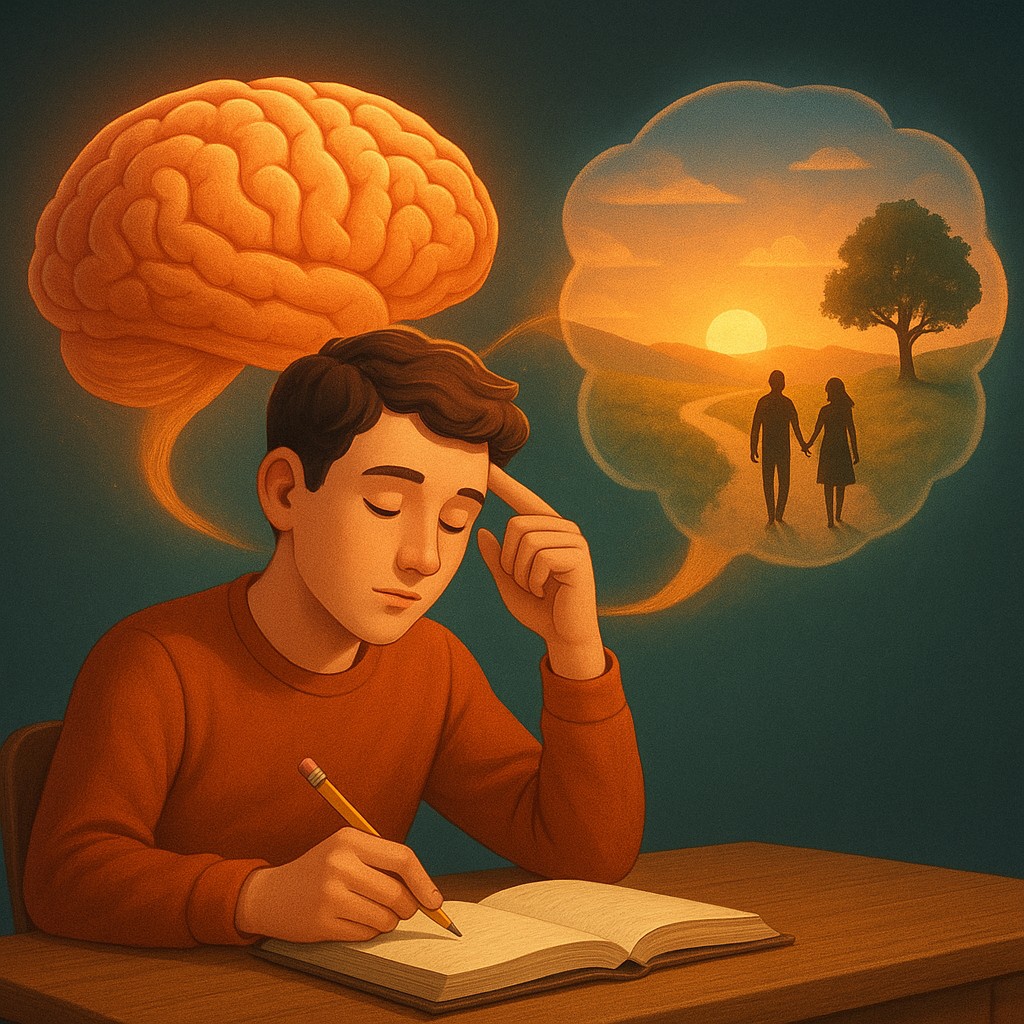
Imagine for a moment that you were tasked with documenting every single second of your life using a high-definition camera. You would need mountains of hard drives, endless cables, and a power grid that never sleeps just to store a single month of footage. Now consider your brain: a three-pound lump of wet tissue that runs on about the same amount of electricity as a dim refrigerator bulb. It has to store decades of your life. If your brain tried to record every pixel of every sunset and every word of every conversation, you would run out of biological "storage space" before you finished elementary school. Evolution faced a massive engineering problem: how do we remember enough to survive without burning through our entire energy budget?
The solution the brain found is both brilliant and slightly terrifying. Instead of acting like a video recorder, your mind operates more like a master storyteller who only keeps a few bullet points on hand. When you try to remember a specific event, your brain does not "play back" a file. Instead, it pulls a few jagged shards of data from its archives and immediately begins building a believable story around them using your general knowledge of the world. This process, known as reconstruction, is the ultimate efficiency hack. It saves you from becoming a walking library of useless textures and shadows, but it also means that many of your most cherished memories are, at least partially, works of fiction.
The Cognitive Architecture of the Gist
When we talk about memory, we often mix up two very different things: verbatim traces and gist traces. Verbatim traces are the raw, specific details of an experience, such as the exact shade of blue on a stranger’s shirt or the precise wording of a joke. These are "expensive" for the brain to maintain and, in the eyes of biology, mostly useless. Gist traces, on the other hand, are the fuzzy, high-level meanings of an experience. They capture the "vibe" or the "point" of what happened. If you visit a coffee shop, your brain might discard the pattern of the floor tiles within minutes, but it will cling to the gist that the coffee was overpriced and the barista wore a funny hat.
This preference for the gist is driven by the brain's reliance on "schemas." A schema is a mental framework or a blueprint that helps you organize and interpret information. You have a schema for "going to a restaurant," which includes expectations about menus, tables, servers, and paying the bill. Because you already have this blueprint, your brain does not need to waste energy recording that there were forks on the table during dinner last night. It simply notes the exceptions to the rule, like a missing fork or a particularly shiny one, and lets the schema "auto-fill" the rest of the scene when you recall it later.
This system is an incredible energy saver. By relying on pre-existing patterns, the brain can compress a three-hour dinner into a few kilobytes of unique data. However, the downside is that we become prone to "schema-consistent" errors. If someone asks you a week later if there were napkins on the table, you will almost certainly say yes, even if there were none. Your restaurant schema insists that napkins are a standard feature, and because your brain prefers a complete, logical picture over a reality full of holes, it fills the gaps with whatever is most likely to be true.
Why Accuracy is a Biological Luxury
From an evolutionary standpoint, perfect memory is not just unnecessary; it might actually be a handicap. Imagine a prehistoric ancestor who survives a narrow escape from a saber-toothed cat near a watering hole at sunset. To survive in the future, that individual does not need to remember the exact number of leaves on the nearby bushes or the specific temperature of the air. In fact, if they remembered those details too clearly, they might mistakenly think they are only in danger when the leaves look exactly like that and the temperature is exactly sixty-eight degrees.
What the ancestor needs is the gist: "Large cats hunt near water when it gets dark." By stripping away specific details and keeping the generalized lesson, the brain creates a portable rule that can be applied to many different situations. This process, called abstraction, is what allows us to learn and adapt. If our memories were too specific, we would be bogged down by the "noise" of life, unable to see the "signal" of survival. We are designed to be "good enough" historians so that we can be excellent future-planners.
The energy cost of maintaining perfect detail is another major factor. The brain is the most metabolically expensive organ in the body, consuming roughly twenty percent of your daily calories despite making up only two percent of your weight. Storing and retrieving detailed information requires strengthening connections between brain cells (synapses) and creating new proteins. By choosing to store only the gist and a few "anchor" details, the brain significantly reduces its workload. It is far cheaper to rebuild a memory using logic and general knowledge than it is to keep a massive, high-fidelity file in permanent storage.
| Feature |
Verbatim Memory (The Recording) |
Gist-Based Memory (The Story) |
| Storage Cost |
Extremely high; requires massive brain resources. |
Low; relies on existing mental blueprints. |
| Durability |
Fades rapidly; details are lost within hours or days. |
Very high; the "point" of the story lasts a lifetime. |
| Function |
Useful for technical tasks or specific identification. |
Essential for learning, logic, and survival. |
| Error Type |
Omission (forgetting a detail entirely). |
Commission (inventing a detail that "should" be there). |
| Brain Approach |
Data logging. |
Narrative construction. |
The Reconstruction Room and the Illusion of Certainty
One of the most unsettling aspects of gist-based memory is that we cannot easily distinguish between a "real" detail and an "auto-filled" one. When the brain reconstructs a memory, it does so with incredible speed and seamlessness. This occurs in the hippocampus and the prefrontal cortex, which work together to stitch shards of data and schematic blueprints back into a cohesive whole. Because the result feels smooth and logical, we feel a high degree of confidence in our recall. This is often called the "illusion of certainty."
This explains why eyewitness testimony is notoriously unreliable, even when a witness is trying their hardest to be honest. If a witness sees a car accident, their brain might store the gist that "the red car was going fast" and a few anchor details like "broken glass." If a lawyer later asks, "How fast was the red car going when it smashed the headlight?", the word "smashed" can act as a suggestion that overrides the original anchor details. The brain, eager to provide a complete picture, might incorporate the "smashed headlight" into the reconstruction, even if the headlight was actually intact.
This flexibility is not a defect; it is a feature of a system designed for adaptation. The same mechanism that allows us to imagine the future, taking pieces of the past and rearranging them into new scenarios, is what makes our memories susceptible to change. This is called the "constructive episodic simulation hypothesis." Our memory system is not really a library for looking backward; it is a simulation engine designed to help us navigate what might happen next. By treating memories as flexible building blocks rather than fixed records, our brains remain adaptable to new information.
The Social and Emotional Weight of the Gist
The way we store the gist of an event also deeply influences our emotional lives and relationships. We rarely remember every word of a fight with a partner, but we remember the "feeling" of being unheard or the "gist" that they were being unfair. Over time, these gist-based memories can harden into "person schemas." Once you have a schema that a certain friend is "unreliable," your brain will be more likely to remember the one time they arrived late (which fits the schema) and completely forget the five times they arrived on time (which it treats as irrelevant noise).
This also explains why we often have "false memories" of childhood. You might "remember" your third birthday party vividly, but research suggests many of these memories are actually reconstructions built from stories your parents told you and photographs you have seen. Your brain takes the gist of the story, adds the "birthday schema" (cake, candles, singing), and inserts your own face from the photos until you have a full-blown "memory" that feels as real as something that happened yesterday. We are, in a very real sense, the authors of our own history, constantly editing the past to make sense of the present.
Understanding this biological shortcut helps us be more forgiving of ourselves and others. When two people remember the same event differently, it is not necessarily because one is lying. It is because their brains started with different schemas, focused on different anchor points, and reconstructed two different, equally "efficient" versions of the truth. We are not failing when we forget details; we are simply being efficient biological machines that prioritize the meaning of life over the minutiae of it.
Embracing the Narrative Self
The discovery that our memories are efficient reconstructions rather than perfect logs can feel a bit destabilizing. We like to think of our past as a solid foundation, a series of unchangeable facts that define who we are. But there is something beautiful in the idea that our brains are artists rather than bookkeepers. By focusing on the gist, your mind is constantly searching for meaning, looking for patterns, and trying to distill the messy chaos of existence into a set of useful lessons. You are not a hard drive; you are a living, breathing narrative.
This efficiency allows you to carry thousands of days of experience within you without being crushed by the weight of every flickering shadow and passing sound. It frees up your mental energy to solve new problems, create new art, and build new relationships. So, the next time you find yourself arguing over the exact color of a house you saw on vacation three years ago or the name of a restaurant you visited once, give yourself a break. Your brain has purposely thinned out that folder so it has more room to handle the important stuff. You may not have all the details, but you have the story, and in the grand scheme of survival and human connection, the story is usually what matters most anyway.