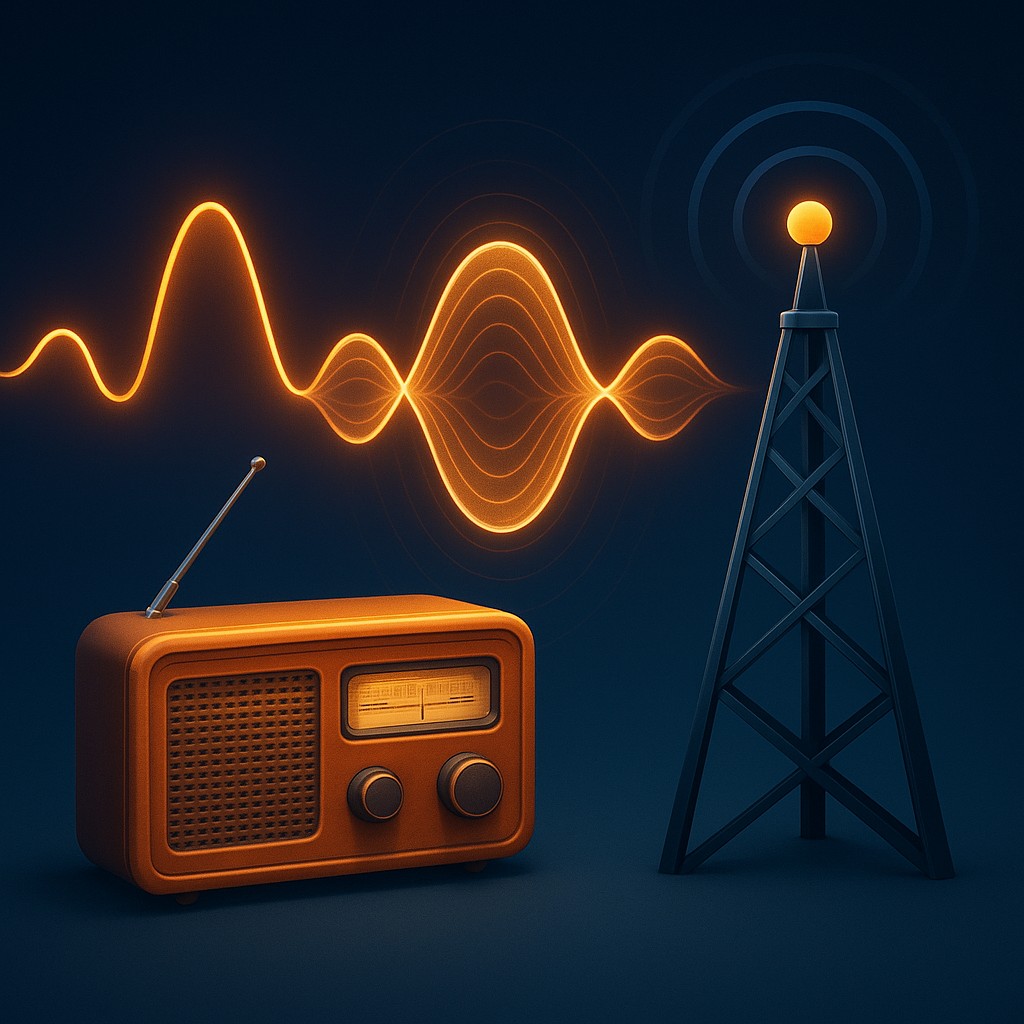
Imagine for a moment that you are standing in the middle of an invisible symphony. Right now, thousands of songs, weather reports, political debates, and distress calls are passing through your body at the speed of light. You cannot feel or hear a thing, yet the air is far from empty. It is saturated with data just waiting for a small electronic device to "fish" it out of the sky. This is the magic of radio. We often take it for granted because it seems like a relic of the last century, but it actually relies on a fascinating mastery of physics and electromagnetism.
Understanding radio is like learning to read a secret language used by the universe to communicate. It all starts with one simple fact: electricity and magnetism are two sides of the same coin. When you make electrons vibrate inside a wire, it creates a wave that spreads through space, much like the ripples that form on a pond when you toss in a stone. Radio is simply the art of "sculpting" these waves so they can carry the sound of a voice or a piano melody across the planet without a single wire to guide them.
Giving Birth to an Invisible Message
Before a sound can become a radio wave, it must undergo a radical transformation. Imagine your voice is a sheet of paper that you want to send to a friend a mile away. If you just throw it, it will fall at your feet. To reach the target, you have to attach it to a stone, a "carrier" heavy enough to cut through the air. In broadcasting, that stone is called the carrier wave. This is a pure, steady, high-speed electromagnetic wave created by a transmitter. Your voice is the information signal. The process of hitching that information to the carrier is called modulation.
A radio transmitter acts like an electronic conductor. It creates an alternating current that cycles back and forth millions of times per second. This current is sent into an antenna, a piece of metal where electrons are forced to race up and down at dizzying speeds. This frantic movement generates the radio wave. However, a wave that only vibrates at a steady pace carries nothing but total silence. To send a message, we must modify that wave, giving it a specific shape that matches the air vibrations we hear as sound. This is where the famous acronyms AM and FM come in, representing two very different ways to sculpt that carrier wave.
The Secret of AM: The Art of the Surge
AM, or Amplitude Modulation, is the historical grandfather of commercial radio. Conceptually, it is the simplest method. Imagine you have a flashlight and want to send a message to a friend across the street. With amplitude modulation, you wouldn't change the color of the light, but you would vary its brightness. For a loud sound, you shine the light brightly; for a soft sound, you dim it. An AM radio wave works the same way: the frequency of the wave (how fast it cycles) stays the same, but its "height" (its amplitude) changes to match the rhythm of the music or speech.
One of the great advantages of AM is its massive range. AM waves have huge wavelengths, sometimes stretching hundreds of yards. They possess an incredible physical property: they can bounce off the ionosphere, a layer of the Earth's atmosphere charged with electricity. This means that under certain nighttime conditions, an AM station in London might be picked up in Rome or Moscow, as the wave ricochets between the sky and the ground instead of escaping into space. However, this sensitivity to the environment is also its biggest flaw. Since the information is stored in the "strength" of the signal, any electrical disturbance (like lightning, a kitchen blender, or power lines) adds static to the broadcast. This creates that classic crackling sound that makes it feel like you are listening to a broadcast from a bygone era.
The FM Revolution: Crystal Clarity
FM, or Frequency Modulation, was invented to solve the static problems of AM. If we return to the flashlight analogy, instead of changing the brightness, you would keep the light at a steady intensity but rapidly change its color (its frequency). In an FM signal, the height of the wave stays exactly the same, making it immune to the power surges caused by atmospheric interference. What changes is the spacing between the peaks of the wave. When the sound is high-pitched or loud, the waves bunch closer together; when it is low or quiet, they spread out.
The FM receiver ignores changes in signal strength entirely, which instantly wipes out almost all background noise and pops. This is why FM is the gold standard for music: it offers much higher sound quality and easily allows for stereo broadcasting. There is, however, a trade-off. FM waves vibrate much faster than AM waves and have much shorter wavelengths (about 10 feet). Unlike their AM cousins, they do not bounce off the atmosphere. They travel in a straight line, known as "line-of-sight" propagation. If you are behind a large mountain or drive too far from the transmitter (usually more than 40 to 60 miles), the signal disappears abruptly. This is why you lose your favorite station during a long highway road trip.
A Technical Comparison of the Two Giants
To visualize the fundamental differences between these two technologies, it helps to see them side-by-side. While they share the same goal, delivering audio to thousands of listeners, their technical traits determine how we use them today.
| Feature |
Amplitude Modulation (AM) |
Frequency Modulation (FM) |
| Modified Variable |
Wave height (Amplitude) |
Wave speed (Frequency) |
| Sound Quality |
Lower (mono, narrow range) |
Higher (stereo, high fidelity) |
| Noise Sensitivity |
Very high (frequent static) |
Very low (clear sound) |
| Signal Range |
Very long (bounces off the sky) |
Short (direct line-of-sight) |
| Complexity |
Simple and inexpensive |
More complex and costly |
| Primary Use |
News, talk radio, long distance |
Music, high-quality local radio |
The Journey from the Antenna to Your Ears
Once the wave leaves the transmitter and travels through buildings and forests, it hits your radio's antenna. Here, the reverse miracle occurs: demodulation. Your antenna is bombarded by thousands of different waves all at once. To avoid hearing a chaotic mess of every station at once, you turn the tuner knob. By doing this, you change the electrical properties of an internal circuit so it only vibrates at one specific frequency. It is like having a tuning fork that only rings if one particular note is played in the room.
Once the station is isolated, the device must pull the information off the carrier wave. For AM, a simple component called a diode can "rectify" the signal to keep only the outer shape of the wave, which matches the original sound. For FM, the process is more precise: the receiver measures tiny timing variations between each wave cycle and translates them into electrical pulses. These pulses are sent to an amplifier, which gives the signal enough power to vibrate the cone of your speaker. That cone then pushes the air, creating pressure waves that your eardrums finally interpret as a host's voice or a guitar chord.
Debunking Myths about Quality and Reception
People often say "FM gets better reception." In reality, that is a bit of an oversimplification. FM does not necessarily "catch" the signal better; it catches it "cleaner." If you are in a very isolated area far from any transmitter, an AM radio is your best bet for hearing a human voice because it can travel over the horizon. Conversely, in a city full of electrical interference from elevators, computers, and neon lights, AM quickly becomes unlistenable, while FM remains stable. It is not about raw performance, but rather which tool fits the environment.
Another common myth is that radio is a dying technology in the digital age. While digital radio (DAB) is starting to replace FM in some countries, the core principle remains the same. Even digital signals use electromagnetic waves and complex modulation. Analog radio remains the most resilient technology in the world. In a major disaster, when the internet goes down and cell networks are overwhelmed, AM and FM waves keep moving. They are easy to receive, require no complex login systems, and can be picked up with a device that costs just a few dollars and runs on a single battery.
The world of radio is a constant reminder that we live in a universe of vibrations. Every time you turn on your set, you are participating in a scientific experiment that began with the discoveries of Hertz and Marconi over a century ago. You are using waves that are the same as visible light, but at a frequency your eyes cannot see. This ability to transform the silence of empty space into a source of emotion, culture, and information is one of the greatest victories of human ingenuity. So, the next time you dial in your favorite station, try to visualize those invisible waves bending, bouncing, and vibrating all around you, bringing the whole world within reach.