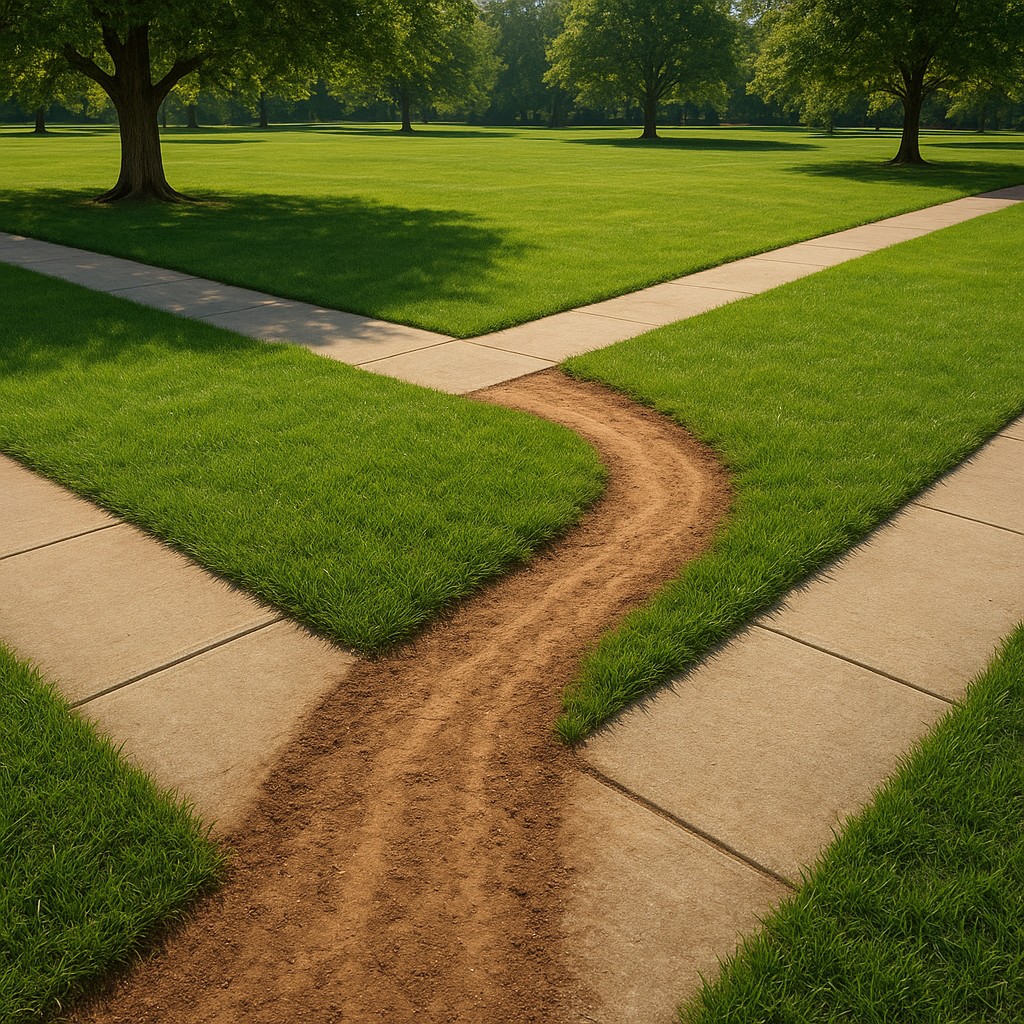
Imagine you are standing at the edge of a perfectly kept university quad or a pristine city park. Before you lies a network of expensive, right-angled concrete sidewalks. They were designed by an architect who likely favored geometric symmetry and a tidy aesthetic. Yet, cutting directly across the vibrant green grass is a jagged, dusty brown scar where the turf has been worn away by thousands of individual footsteps. This unofficial trail, often called a "cow path" or a "pirate path," is what urban planners and sociologists call a desire line. It represents a silent, collective rebellion against the dictated route. It proves that while humans appreciate beauty, they prioritize efficiency above almost everything else.
These dirt tracks are more than just eyesores for groundskeepers; they are incredible visual maps of human intent. Every time a pedestrian shaves three seconds off their commute by cutting a corner, they are casting a physical vote against the existing layout. When enough people cast that same vote, the landscape changes. This phenomenon highlights a fundamental tension in design: the battle between a creator’s "top-down" vision of how the world should work and the "bottom-up" reality of how people actually move through their environment. By studying these paths, we can learn how to build systems that work with human nature instead of fighting against it.
The Architecture of Human Impatience
To understand why desire lines exist, we first have to look at the philosophy of traditional urban planning. For centuries, designers operated under a "command and control" mindset. They believed that by placing a path in a certain location, they could dictate how the masses moved. This approach often prioritizes how things look, such as long vistas or symmetrical patterns that look beautiful from an airplane but feel tedious to someone carrying heavy groceries. Design in this mode is a static event - a finished product delivered to a passive audience who is expected to follow the rules provided.
However, humans are biologically programmed to seek the path of least resistance. This isn't just laziness; it is an evolutionary trait designed to conserve energy. If a paved walkway forces you to walk 50 feet north just to turn 50 feet back south, your brain recognizes the waste of effort. The desire line emerges as a correction. It is the shortest distance between two points, carved into the earth by the collective subconscious of a community. It is an honest expression of where people are coming from and where they want to go, stripped of any artistic pretension or bureaucratic oversight.
Interestingly, desire lines are a form of "stigmergy," a concept used to describe how ants and termites coordinate their work. When an ant finds food, it leaves a chemical trail. Other ants follow that trail, strengthening it with their own scent until a clear highway is established. Humans do the same thing with mud and grass. One person takes a shortcut, flattening a few blades of grass. The next person sees the slightly flattened patch and finds it easier to walk there than through the tall grass. Eventually, the vegetation dies, the soil packs down, and a permanent trail is born. No one sat down to plan the shortcut, yet it exists because of a shared, uncoordinated effort.
Flipping the Script Through Emergent Design
The traditional response to desire lines has been one of discipline and frustration. You have likely seen "Keep Off the Grass" signs or low wire fences meant to trip up anyone daring to stray from the concrete. These fixes rarely work. They treat the symptoms rather than the cause, often leading to "braided paths" where people simply step over the fence and create a new trail a few inches to the side. It is an expensive, never-ending battle against the very people the park was built to serve.
A much more elegant solution is found in "emergent design," a strategy where planners intentionally leave a landscape blank for a time. At some progressive universities, new buildings are finished without any connecting sidewalks. The planners simply plant grass and wait through one full school year. By the end of the term, the students will have worn clear, brown paths into the lawn exactly where they need to walk. Only then does the university bring in the paving crews. This ensures that every dollar spent on concrete goes toward a path that will actually be used, resulting in a campus that feels natural to navigate.
This shift in perspective changes the designer's role from an all-knowing authority to an observant helper. It requires humility to admit that the people using a space might know more about its utility than the person who drew the blueprints. By paving the desire lines, the designer creates a partnership with the public. The infrastructure becomes a mirror of human behavior. This leads to lower maintenance costs because walkers no longer destroy the landscaping in areas where they aren't "supposed" to be. The table below illustrates the core differences between these two competing philosophies.
| Feature |
Predictive/Traditional Design |
Emergent/Responsive Design |
| Logic |
Aesthetic, geometric, and theoretical |
Functional, behavioral, and practical |
| Timeline |
Paving happens before the site is used |
Paving happens after the site is tested |
| Authority |
The architect or planner |
The collective crowd of users |
| Maintenance |
High (fencing, replanting turf) |
Low (infrastructure follows use) |
| User Experience |
Can feel restrictive or confusing |
Feels intuitive and effortless |
Beyond Parks: Desire Lines in the Digital World
While the term started in landscape architecture, the concept of desire lines has become a vital metaphor in software engineering and user experience (UX) design. Just as a walker might cut across a park lawn, someone using an app or a website will often find shortcuts that the developers never intended. Perhaps they use a search bar instead of navigating a complex menu, or they use a specific feature in a creative, unexpected way. If you have ever seen a "hack" for software that makes it easier to use, you are looking at a digital desire line.
Smart tech companies monitor these digital trails using heatmaps and click-tracking software. If a developer notices that 80% of users are clicking a hidden sub-menu item every time they log in, the "emergent design" response is to move that item to the home screen. In this context, the desire line isn't made of dirt; it is made of data. Ignoring these signs leads to "friction," the digital equivalent of a fence that makes users want to quit the app. By building the interface around the paths users are already carving, companies can create a seamless experience that feels like it is reading the user's mind.
This principle also explains why "features" sometimes emerge from bugs or unintended uses. For example, Twitter did not invent the hashtag or the @-reply; users started using those symbols to organize their own conversations on the platform. Rather than banning the practice or forcing a different system, Twitter’s developers paved those desire lines by writing official code to support and highlight them. This allowed the platform to evolve in a direction dictated by the users themselves, ensuring it stayed relevant and easy to use.
The Danger of Following Every Path
It is tempting to think that we should always pave every desire line, but the natural world and human safety require a more careful approach. Not every shortcut is a good one. Sometimes, a desire line forms because it is the fastest way to get to a cliff's edge or across a dangerous, high-speed intersection. In these cases, the "intent" of the crowd is clear, but the outcome is hazardous. A designer must step back in and decide whether to provide a safer alternative or use stronger barriers to protect the public from their own search for efficiency.
Environmental protection is another area where desire lines must be managed carefully. In fragile ecosystems, such as sand dunes or mountain meadows, a single season of desire lines can cause permanent damage to rare plants or lead to massive soil erosion. In these special cases, the designer’s job is to educate and redirect. Instead of a "Keep Off the Grass" sign, they might install a raised wooden walkway. This provides a clear, easy path that satisfies the human need for a shortcut while keeping heavy boots off the delicate ground. It acknowledges the desire to move through the space while protecting the space itself.
Furthermore, desire lines can occasionally lead to "social traps." If everyone takes a shortcut through a small patch of woods to save time, they eventually destroy the very woods they enjoy walking through. This creates a conflict between individual efficiency and collective value. The challenge for modern planners is to distinguish between a desire line that reveals a flaw in the system, like an awkwardly placed sidewalk, and one that represents a "tragedy of the commons," where individual actions unintentionally ruin a shared resource.
Seeing the World Through a Responsive Lens
Learning to identify desire lines changes the way you look at the world. You begin to see the "errors" in your environment not as failures of the people using them, but as failures of the people who built them. Whether it is a worn spot on a carpet, a "workaround" in an office filing system, or a common phrase that people use despite it being technically incorrect, these are all signals. They are the world’s way of telling us that the current system is out of sync with reality.
When we embrace the wisdom of the desire line, we move toward a more compassionate and efficient way of living. We stop blaming the student for "ruining the lawn" and start asking why the sidewalk wasn't there in the first place. We stop fighting against the natural flow of human energy and instead learn to harness it. By becoming observers of behavior rather than enforcers of rules, we can create environments, products, and communities that feel tailor-made for the people who live in them. Look around your own life today. Where is the grass being worn down? What unwritten path is waiting for you to pave it? The most elegant solutions are rarely the ones we force onto the world, but the ones we discover by watching how the world already wants to move.