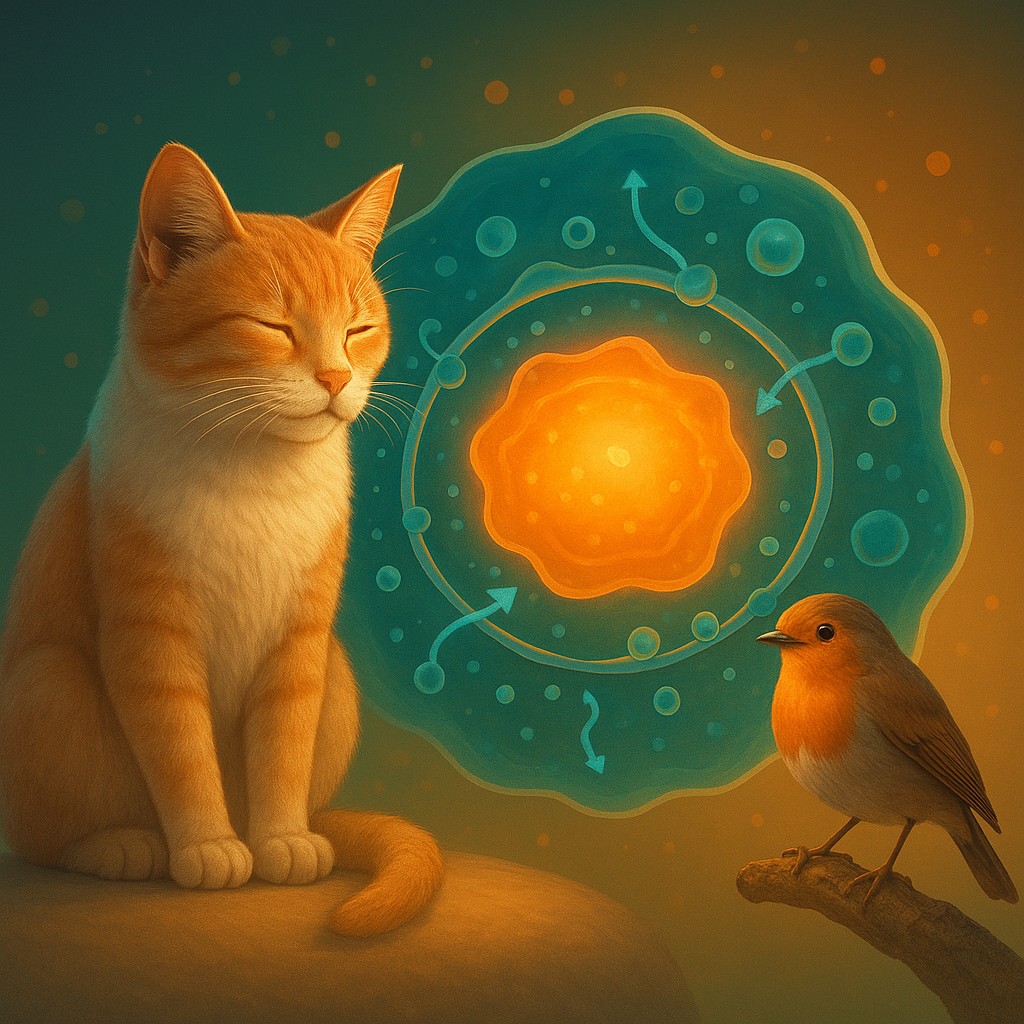
Think about the common house cat or a robin hopping across the grass. From a distance, they seem calm and still. However, beneath the fur and feathers, a microscopic storm is brewing. Unlike a lizard, which might spend hours stretched out on a hot rock just to soak up enough energy to move, these warm-blooded creatures are like internal combustion engines that never stop running. They are constantly burning fuel just to stay exactly as they are. This internal furnace is called endothermy. It allows them to hunt in the midnight chill of a forest or fly through the freezing sky, but it comes at a price so high it would bankrupt almost any other life form.
The secret to this internal heat is not just a "fast metabolism" in a general sense. It is actually the result of a deliberate and constant chemical failure at the cellular level. Imagine trying to keep a swimming pool full while several holes are intentionally poked in the liner. You would have to keep the pump running at full speed just to maintain the water level. This sounds like a disaster, but for birds and mammals, these "leaky" membranes are exactly what keep the lights on. By letting ions constantly slip across cell boundaries, our bodies force our cellular pumps to work overtime. The friction of that endless work creates the heat that keeps us alive.
The High Cost of Maintaining the Cellular Balance
To understand why we leak, we first have to understand what we are protecting. Every cell in your body is essentially a tiny battery. It maintains a specific electrical charge by keeping certain minerals, specifically sodium and potassium, in a delicate balance. Sodium is mostly kept outside the cell, while potassium is packed inside. This "concentration gradient" is vital because it allows cells to communicate, muscles to twitch, and nerves to fire. If these concentrations ever leveled out, you would stop functioning instantly. To prevent this, your cells are equipped with millions of tiny proteins called sodium-potassium pumps. These pumps act like microscopic bouncers, constantly grabbing sodium to throw it out while pulling potassium back in.
In most cold-blooded animals, like frogs or snakes, the cell membranes are relatively tight. They are good at holding onto their ions, which means the pumps only have to work occasionally to top things off. However, in humans, dogs, and eagles, the membranes are leaky by design. They have specialized channels that allow these ions to seep through much more easily than they do in reptiles. Because the ions are constantly slipping back to where they shouldn't be, the sodium-potassium pumps can never rest. They must churn 24 hours a day, using up a massive portion of the body's total energy just to maintain the status quo.
This constant activity is what we feel as body heat. Just as a laptop gets warm when the processor is working hard, or a car engine creates heat as it burns fuel for motion, your cellular pumps generate heat as a byproduct of their endless labor. In a resting human, about one-fifth of all the oxygen you breathe and the food you eat goes toward powering these pumps. We aren't just warm because we are active; we are warm because our cells are engaged in a permanent, high-stakes tug-of-war against their own leaky boundaries.
Comparing the Energy Strategies of Life
When we compare the energy budgets of different animals, the gap is staggering. A mammal generally needs between five to ten times more food than a reptile of the exact same weight. This is why a large python might eat one big meal and then disappear for a month, while a wolf must hunt constantly to avoid wasting away. The python is an "ectotherm," relying on the environment to provide heat, whereas the wolf is an "endotherm," generating its own heat from within. One is a master of thrift, while the other is a high-performance, high-consumption machine.
The following table highlights the trade-offs between these two biological philosophies. It shows how the simple act of "leaking" ions changes everything about how an animal lives, eats, and survives.
| Feature |
Ectotherms (e.g., Reptiles, Insects) |
Endotherms (e.g., Mammals, Birds) |
| Membrane Permeability |
Relatively "tight" membranes with low ion leakage. |
"Leaky" membranes that require constant pumping. |
| Metabolic Rate |
Low baseline metabolism; energy use changes with temperature. |
High baseline metabolism; energy use is constant and high. |
| Food Requirements |
Minimal; can survive long periods without eating. |
Massive; must eat frequently to avoid starvation. |
| Environmental Range |
Limited to warm climates or seasonal activity. |
Can live in nearly every climate on Earth, including the poles. |
| Activity Levels |
Explosive bursts followed by long recovery periods. |
Sustained, high-intensity activity over long durations. |
The Evolutionary Gamble of the Internal Furnace
You might wonder why evolution would favor such an inefficient design. Why would nature choose an animal that has to eat ten times more than its neighbor just to stay alive? The answer lies in the incredible advantages of a stable internal environment. Chemical reactions, including the ones that allow muscles to move and nerves to process information, are highly sensitive to temperature. If a lizard gets too cold, its body chemistry slows down, its tongue becomes sluggish, and it can barely move. It becomes a prisoner of the weather.
Endotherms, by contrast, carry their own climate with them. Because their cells are always generating heat via those leaky membranes, their internal chemistry is always running at the perfect speed. This gives birds and mammals a "thermal niche" that is much wider than that of any reptile. We can hunt at night when the sun is gone. We can survive a winter in the frozen tundra. We can maintain complex, high-energy brains that require a perfectly steady temperature to function. The "leak" isn't a flaw; it's a feature that gave us the ability to be active whenever and wherever we choose.
However, this advantage only holds as long as the food keeps coming. The leaky membrane strategy is an all-or-nothing bet. If a mammal runs out of food, it cannot simply "shut down" and wait for better weather like a desert toad might. The pumps must keep running, or the ionic balance will fail, and the animal will die. This makes endotherms incredibly vulnerable to food shortages. We are the Ferraris of the animal kingdom, capable of amazing performance but prone to breaking down the moment the gas tank hits empty.
Debunking the Myth of the Efficient Mammal
There is a common misconception that mammals and birds are "more evolved" because we are more complex or active. This leads many to believe that our bodies are models of efficiency. In reality, from a purely physical standpoint, we are shockingly wasteful. If an engineer from another planet were asked to design a life form to survive on a world with limited resources, they would likely choose the reptile model every time. A reptile turns more of its food into actual body mass (growth and reproduction) than a mammal does, because it doesn't waste ninety percent of its calories just on keeping its temperature steady.
We often think of "metabolism" as the process of burning fat to move our muscles, but for an endotherm, the vast majority of metabolism is actually "basal." This is the energy you burn while lying perfectly still in a dark room. Your heart beats, your lungs expand, and most importantly, your cells pump ions to fight the leaks. Even when you are sleeping, your body is a raging furnace. This explains why small mammals, like shrews or hummingbirds, face such a terrifying struggle for survival. Because they are so small, they lose heat much faster than a large human. To compensate, their membranes must be even leakier and their pumps even faster. A shrew can starve to death in just a few hours simply because it cannot eat fast enough to pay its "ion tax."
The Molecular Mechanism of Heat Generation
If we zoom in even further, past the tissue and the cell, we find the specific proteins responsible for this miraculous waste. The primary player is an enzyme called Na+/K+-ATPase. This protein sits in the cell membrane and uses a molecule called ATP, the basic currency of energy in the body, to do its work. Every time the pump cycles, it releases a tiny puff of heat. In the tissues of endotherms, these pumps are much more numerous than in ectotherms. We don't just have leakier borders; we have a much larger army of workers trying to fix them.
Furthermore, endotherms have a second trick: "thermogenin," or uncoupling proteins. While the sodium-potassium pump creates heat as a byproduct of a job, these uncoupling proteins create heat as their main goal. They are found in the mitochondria, the power stations of the cell. Usually, mitochondria use a flow of particles called protons to create ATP. Uncoupling proteins act like a shortcut, allowing those protons to flow through without making any energy molecules, effectively short-circuiting the battery to generate nothing but pure heat. Between the constant pumping forced by leaky membranes and the deliberate short-circuiting in the mitochondria, our bodies are masterpieces of controlled energy loss.
This complex system is coordinated by the thyroid gland and the hypothalamus in the brain. When you step out into the cold, your brain senses the drop in temperature and sends out signals to ramp up the activity of these cellular pumps. It’s like turning up the thermostat in a house. The membranes don't necessarily get leakier in real-time, but the speed of the pumps can be adjusted, and other heat-generating tissues, like brown fat, can be turned on. It is a dynamic, highly responsive system that ensures your core remains a steady 98.6 degrees Fahrenheit, whether you are in a sauna or a snowdrift.
A New Perspective on the Gift of Warmth
Understanding the "leaky membrane" theory changes how we see our relationship with the world. We are not separate from our environment; we are in a constant, high-energy conversation with it. Every breath we take and every meal we eat is a tribute paid to the laws of physics that want our bodies to be as cold as the air around us. We resist that cold through a magnificent, microscopic struggle.
Next time you feel the warmth of your own skin or watch a bird endure a cold rain, remember that this comfort is bought every second by trillions of tiny pumps working themselves to exhaustion. We come from a line of survivors who chose the path of the furnace, trading the slow, steady life of the lizard for the fast-paced, high-stakes drama of the mammal. It is a beautiful, expensive, and daring way to live, fueled by the simple act of letting a few ions slip through the cracks. Embrace the energy you burn, for it is the very thing that gives you the freedom to move, to think, and to thrive in a world that is always trying to cool you down.