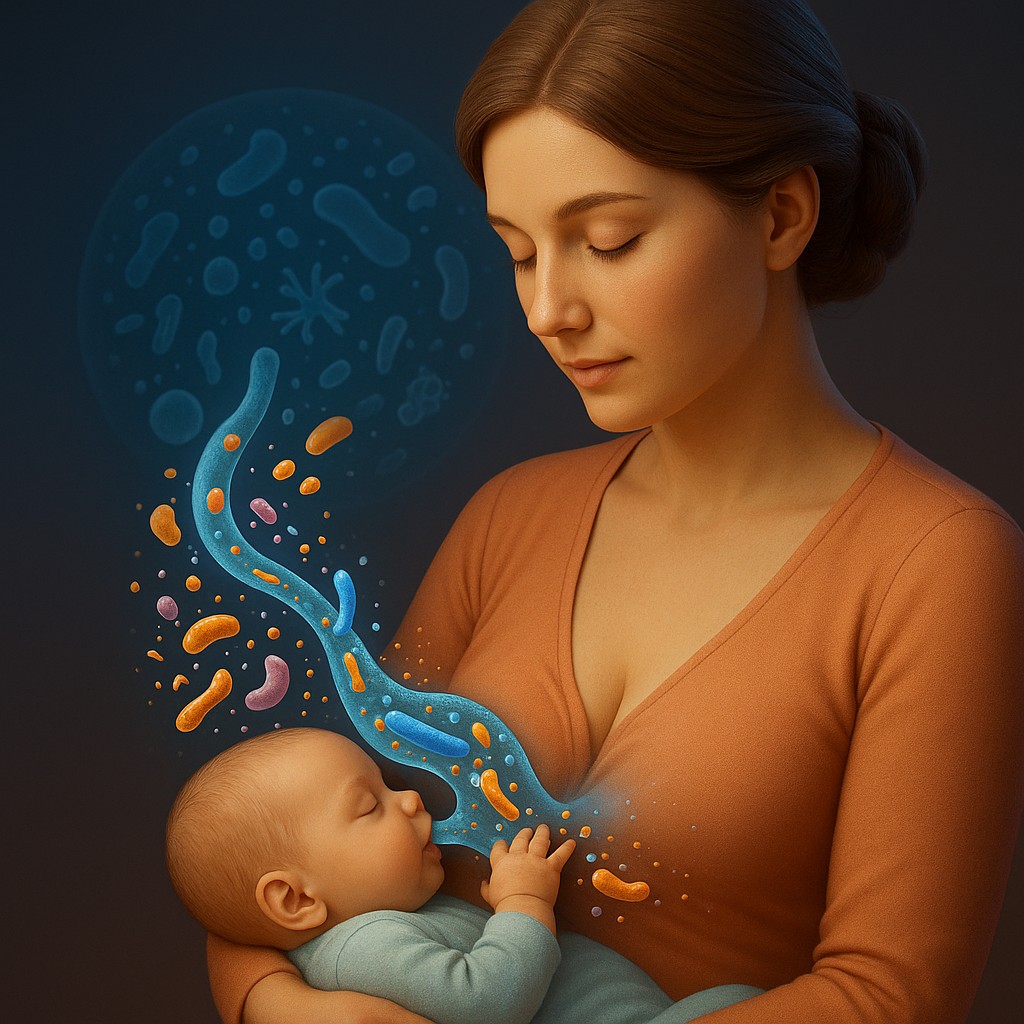
Deep within the quiet, miraculous routine of a midnight feeding lies a biological hand-off so sophisticated it rivals the world’s most advanced logistics networks. For decades, we looked at breast milk primarily as a source of calories, fats, and antibodies - a "liquid gold" designed to keep a baby full and growing. However, recent breakthroughs are revealing that breast milk is much more than a nutritional cocktail. It is actually a living transport system, acting as a bridge between the mother’s internal ecosystem and the brand-new, empty world of her infant’s digestive tract.
Researchers at the University of Basel have recently pulled back the curtain on this microscopic relay race. They discovered that mothers are physically seeding their children with specific, beneficial bacteria. This process is not accidental or random. Instead, it is a carefully chosen selection of "pioneer" microbes that travel through a secret biological pathway to set up shop in the baby's gut. By understanding how these tiny passengers make the journey, we are beginning to realize that breastfeeding is the first and most important ecological intervention a human being ever experiences, shaping their health for decades to come.
The Microscopic Garden of the Human Gut
To understand why this discovery is so groundbreaking, we first need to imagine the infant gut as a freshly tilled, empty plot of soil. At birth, a baby’s digestive system is largely a blank slate, waiting for the first seeds of life to be planted. These seeds make up what scientists call the microbiome - a vast community of trillions of bacteria, viruses, and fungi that live inside us. These microbes are not invaders. They are essential partners that help us break down food, produce vitamins, and, perhaps most importantly, train our immune systems to tell the difference between a harmless piece of dust and a dangerous germ.
The Basel study focused on a group of bacteria known as Bifidobacterium. If the microbiome were a city, Bifidobacterium would be the founding fathers and the civil engineers. These specific strains are experts at navigating the harsh environment of the stomach to settle in the colon. Once there, they create an acidic environment that is hostile to "bad" bacteria like E. coli or Salmonella. Without these early settlers, the "soil" of the infant gut might be taken over by weeds, leading to inflammation, colic, or even long-term issues like allergies and asthma.
What makes Bifidobacterium so special is their appetite. While humans cannot digest certain complex sugars found in breast milk called Human Milk Oligosaccharides (HMOs), these bacteria love them. It is one of nature’s most clever tricks: the mother produces a sugar that the baby cannot even use, specifically to feed the bacteria she is sending along with the milk. This ensures that the beneficial microbes have a "packed lunch" for their journey, giving them a competitive advantage over any random germs the baby might pick up from the environment.
Tracking the Genetic Fingerprints of Life
Proving that these bacteria move directly from the mother’s milk to the baby’s gut was no small feat. In the past, scientists noticed that both mothers and babies had similar bacteria, but they could not be 10 to 100 percent sure if the baby got them from the milk, from skin-to-skin contact, or just from the shared environment of the home. It was a classic "chicken or the egg" problem. To solve this, the University of Basel team used a high-tech method called advanced genomic sequencing. Think of this as the ultimate forensic tool, allowing scientists to read the entire DNA "barcode" of a bacterial cell.
By mapping the DNA of Bifidobacterium found in a mother’s breast milk and comparing it to the strains found in her infant’s stool samples, the researchers found a perfect match. They weren't just looking at the same species of bacteria; they were looking at the exact same strains, which are like individual family lineages. When the DNA sequences matched perfectly, it provided the "smoking gun" evidence that these microbes were being physically transferred during nursing. The milk acts as a direct conduit - a biological highway designed to move life from one body to another.
This discovery debunks the old idea that breast milk is sterile. For a long time, medical textbooks suggested that milk was a germ-free fluid and that any bacteria found in it were probably just contaminants from the skin. We now know that the mother’s body actually recruits these bacteria from her own gut and transports them to the mammary glands. It is a deliberate, highly evolved process. The table below highlights the differences between what we used to think and what the Basel study has helped prove.
| Feature |
Old Perspective (The Sterile Myth) |
New Perspective (The Living Bridge) |
| Milk Composition |
Strictly nutritional; vitamins and fats. |
Bioactive; contains live microbes and food for them. |
| Bacterial Source |
Environmental contamination or skin contact. |
Deliberate transfer from mother's internal microbiome. |
| Role of Sugar |
Simple energy for the baby's growth. |
Complex HMOs designed to feed "good" bacteria. |
| Immune Impact |
Passive protection through antibodies only. |
Active training of the immune system via microbes. |
| Gut Status |
Randomly colonized by the environment. |
Specially "seeded" by curated pioneer strains. |
The Role of Pioneer Microbes in Baby’s First Days
When these Bifidobacterium strains arrive in the infant’s gut, they don't just sit around. They immediately go to work as "pioneer" species. In ecology, a pioneer species is the first one to inhabit a new environment, paving the way for a more complex ecosystem to follow. In the baby's gut, these bacteria begin to ferment the milk sugars, which lowers the pH level of the intestines. This acidity acts as a natural shield, making the gut a very uncomfortable place for harmful germs to live.
Beyond protection, these microbes are the primary instructors for the infant’s developing immune system. About 70 to 80 percent of the human immune system is located in the gut. When the Bifidobacterium settle in, they interact with the lining of the intestines, sending signals to the baby’s white blood cells. This "conversation" teaches the baby's body what is "self" and what is "other." It is like a training camp for soldiers; without these friendly bacteria to practice on, the immune system might become overreactive, attacking harmless things like peanuts or pollen later in life.
Furthermore, these pioneer microbes help strengthen the gut barrier itself. A newborn’s gut is somewhat "leaky," which is normal for a short time, but it needs to seal up to prevent unwanted proteins from entering the bloodstream. The bacteria found in breast milk produce short-chain fatty acids during their fermentation process. These fatty acids act as a fuel source for the cells lining the gut, helping them grow tight and strong. It is a beautiful cycle where the mother provides the milk, the milk feeds the bacteria, and the bacteria build the baby’s defenses.
Why This Revelation Changes Everything
Understanding the physical transfer of microbes has massive implications for infant health, especially for babies who cannot be breastfed. While infant formula has come a long way in matching the nutritional profile of breast milk, it has traditionally been a "dead" product, lacking the live bacterial cultures found in the real thing. This research provides a roadmap for the future of newborn nutrition. It suggests that we need to do more than just add vitamins to formula; we may need to add the specific, identified strains of Bifidobacterium that the Basel team found.
However, it is not just about the bacteria themselves, but the combination of the bacteria and the specific sugars (HMOs) that feed them. This is often called "synbiotics" - a mixture of probiotics (the bugs) and prebiotics (the food for the bugs). If a baby receives the bacteria without the food, the bacteria might not survive. If they receive the food without the bacteria, there may be no pioneer strains there to eat it. The Basel study reinforces the idea that mother’s milk is a complete, integrated system that must be understood as a whole.
This research also highlights how resilient the human body is. Even when breastfeeding is complicated or impossible, knowing exactly which strains are missing allows doctors to intervene more effectively. It opens the door for "personalized probiotics," where a baby’s microbiome could be tested and a specific booster shot of missing pioneer bacteria could be given. It moves us away from a one-size-fits-all approach and toward a precision-based understanding of how we build a human being from the inside out.
Correcting Common Myths About the Microbiome
As with any scientific breakthrough, it is important to clear up some common misconceptions. One major myth is that the microbiome is "set in stone" at birth and cannot be changed. While the pioneer microbes are vital, the microbiome is actually quite flexible. It continues to develop significantly during the first three years of life. The Basel study shows that breastfeeding provides the best start, but it is one piece of a larger puzzle that includes diet, environment, and even playing with pets.
Another common misconception is that all bacteria are either "good" or "bad." In reality, the microbiome is about balance. Even some bacteria that we consider "bad" in high amounts can play a role in challenging the immune system in small doses. The Bifidobacterium transferred in breast milk are not there to kill every other germ, but to act as the dominant, stabilizing force that keeps the ecosystem in check. They are the governors of the gut community, ensuring that no single group gets out of hand and causes illness.
Lastly, some people believe that if a baby is born via C-section, they miss out on all the beneficial bacteria. While it is true that a vaginal birth provides an initial "bath" of microbes, the Basel research proves that breastfeeding is a powerful secondary way to transfer these essential strains. This is encouraging news for parents, as it shows that the body has multiple, backup systems for ensuring the baby receives its microbial inheritance. The "living bridge" of breast milk is a constant, daily opportunity to support a baby's health regardless of how the birth went.
A New Era of Nurturing the Next Generation
The work done at the University of Basel is more than just a laboratory success. It is a testament to the incredible complexity of the human bond. We are learning that nurturing a child is not just a social or emotional necessity, but a biological requirement that involves passing on life itself at a microscopic level. Every drop of milk is a message from the mother’s body to the child’s, carrying the tools needed to build a resilient, healthy future. This discovery invites us to look at the human body with even more wonder, recognizing that we are never truly alone, but are always part of a vast, interconnected web of life.
As we move forward, this knowledge empowers parents, doctors, and scientists to make better-informed decisions about infant care. It reminds us that nature has spent millions of years perfecting the recipe for human health, and our job is often just to listen and learn from its wisdom. By recognizing the importance of these tiny pioneer passengers, we can better protect the health of our children and ensure that their internal "gardens" flourish for a lifetime. The next time you see a mother nursing a child, remember that you aren't just seeing a meal - you are witnessing an ancient, beautiful transfer of a biological legacy that will guide that child into adulthood.