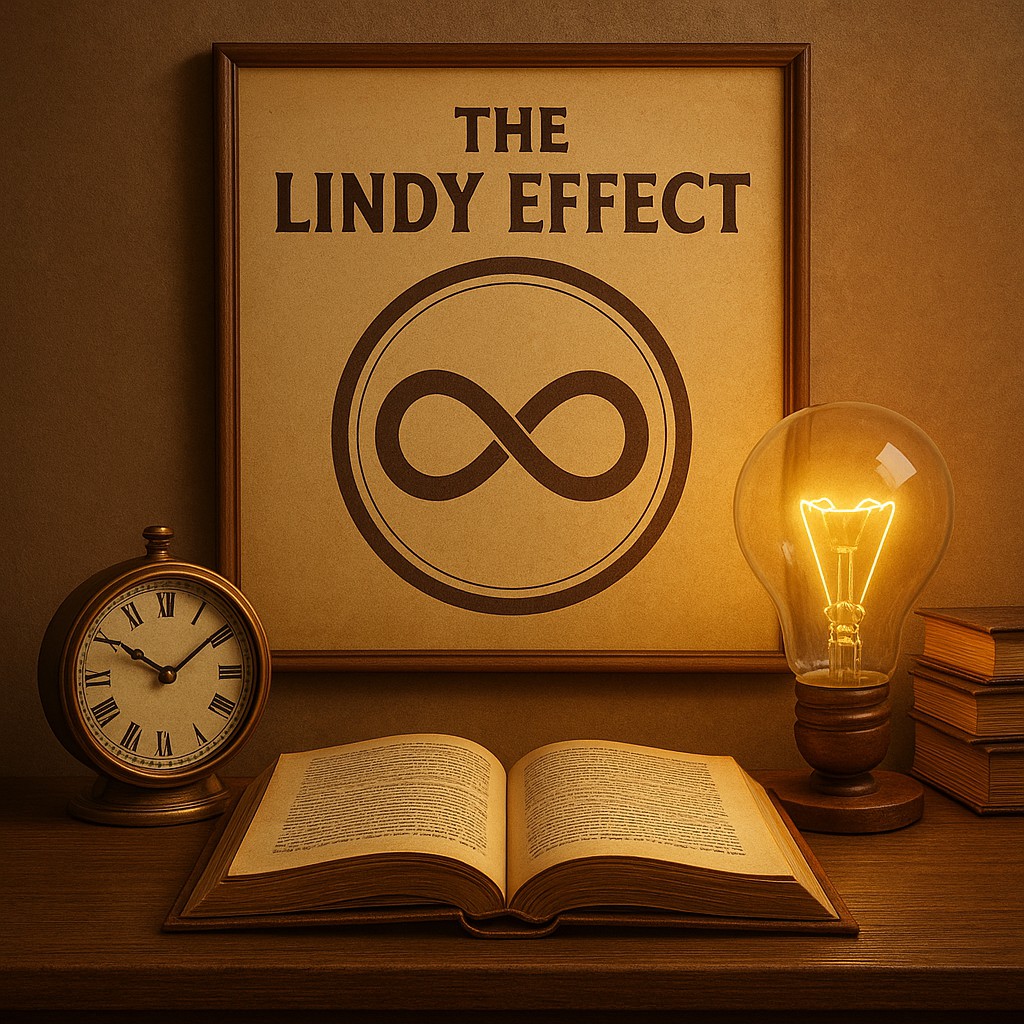
We live in an era obsessed with the "Next Big Thing." We wait in long lines for the latest smartphones and constantly refresh our social media feeds for the newest viral trends. We carry a deep-seated psychological bias: the newer a technology is, the more we believe it will define our future. We assume that if a startup is valued at billions today, it must become a cornerstone of our digital lives a decade from now. However, history and mathematics tell a counterintuitive story about what actually lasts.
When we look at the objects and ideas around us, we find a curious divide between the physical and the conceptual. If you buy a loaf of bread, you know it has a shelf life; every day it sits on your counter, it occupies more of its limited time. But if you pick up a copy of Homer’s Iliad, the opposite logic applies. The fact that this epic poem has survived for nearly three thousand years suggests it is far more likely to be read in the year 3000 than the latest celebrity memoir released this morning. This phenomenon, known as the Lindy Effect, provides a radical way to understand longevity. it helps us distinguish between fleeting fads and the enduring foundations of civilization.
The Curious Origins of a Timeless Concept
The "Lindy" name does not come from a grand laboratory or a prestigious university, but from a cheesecake deli in New York City. In the mid-twentieth century, comedians gathered at Lindy’s Deli to talk shop. They noticed something peculiar about Broadway shows: the longer a play had been running, the longer it was expected to stay open. If a show had been on stage for 100 nights, it was likely to make it to 200. If it survived for 50 weeks, it would likely survive another 50. It was as if the passage of time, instead of wearing the idea out, was actually giving it a second wind.
This observation was eventually formalized by the mathematician Benoit Mandelbrot and later popularized by the author Nassim Nicholas Taleb. The core realization is that "mortality" works differently for things that do not rot. For a human being, life expectancy decreases as you age because you are a biological organism subject to physical decay. You are "perishable." But for an idea, a book, or a mathematical proof, there is no biological clock. These entities do not age in the traditional sense; instead, they undergo a continuous series of tests. Every day they survive, they prove their relevance against shifting cultures, new technologies, and public scrutiny.
To understand why this happens, we have to view time as a filter. The world is constantly trying to kill off ideas. New theories replace old ones, fashions shift, and technological breakthroughs make old tools obsolete. When an idea survives for a century, it has already withstood massive pressure. It has survived wars, economic depressions, and cultural revolutions. This track record is the most reliable predictor we have for future survival. As Taleb noted, for the non-perishable, every additional day of survival adds to your life expectancy rather than subtracting from it.
Distinguishing the Fragile from the Robust
To apply the Lindy Effect correctly, we must first learn to distinguish between what is perishable and what is not. This sounds simple, but we frequently get it wrong. A bridge is a physical object that rusts and suffers from metal fatigue; it is perishable. However, the architectural principle of the "arch" that holds the bridge up is an idea. The bridge will eventually fall, but the concept of the arch will likely outlive the civilization that built it. This distinction is the key to making better long-term investments in our careers, our education, and even our hobbies.
Perishable items follow a "normal" distribution, often called a bell curve. Think of human height or the lifespan of a dog. There is a clear average, and most examples cluster around it. Non-perishable items follow a "power law" distribution. The more "age" they gain, the more "wealth" of future time they earn. This is why our bookshelves are a mix of ancient philosophy and modern thrillers, but our software folders are filled almost entirely with things created in the last five years. Software, while made of digital instructions, often behaves like a perishable item because it relies on specific hardware that eventually disappears.
The following table helps illustrate how we can categorize the world to determine what is likely to stick around:
| Category |
Perishable (Shrinking Life) |
Non-Perishable (Growing Life) |
| Physical Goods |
Fresh produce, sneakers, car tires |
Gold, geometric shapes, stone tools |
| Information |
Breaking news, weather reports |
Mathematics, myths, logic |
| Culture |
Pop hits, viral memes, fast fashion |
Classical music, religious texts, folk tales |
| Technology |
Smartphone models, VR headsets |
The wheel, the hammer, the alphabet |
| Social |
Corporate slogans, trendy slang |
Family structures, handshakes, storytelling |
Why Old Technologies are Often the Safest Bets
We tend to use the word "technology" for things with screens and batteries, but the most successful technologies are so reliable they have become nearly invisible. Consider the spoon. The design has remained largely unchanged for thousands of years. It doesn’t need a software update, a charging cable, or a manual. Because the spoon has been around for millennia, the Lindy Effect suggests it will likely be around for thousands of years more. It is a "Lindy" technology.
In contrast, consider a modern social media platform. It might feel like the center of the universe today, but it has only existed for about fifteen years. According to Lindy logic, its expected future life is roughly another fifteen years. This is a sobering thought for businesses that build their entire strategy around a single digital ecosystem. When we chase the latest trend, we are gambling on a high-risk outcome. We are betting that a newcomer can do what very few things in history have done: survive the relentless filtering of time.
This doesn't mean we should never adopt new things; it means we should build our foundations on older ones. If you are learning to code, for instance, picking up a trendy new "framework" from six months ago is risky because it might be dead in two years. However, learning the underlying logic of algorithms or the C programming language is a much safer bet. C has been around since the early 1970s. Its survival through the rise and fall of dozens of other languages suggests it contains fundamental truths about how computers work that will remain relevant for decades.
The Trap of Newness and the Lure of the Latest
The greatest enemy of the Lindy Effect is "neomania," the irrational love of something just because it is new. Marketing departments rely on neomania to convince us that our current tools are "obsolete" simply because a newer version exists. But if we look closely at what truly improves our lives, we find they are often the things refined over centuries. The Mediterranean diet is "Lindy" because it has been tested by hundreds of generations; a "fad diet" promoted by an influencer is not, as it has no track record of long-term safety.
To resist neomania, we must learn to value "skin in the game" and "time in the ring." When an idea has survived for a long time, it means it has been useful to many people in many different contexts. It is dense with information. Newer ideas are often "noisy"; they contain a lot of excitement but very little proven substance. This is why reading a book published fifty years ago is often more intellectually nourishing than reading fifty articles published this morning. The old book has already passed the filter; the articles are still fighting for their lives, and most will be forgotten by next Tuesday.
We can also apply this to social systems and traditions. Many modern reformers look at ancient customs and see them as irrational or outdated. However, from a Lindy perspective, a tradition that has survived for a millennium likely serves a hidden purpose. It has survived because it solves a recurring human problem or provides a necessary social bond. Tearing down a "Lindy" tradition without understanding why it lasted can lead to unintended consequences, as we are replacing a time-tested solution with a theory that has zero years of evidence behind it.
Building a Lindy-Compatible Life
How do we apply these insights to our own lives? It starts with how we choose what we consume. If you want to build a library of knowledge that doesn't expire, you should aim for a "Lindy-heavy" diet. This means spending more time with the classics and less time with the "current thing." If a book has been in print for fifty years, it is a much better use of your limited reading time than a bestseller that just hit the shelves. The older book has proven it has something to say to people across different eras.
In your professional life, focus on "Lindy skills." These are abilities not tied to a specific piece of software or a temporary market trend. Productive deep work, clear writing, persuasive speaking, and mathematical reasoning are all highly Lindy. They were valuable in the Roman Senate, they were valuable in the Renaissance, and they will be valuable in any future we can imagine. While you may need to learn new tools to stay competitive, your core value should come from these ancient, robust skills that have no expiration date.
Finally, the Lindy Effect teaches us intellectual humility. It reminds us that we are not the first generation to face complex problems, and we won't be the last. By looking at what has already survived for a long time, we find the most reliable blueprints for living well. Whether it is the design of a city, the structure of a story, or the wisdom of a proverb, the past is not a graveyard of old ideas. It is a laboratory where the most resilient truths have been distilled. When you invest in the Lindy, you aren't just looking backward; you are looking at the only parts of the present guaranteed to be part of the future.
Embracing the Lindy Effect is an act of liberation from the frantic pace of modern life. It gives you permission to stop worrying about every new notification, knowing that things truly worth your time are the ones that have already stood the test of centuries. By shifting your gaze away from the flickering lights of the immediate present and toward the steady glow of time-tested wisdom, you gain a clearer vision of what lies ahead. Walk with the things that last, and you will find yourself on much firmer ground.