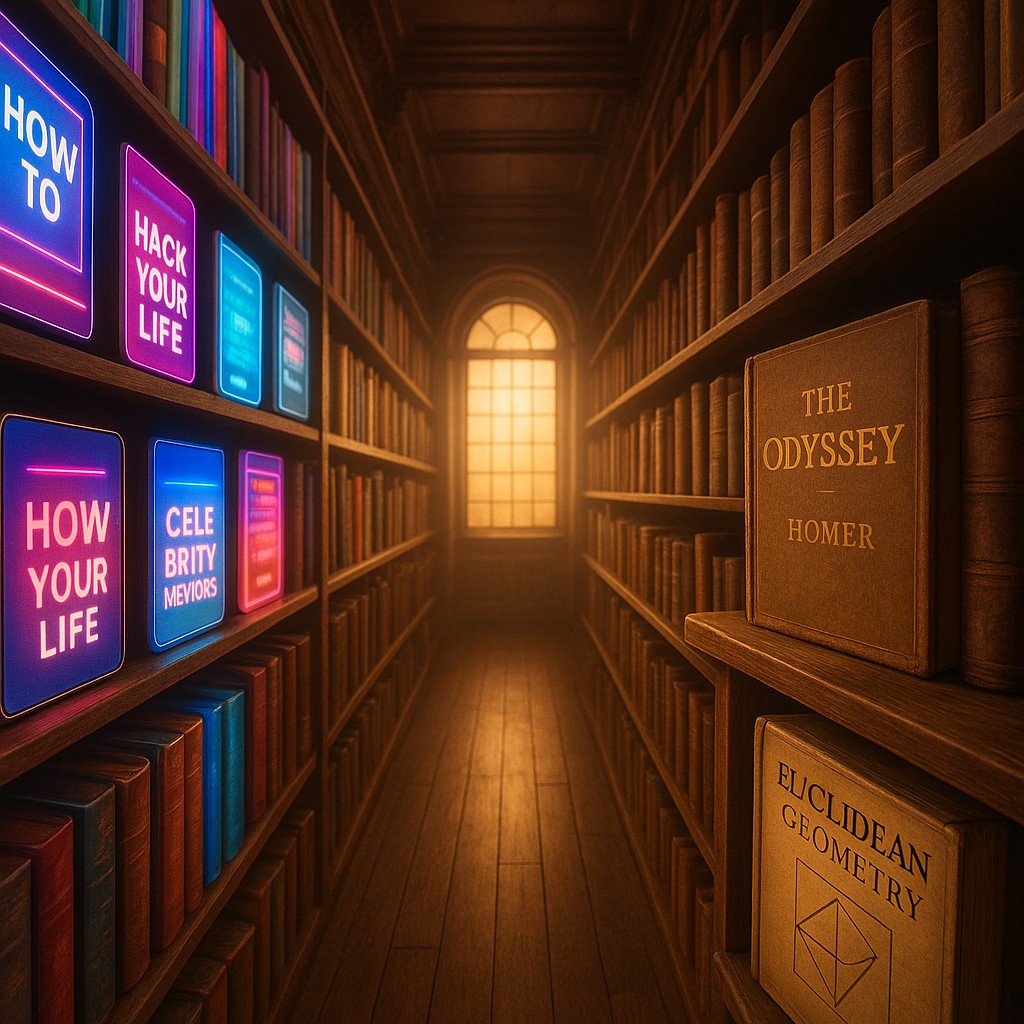
Imagine you are standing in a massive library where the shelves stretch toward the sun. On one side, you see a collection of shimmering, neon-colored tablets. These contain the very latest software manuals, celebrity memoirs, and "life hack" guides published just this morning. On the other side, tucked away in a dusty corner, sits a weathered copy of Homer’s The Odyssey and a collection of geometry proofs by Euclid.
If you had to place a high-stakes bet on which of these items would still be relevant, readable, and in use two hundred years from now, where would you put your money? Most of us are conditioned by a "cult of the new" to believe the latest invention is always the most durable. However, the logic of time suggests the exact opposite.
This surprising reality is known as the Lindy Effect. It is a concept that changes how we view the shelf life of everything from Shakespearean plays to the invention of the wheel. The theory suggests that for non-perishable things, the longer something has already survived, the longer it is likely to keep surviving.
While an eighty-year-old person is statistically closer to the end of their life than a twenty-year-old, the same does not apply to a book. A book that has been in print for eighty years is actually more likely to stay in print for another eighty years than a new release is. Understanding this principle helps us filter out the noise of the modern world. It allows us to focus our limited energy on "deep" knowledge that has already passed the ultimate stress test: the passage of time.
The Mystery of Aging Without Decaying
To understand why the Lindy Effect feels so strange, we first have to distinguish between things that perish and things that do not. Humans, cats, and heads of lettuce are perishable. As biological entities, we are governed by a "path toward the exit." Every day a human lives is a day they are theoretically closer to their expiration date. We follow a bell curve where the probability of dying increases as we age. This is a predictable, physical world limited by the laws of biology. If you meet a ninety-year-old man, you do not expect him to live another ninety years. In fact, you would be surprised if he lived another ten.
However, the world of ideas, stories, and technologies operates by an entirely different set of rules. These things do not have cells that decay or hearts that stop beating. They are "informational" entities. For these non-perishables, time acts as a validator rather than a killer.
Every year that Marcus Aurelius’s Meditations remains on the nightstands of world leaders is a year that confirms its usefulness. If a piece of advice has survived two thousand years of wars, plagues, and technological revolutions, it has proven it contains a core truth that outlives its original setting. Consequently, its "life expectancy" actually increases with every passing day it remains relevant.
A Tale of Two Cheesecakes and a Broadway Show
The name "Lindy" comes from a New York City deli called Lindy’s, where comedians used to gather to talk shop. As the legend goes, these performers noticed a pattern regarding Broadway shows. If a show had been running for one hundred days, it had likely found its audience and fixed its flaws, meaning it would probably run for another hundred. If it survived for a year, it was likely to last another year.
However, a show that opened just yesterday was a total gamble; it could close by the weekend. This observation was later polished and popularized by thinkers like Benoit Mandelbrot and Nassim Nicholas Taleb. They turned this casual insight into a mathematical framework for understanding risk and probability.
Consider the difference between a trendy "fusion" restaurant that opened last week and a traditional Italian trattoria that has been in the same family for three generations. The new restaurant is fragile. It relies on a specific trend, one chef, or a shout-out from a social media influencer. The older trattoria has already survived recessions, changing diets, and neighborhood shifts. The very fact that it is still there suggests it is "antifragile." It has survived because its value is not tied to a temporary whim, but to something fundamental, like good service or a timeless recipe. The older it gets, the more "Lindy" it becomes, signaling to the world that it was built to last.
Sorting the Perishable from the Persistent
One of the most common mistakes in applying the Lindy Effect is trying to use it on things with a physical expiration date. You cannot argue that because your milk has been in the fridge for two weeks, it will likely last another two weeks. That is a recipe for a very bad afternoon. To use this model effectively, you must categorize items into "Lindy" (information-based) and "Non-Lindy" (biological or mechanical).
While ideas are Lindy, the physical books they are printed on are not. A first edition of Don Quixote will eventually crumble into dust, but the story of the man fighting windmills is immune to the decay of the paper.
| Category |
Example |
Governed by |
Future Expectancy |
| Perishable |
A 2023 Toyota Camry |
Physical wear and tear |
Decreases as it ages |
| Non-Perishable |
The concept of the wheel |
Utility and logic |
Increases as it stays relevant |
| Perishable |
A Golden Retriever |
Biological aging |
Decreases as it ages |
| Non-Perishable |
Beethoven's 9th Symphony |
Aesthetic value |
Increases as it stays loved |
| Perishable |
A loaf of sourdough bread |
Organic decay |
Decreases as it ages |
| Non-Perishable |
The recipe for sourdough |
Cultural knowledge |
Increases as it is used |
As shown in the table above, the distinction lies in whether the item is a "copy" or the "concept" itself. Technology often straddles this line in fascinating ways. The physical smartphone in your pocket is highly perishable; it will likely be obsolete or broken in four years. However, the fundamental concepts of telecommunication and the binary logic that powers the software are highly Lindy. We often confuse the vessel with the content. By focusing on the vessel, we become obsessed with the newest gadget. By focusing on the content, we realize that the most important ideas in computing were actually developed in the 1960s and 70s.
Learning with a Focus on the Old
If we accept the Lindy Effect as a reliable guide for the future, it should radically change how we choose what to learn and read. We live in an era of "recency bias," where we assume the newest information is the most accurate or valuable. We scroll through news feeds and social media, consuming "knowledge" that has a shelf life of about twelve hours. This creates a treadmill effect where we are constantly running to stay current, yet our understanding feels increasingly shallow. The Lindy Effect suggests we should flip this approach.
If you spend your time reading the "Book of the Year," you are essentially a test subject for an unproven idea. There is a 90 percent chance that book will be forgotten in five years. However, if you spend that same time reading Aristotle, Seneca, or Lao Tzu, you are engaging with ideas that have already survived thousands of years of scrutiny. You are spending your "mental capital" on assets that are unlikely to lose value. This does not mean we should ignore modern breakthroughs, but rather that our foundation should be built on the "Lindy" classics. The fundamentals of human nature, logic, and mathematics do not change, even if the "apps" we use to express them do.
Filtering the Noise of the Tech Treadmill
The Lindy Effect also serves as a brilliant filter for detecting "neomania," which is the obsession with anything new simply because it is new. In the world of software development, for example, a new framework or programming language is released almost every month. Developers often feel immense pressure to learn every single one of them.
However, if you look at the industry through a Lindy lens, you will notice that the underlying foundations, like C, SQL, and the principles of algorithms, have remained stable for decades. A programmer who masters the "Lindy" core of computer science is far more resilient than one who only knows the "flavor of the week" JavaScript library.
This principle applies to health and diet as well. There is a reason why the Mediterranean diet remains a gold standard while extreme "juice cleanses" vanish within a season. The Mediterranean diet is Lindy; human populations have practiced it for centuries with clear success. It has survived the test of time and tradition. When a new "superfood" is discovered in a lab tomorrow, it has no Lindy status. It might be revolutionary, or it might be toxic in ways we won't discover for another twenty years. The Lindy Effect encourages a healthy skepticism of anything that hasn't been "cured" by time.
Why the Future Looks More Like the Past Than We Think
We often imagine the future as a sleek, sci-fi landscape filled with silver suits and flying cars. But if you were to transport someone from 1920 to the year 2024, they would be most surprised by what hasn't changed. We still sit on chairs (a technology thousands of years old), we still eat bread, we still tell stories, and we still use the basic principles of law and property that the Romans used.
The things that will be here in the year 2124 are likely the things that have already been here since 1924. The "new" parts of our world are the most fragile and the most likely to be replaced by even "newer" parts.
To be a "Lindy" thinker is to recognize that stability is a feature, not a bug. It allows us to stop chasing every shiny object and start investing in perennial truths. This approach reduces anxiety because it frees us from the fear of missing out on the latest trend. Usually, the latest trend is just a distraction that hasn't yet been filtered out by the relentless sieve of time. By aligning our lives with things that have already lasted, we build a foundation that is robust, deep, and surprisingly future-proof.
As you step back out into a world screaming for your attention with "breaking news" and "revolutionary inventions," remember the power of the old. Look for the books with worn spines, the recipes handed down through generations, and the mathematical principles that never fail. In a world obsessed with the next five minutes, there is a quiet, profound power in choosing things that have already survived the last five centuries. By leaning into the Lindy Effect, you aren't just looking backward; you are looking toward a future built on the most solid ground imaginable. Reach for the classics, master the fundamentals, and trust that the best way to predict what will stay is to see what has never left.