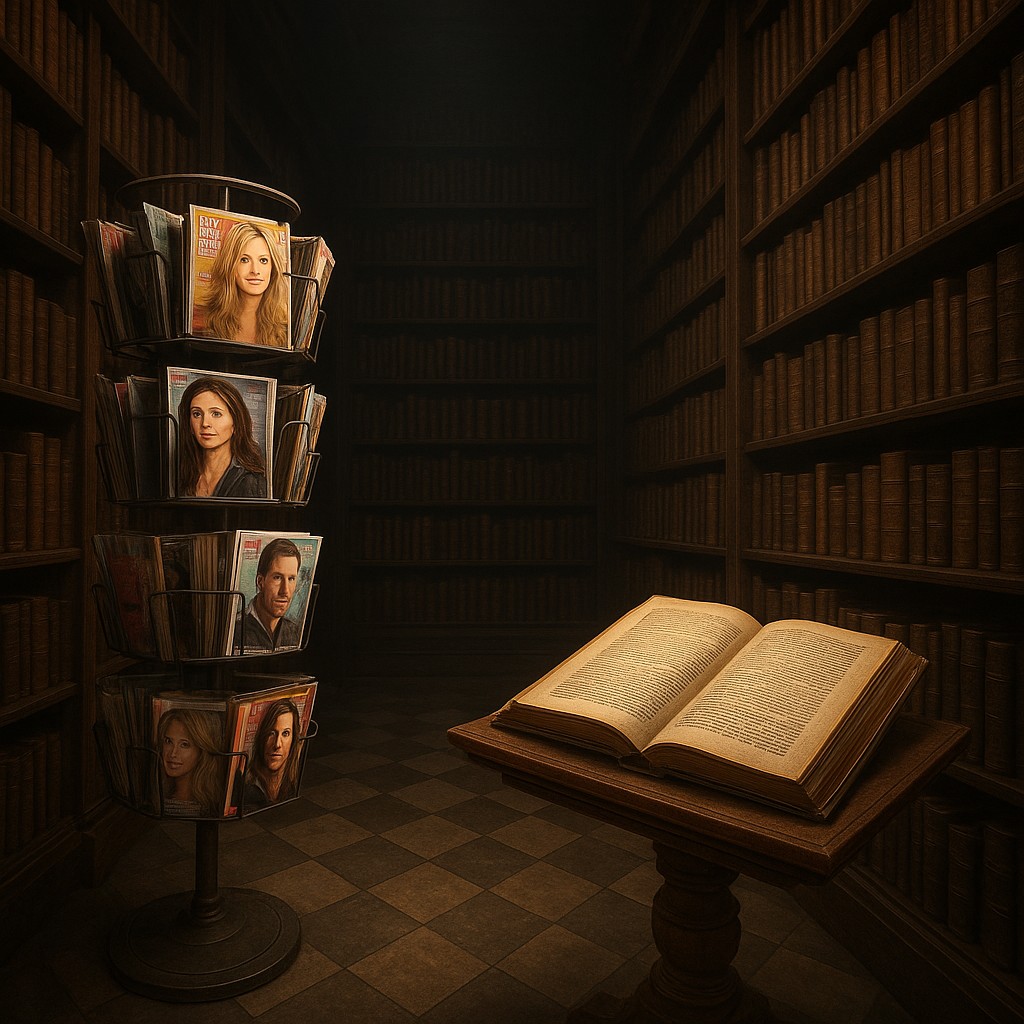
Imagine you are standing in a vast, ancient library where the shelves stretch toward a ceiling lost in shadow. On one side, there is a spinning rack of glossy magazines featuring celebrities whose names will be forgotten by next Tuesday. On the other side, there are leather-bound volumes of Homer’s Odyssey and Euclidean geometry. If you had to bet a thousand dollars on which of these items will still be in active use a century from now, the choice is easy. You do not need a degree in statistics to know that a three-thousand-year-old poem has a much higher chance of surviving another hundred years than a magazine has of surviving ten. This intuitive sense - that the old is bold and the durable is reliable - is more than just nostalgia. It is a mathematical phenomenon that helps us navigate an era of overwhelming information.
This concept is known as the Lindy Effect, and it turns our traditional understanding of aging upside down. While humans, cats, and refrigerators follow a predictable path of decay where every day lived brings us one day closer to the end, ideas and information work on a different clock. In the world of non-perishables, time is not a predator that consumes; it is a filter that validates. By understanding how this works, we can stop chasing every shiny new trend and start investing our attention in concepts that have already survived the brutal gauntlet of history. Whether you are choosing a book to read, a software language to learn, or a philosophy to live by, the Lindy Effect offers a rigorous way to predict the future by looking deep into the past.
The Counterintuitive Math of Immortality
To understand why some things get "younger" as they age, we have to distinguish between the perishable and the non-perishable. Living things are subject to senescence, the biological process of declining with age. A mammal has a maximum life expectancy; a forty-year-old human is statistically likely to live another forty years, but an eighty-year-old human is very unlikely to live another eighty. We are fragile, and every tick of the clock uses up our finite biological capital. Physical objects like cars or washing machines follow a similar path because they suffer from mechanical wear and tear. This is "linear" aging, where the risk of death increases with every passing year.
The Lindy Effect applies to the non-perishable realm: ideas, stories, recipes, musical styles, and religions. For these things, the mortality rate actually decreases over time. This is often called "power law" aging, a mathematical pattern where a value changes at a constant rate relative to its size. If a play has been performed on Broadway for one hundred days, it is expected to run for another one hundred days. If it survives until its two-hundredth day, its life expectancy grows to another two hundred days. This seems like magic, but it is actually a reflection of survival of the fittest. The longer something lasts, the more "antifragile" it proves to be - meaning it actually gets stronger under stress. It has survived cultural shifts, wars, technological revolutions, and changes in taste. The mere fact of its survival is evidence that it contains a core of utility or truth that works regardless of the era.
Broadway Cheesecakes and Mathematical Origins
The name for this effect did not come from a prestigious laboratory or a dusty university archive; it came from a deli in Manhattan. Lindy’s Deli was a famous hangout for comedians in the mid-twentieth century. these performers noticed a pattern: a comedian's total material predicted how long they would stay in show business, but specifically, the longevity of their current jokes predicted their future success. If a joke had been funny for ten years, it would likely be funny for ten more. The concept was later formalized by the mathematician Benoit Mandelbrot and popularized in the modern era by the author Nassim Nicholas Taleb. They realized that for informational entities, the past is the best statistical stand-in for the future.
This realization is a powerful antidote to "neomania," the modern obsession with the brand new. We often assume the latest version of a thing is the best, but in the realm of ideas, the latest is often the most fragile. Technology that has been around for decades, like the bicycle or the paper book, is likely to outlast the latest VR headset or e-reader because it has already solved the fundamental problems of its existence. When you look at the world through this lens, you realize that the most "modern" things are actually the most likely to disappear, while the "ancient" things are the most likely to remain.
| Category |
Typical Aging Pattern |
Expected Lifespan Trajectory |
Examples |
| Perishable |
Linear / Degenerative |
Decreases with every day lived |
Humans, Dogs, Fruit, Cars |
| Non-Perishable |
Power Law / Regenerative |
Increases with every day survived |
Myths, Math, Languages, Religions |
| Fragile |
High Early Mortality |
Likely to crash within weeks |
Viral memes, Pop songs, Trendy diets |
| Antifragile |
Lindy-Consistent |
Gains strength from time and stress |
Stoicism, Chess, Fermentation recipes |
Time as the Ultimate Filter
Why does time have this predictive power? It is because time acts as a universal stress test. Every year that passes brings new challenges: a different political regime, a new invention, or a shift in social values. If an idea can survive all of these changes, it means it is not dependent on the specific circumstances of the era in which it was born. A "bestselling" business book from last year might rely on strategies for a specific social media algorithm. When that algorithm changes, the book becomes useless. Meanwhile, Machiavelli’s The Prince remains relevant because it describes human nature, which does not change as fast as software.
This filtering mechanism helps us identify what is truly valuable versus what is merely "noisy" data. Our modern world is designed to grab our attention with the novel and the sensational. "Breaking news," "disruptive" startups, and "revolutionary" wellness hacks all compete for our brain space. However, most of these fail the Lindy test. They are fragile because they have not yet been exposed to the chaotic fluctuations of time. When we prioritize Lindy-compatible information, we are essentially outsourcing our filtering process to the collective experience of humanity. If people have been reading Meditations by Marcus Aurelius for nearly two millennia, it is because the signal in that book is strong enough to pierce through twenty centuries of noise.
Developing a Lindy-First Lifestyle
Applying the Lindy Effect to your daily life requires a shift in how you consume information and make decisions. Start by looking at your bookshelf or your watchlist. If you only read books published in the last twelve months, you are essentially a guinea pig for the publishing industry. You are testing material that has not yet been vetted by time. A more stable strategy is to ensure a significant portion of what you consume consists of the classics. If you want to understand economics, you might get more long-term value from Adam Smith than from a social media thread discussing this morning's stock market dip.
The same applies to learning skills. If you spend all your time learning the specific layout of a piece of software released last month, that knowledge will likely be obsolete within five years. However, if you spend time learning the fundamental principles of design, logic, or rhetoric, you are acquiring "Lindy" skills. These are skills that have been valuable for centuries and will remain valuable whether we are typing on screens or projecting holograms. By focusing on the old fundamentals, you build a foundation that can resist the shifting sands of the economy.
Common Misconceptions and the Limits of the Law
It is important to remember that the Lindy Effect is a statistical observation, not a moral judgment. Just because an idea has lasted a long time does not mean it is "good" in an ethical sense. Dangerous superstitions and systemic injustices can be Lindy too. Survival proves endurance and toughness, but it does not replace the need for moral evaluation. The Lindy Effect tells us what is likely to persist, but we still have the power to decide what we want to persist. We must be careful not to fall into the trap of thinking that anything old is automatically better than anything new. Rather, we should use age as a proxy for reliability in systems we don't fully understand.
Furthermore, the Lindy Effect does not apply to things with an internal clock or a built-in expiration date. You cannot apply Lindy to a carton of milk; it will not become immortal just because it survived a week in your fridge. It also struggles in fields with a genuine, cumulative "frontier" of knowledge, such as medicine or experimental physics. While the basic laws of physics are Lindy, contemporary medical treatments are often replaced by better ones. However, even in medicine, you can see Lindy at play: the ancient advice to walk daily, sleep well, and eat whole foods has outlived thousands of fad diets and "miracle" supplements. The foundational truths stay, while the experimental fringe rotates rapidly.
Building for the Long Term
When we embrace the Lindy Effect, we find a strange sense of peace. We no longer feel the frantic need to keep up with every update, "hot take," or trending topic. We realize that most of what is being discussed today will be forgotten by next year; therefore, ignoring it is not just okay - it is a competitive advantage. By focusing on ideas that have already stood the test of time, we are standing on the shoulders of giants rather than trying to balance on shifting sand. We become more discerning, grounded, and effective in how we use our limited mental energy.
The beauty of the Lindy Effect is that it rewards patience and curiosity about the past. It suggests that the future is not a total mystery; it is hidden in plain sight, tucked away in the rituals, stories, and principles that our ancestors refused to let go of. As you move forward, try to look for the "Lindy" version of your interests. Seek out the recipes your grandmother used, the books that have been in print for decades, and the tools that don't require a battery. In doing so, you aren't just being a traditionalist; you are being a master of probability. You are aligning yourself with the forces of time, ensuring that the knowledge you gain today will still serve you, and perhaps the world, for many years to come.