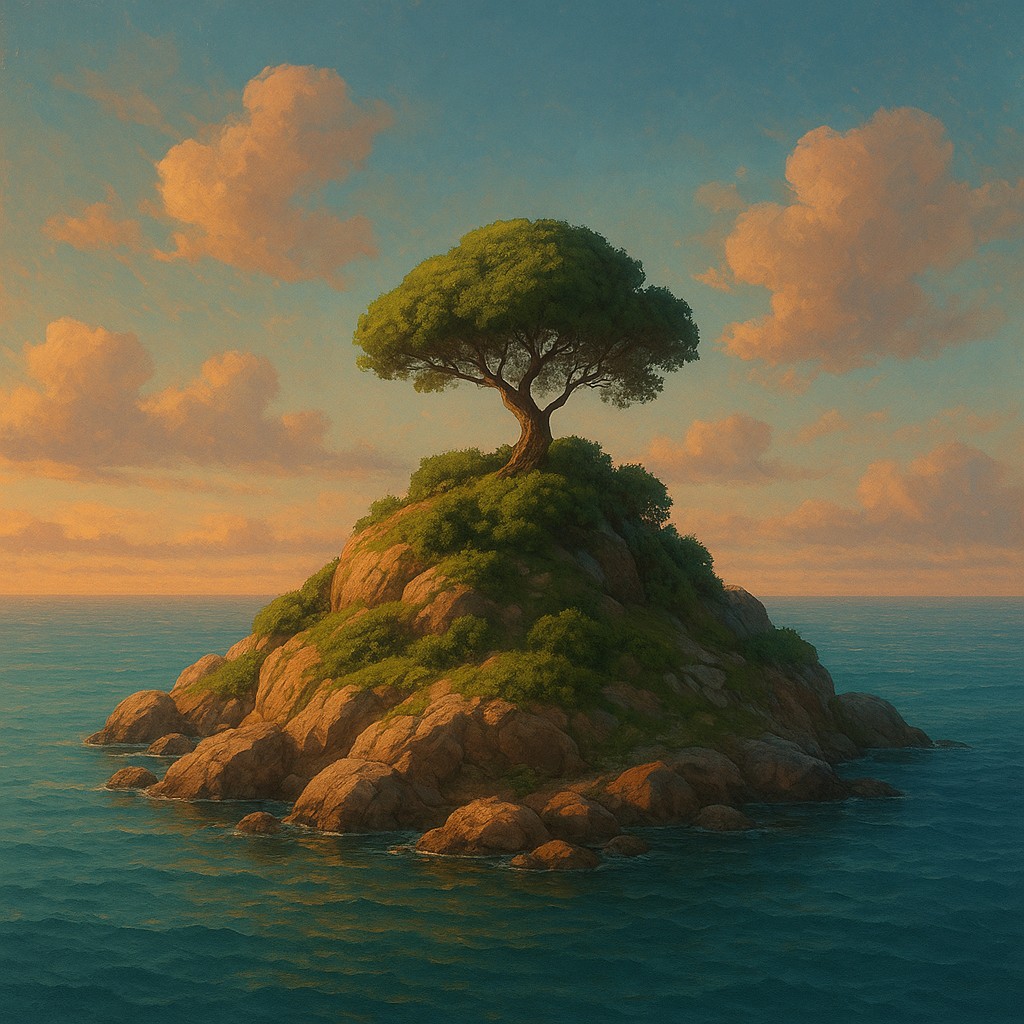
Imagine a small, rocky island sitting hundreds of miles from the nearest coast. If you dropped a few finches or lizards there and returned ten thousand years later, you wouldn’t find the same animals you left behind. Instead, you would find something strange, specialized, and completely unique. This is the foundation of biological evolution: the idea that physical distance let's life experiment with new forms without being "watered down" by the rest of the species. But what if this same rule applied to the way we speak, the clothes we wear, and the ideas we hold dear?
In our connected world of satellite internet and global trade, we often assume everyone is slowly blending into one giant, identical culture. We eat the same fast food and watch the same streaming hits, creating a sense that the world’s "weirdness" is being smoothed over. However, a powerful force is working in the opposite direction. Known as the Lindau Effect, this phenomenon suggests that when a group of people is socially or geographically cut off, their culture doesn't just stand still. Instead, it begins to drift and speed up, creating a unique identity that can become unrecognizable to outsiders in a surprisingly short time.
The Cultural Greenhouses of Isolation
To understand how isolation breeds uniqueness, we have to look at how information moves. In a large, busy city, culture is constantly being "standardized." If you start using a strange new word or wearing a bizarre hat, the sheer number of people around you will likely correct that behavior through social pressure or simply by drowning out your influence. The mainstream acts like a heavy anchor, keeping everyone’s behavior within a predictable range. This is why major global cities often feel similar; they are all plugged into the same massive loop of information.
When a group is cut off from that loop, the anchor is lifted. In a lonely mountain village or a remote island, the "mainstream" no longer exists to enforce a standard. If a charismatic leader in that village starts using a specific phrase, or if a local craftsman develops a new way to weave baskets, that innovation isn't buried by global trends. Instead, it gets trapped. It bounces around the small community, gaining steam until it becomes the new local norm. This is the Lindau Effect in action: isolation acts like a greenhouse, protecting fragile new ideas and letting them grow into sturdy, distinct traditions that would have been crushed in the wild environment of a globalized society.
This process isn't just about physical distance. In the digital age, we see this happening in "virtual islands." Think of a niche internet forum or a private chat server dedicated to an obscure hobby. These groups often develop their own slang, inside jokes, and rules that are totally confusing to an outsider. They are socially isolated from the "General Internet," and as a result, their micro-culture evolves at breakneck speed. Within months, a community of gamers or hobbyists can develop a way of speaking so specific that someone from a neighboring digital community would need a dictionary to understand them.
The Linguistic Laboratory of the Deep Valleys
Language is perhaps the clearest example of the Lindau Effect. If you look at a map of the world’s most linguistically diverse regions, you won’t find them on flat, open plains. You find them in the dense jungles of Papua New Guinea or the rugged, jagged peaks of the Caucasus Mountains. Here, geography acts as a series of walls. When a group settles in a valley and is separated from their neighbors by a dangerous mountain pass, their language begins to drift. Because they aren't talking to the people on the other side of the mountain, there is no "correction" to keep their speech patterns the same.
Over generations, small "slips" or creative flourishes in speech become permanent. A vowel might shift, a grammar rule might get simpler, or a new word might be invented for a local flower. Because the group is small, these changes take hold quickly. This is similar to the "Founder Effect" in genetics, where a small starting population carries only a tiny slice of the original group's traits, and any new mutation becomes a dominant feature for all their descendants. In language, the "mutation" is a new slang word or a unique accent that eventually hardens into a completely different language.
This acceleration is why we see such a sharp contrast between "Old World" and "New World" language diversity. In areas where people have stayed in isolated clusters for thousands of years, you can find two villages five miles apart that speak languages as different as English and Mandarin. Meanwhile, in vast, open territories that were settled more recently, you can travel three thousand miles and find people speaking almost exactly the same way. The constant flow of people prevents the Lindau Effect from taking hold, keeping the cultural soup well-stirred and uniform.
Comparing Biological and Cultural Divergence
It helps to see how these two systems of evolution mirror one another. While biology deals with genes and physical survival, culture deals with "memes" (units of cultural information) and social belonging. Both systems react to isolation in remarkably similar ways, leading to patterns that scientists can actually predict.
| Feature |
Biological Evolution (Island) |
Cultural Evolution (Lindau Effect) |
| Driver of Change |
Genetic mutations and local adaptation |
Language innovation and social trends |
| Isolation Mechanism |
Oceans, mountains, or deserts |
Language barriers, geography, or digital echo chambers |
| Result of Separation |
New species (Speciation) |
New dialects, religions, or customs |
| Speed of Change |
Slow (thousands of years) |
Fast (decades or generations) |
| Main Threat |
Over-specialization and extinction |
Knowledge loss (The Bottleneck Effect) |
| Effect of Re-connection |
Invasive species can wipe out locals |
Global blending (Loss of unique identity) |
This comparison highlights a fascinating reality: our mental lives follow many of the same "rules" as our physical bodies. When we are separated from the herd, we don't just stop changing; we change in a way that makes us more specific to our immediate surroundings. The Lindau Effect reminds us that "different" does not mean "backward." A mountain dialect isn't a "failed" version of a national language; it is a highly specialized tool that evolved to fit a specific social ecosystem.
The Risk of the Narrowing Bottleneck
While the Lindau Effect is a source of creativity and variety, it carries a hidden danger called the "Cultural Bottleneck." For a culture to remain healthy, it needs a "critical mass" of people to pass down its knowledge. If a group becomes too isolated and its population shrinks too much, it begins to lose its hard-earned wisdom. This isn't because the people are less intelligent, but because there are simply not enough minds to hold all the complex information a society needs to function.
Imagine an isolated tribe that has mastered the art of building complex sea-faring canoes. This skill requires a master woodworker, a navigator, and someone who knows how to harvest specific tree resins. If a disaster or a disease hits and the population drops, the person who knows the secret of the resin might die without a student. Suddenly, the entire culture "backslides," not because it wanted to, but because a link in the chain was broken. We see this in the history of Tasmania, where indigenous groups became so isolated from mainland Australia that they actually lost technologies, such as bone tools and cold-weather clothing, that their ancestors had once used.
This reveals a delicate balance every culture must strike. Too much connection to the outside world leads to "flattening," where the unique colors of a culture are washed away by a global gray tide. But too much isolation leads to a fragile ecosystem where a single stroke of bad luck can erase centuries of progress. The goal for a healthy society is often to be "semi-permeable": open enough to trade useful ideas and stay healthy, but closed enough to let its own local genius grow without being drowned out by the noise of the mainstream.
Redefining Progress and Diversity
One of the deepest lessons of the Lindau Effect is how it changes our view of "remote" or "traditional" communities. In the past, modern observers often looked at isolated groups as "primitive" or "stuck in the past." We assumed they were simply behind us on a single, straight path of progress. However, the Lindau Effect shows that these groups aren't "behind" at all. They have been moving just as fast as the rest of the world, but they have been moving in a different direction.
A remote village in the Andes isn't a time capsule from the year 1500; it is a modern community that has spent the last five hundred years specializing in a very specific set of social and environmental challenges. Their music, their farming techniques, and their family structures have evolved to be perfectly suited for the high altitude and the isolation of the mountains. When we value diversity, we are essentially valuing the fruits of separation. We are acknowledging that the world is more interesting and more resilient when we have many different "laboratories" testing different ways to be human.
This is especially important today as we deal with globalization. We often talk about "protecting" diversity as if it’s a fragile museum display, but the Lindau Effect suggests that diversity is a living process. If we want to keep the world colorful, we have to allow for spaces where people can be "off the grid," both physically and mentally. We need pockets where the global standard doesn't reach, allowing new subcultures, new art, and new ways of thinking to develop in peace.
Embracing the Power of the Fringe
Recognizing the Lindau Effect lets us look at the "fringe" of society with new respect. Whether it is a small town with a weird annual festival, a group of scientists working on an unusual theory, or a community of artists living in a secluded commune, these are the places where the next great leap in human culture is likely to start. They are the evolutionary islands where the rules of the mainstream don't apply, and where the "weird" has the room it needs to become "wonderful."
In your own life, you might feel the pressure to constantly stay "in the loop." We are told we must follow every trend, use every new app, and stay updated on every news story to stay relevant. But there is a quiet power in stepping away from the crowd. By cultivating your own "island" of interests, reading books that aren't on the bestseller list, or pursuing hobbies that your peers don't understand, you are creating the conditions for your own personal Lindau Effect. You are giving your ideas the space to branch off, to grow sharp, and to become truly your own. Diversity is not just something we watch in the world; it is something we create whenever we have the courage to stand apart and let our own unique traits take root.