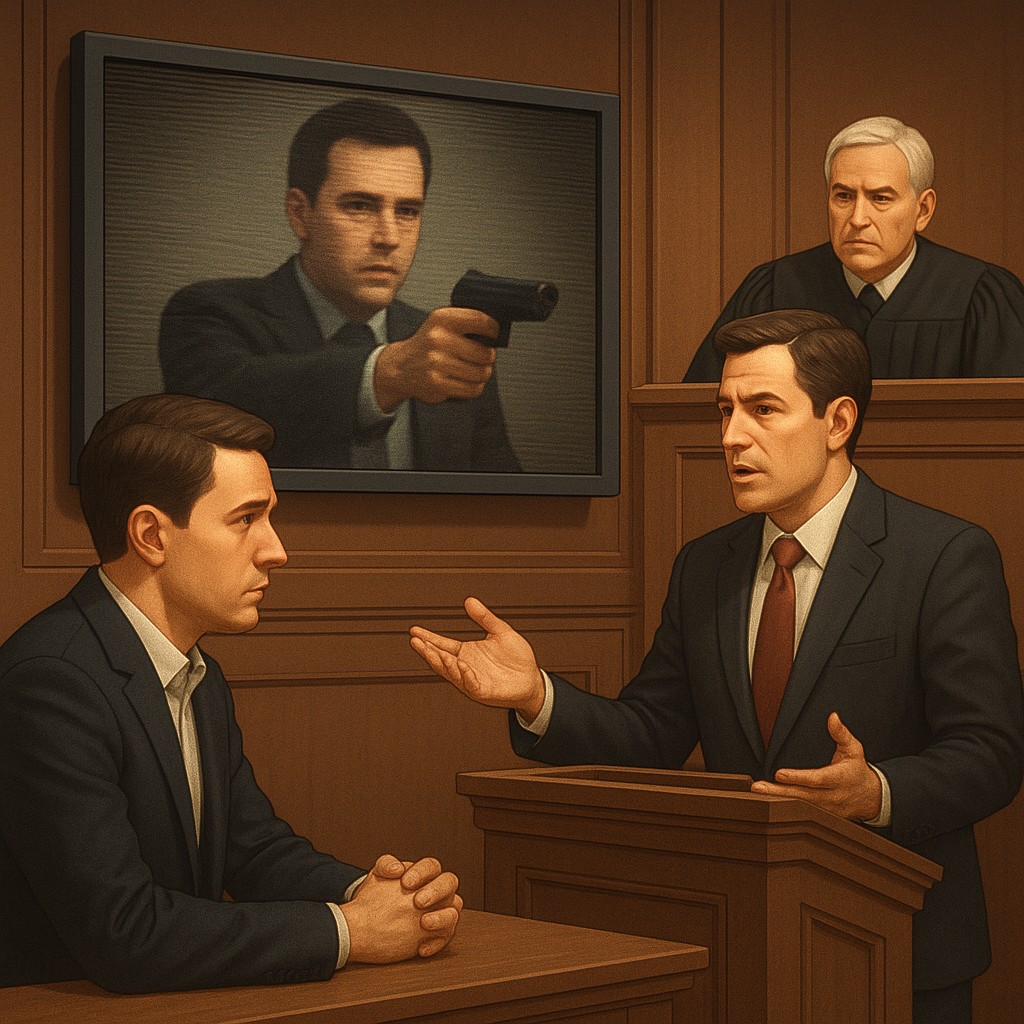
Imagine walking into a courtroom to defend yourself against a serious charge. The prosecution shows a high-definition video where you clearly commit the crime, yet you know for a fact you were miles away when it happened. In the past, this would have been a science fiction nightmare. Today, "synthetic media" is so advanced that the old saying "seeing is believing" has become a dangerous relic. We have entered an age where an algorithm can rewrite the fabric of visual reality, making it nearly impossible for the average person to tell the difference between a recorded moment and a computer-generated one. This shift doesn't just threaten our social media feeds; it shakes the foundation of a justice system that relies on objective evidence to find the truth.
However, this digital arms race has an unexpected twist. While the ability to fake evidence is a massive problem, the simple knowledge that fakes exist has created a strange legal loophole. This is known as the "liar’s dividend." It happens when a defendant is confronted with 100 percent real evidence but claims it is a "deepfake" (a realistic AI-generated video) simply because the public knows such things are possible. By casting doubt on every pixel, the mere existence of AI allows the guilty to hide in plain sight, claiming the truth itself is a forgery. In this environment, the burden of proof begins to collapse under the weight of universal skepticism.
The Architecture of Erased Trust
To understand how we got here, we have to look at how the liar’s dividend works. Traditionally, a photo or recording had high "probative value," meaning it was treated as strong proof. If a camera caught you speeding, you paid the fine. The system worked because the cost and skill needed to forge a realistic video were once incredibly high, limited to Hollywood studios with millions of dollars. Today, that barrier has fallen. Tools like Generative Adversarial Networks (GANs) and diffusion models have made forgery available to everyone, allowing anyone with a decent computer to swap faces or clone voices with startling accuracy.
This shift doesn't just make it easier to lie; it makes it harder to tell the truth. When people realize any video could be a fake, their basic level of trust drops. This is the "dividend" the liar receives. They don't even need a high-quality fake to win; they just need to point at a real video and say, "That looks like AI to me." Because our brains are now trained to look for "uncanny valley" glitches (that eerie feeling when a digital person looks almost, but not quite, human), we start seeing them even when they aren't there. A natural stutter or a weird reflection in an eye becomes "proof" of a deepfake to a skeptical jury.
This flips the traditional legal script. In the past, the person claiming a video was fake had to prove it was tampered with. Now, the person presenting the video often has to prove it is real. This adds a massive cost to the legal system. It requires hiring expensive experts to analyze metadata (the hidden digital history of a file), lighting patterns, or even "photoplethysmography" (the study of blood flow patterns in the skin) just to get a single piece of evidence admitted. If an accuser cannot afford this level of testing, the evidence might be thrown out, letting the liar walk free.
The Cryptographic Shield and Metadata Chains
As the "seeing is believing" model fails, the legal and tech worlds are moving toward a "math is believing" model. This involves "digital provenance," which acts like a digital birth certificate for a file. Instead of looking at the image to see if it looks real, we look at the invisible data attached to it. Groups like the C2PA (Coalition for Content Provenance and Authenticity) are creating standards to track where a file came from and how it has been edited.
The core technology here is the "cryptographic timestamp" and the "digital signature." Imagine a camera that "seals" an image the millisecond it is taken. The camera uses a secure chip to sign the file with a unique digital key. This signature is linked to a specific time, date, and GPS location. If even one pixel is changed later, the seal breaks. In court, a lawyer wouldn't just show the video; they would show the "chain of custody" for the pixels, proving the file in court is identical to the one that left the camera lens.
This creates a "hardware-to-hallway" pipeline. For evidence to be the gold standard, it will likely need to be captured on "authenticated" devices. Smartphones are becoming forensic tools that keep a secure record of their own activity. However, this transition shifts our trust from our own eyes to the companies that make the chips and software. We are essentially betting that the math behind the encryption is more reliable than our own senses.
The Digital Divide in the Courtroom
While high-tech solutions like C2PA offer a way out of the liar’s dividend, they create a new problem: the "evidence elite." If courts prioritize "authenticated" media, what happens to someone who records a crime on an old phone that doesn't have these features? Or a whistleblower who must strip data from a file to hide their identity? There is a risk that truthful evidence will be rejected simply because it lacks a "digital pedigree."
This could create a two-tiered justice system. On one side are wealthy individuals or corporations who can afford secure hardware and expert witnesses. On the other are everyday citizens whose genuine recordings might be dismissed as "unverifiable." This is the secondary sting of the liar’s dividend: by raising the bar for what counts as "truth," we inadvertently make it harder for marginalized voices to be heard.
| Feature |
Visual Evidence (Old Model) |
Authenticated Evidence (New Model) |
| Source of Trust |
Human perception and common sense. |
Digital signatures and metadata. |
| Primary Weakness |
Vulnerable to AI deepfakes and forgeries. |
Vulnerable to hardware hacking or "analog holes." |
| Burden of Proof |
Usually on the person claiming it is fake. |
Increasingly on the person claiming it is real. |
| Accessibility |
High (anyone with a camera can participate). |
Low (requires specific, expensive hardware). |
| Verification |
Visual inspection and traditional forensics. |
Automated digital verification. |
The "analog hole" mentioned above is a specific weakness: even with perfect encryption, someone could play a deepfake on a high-quality screen and record that screen with an "authenticated" camera. The camera would faithfully sign the recording, certifying a "real" recording of a "fake" event. This shows that technology cannot be the only judge of truth. We still need human intuition and old-fashioned detective work to connect the dots.
Redesigning the Rules of Truth
The legal system is racing to adapt. Judges are realizing they cannot guard the gates of reality without new tools. One idea is a "preliminary hearing for authenticity." Before a jury ever sees a video, the judge would hold a mini-trial to discuss its technical origins. If the evidence has a clear digital history, it is allowed in. If not, the person presenting it must work much harder to prove it wasn't manipulated.
Another strategy involves jury instructions. Soon, jurors might be given a crash course in the liar’s dividend before a trial starts. Judges might explicitly warn them: "Do not assume a video is fake just because deepfakes exist, but do not assume it is real just because it looks convincing." This is a difficult task. We are asking humans to ignore millions of years of evolution that tells us seeing something happen means it actually happened.
Ultimately, the fight against the liar’s dividend is about more than just software; it is about "media literacy," or the ability to think critically about what we see. We are learning that the digital world is not a perfect mirror of the physical world. To navigate it, we must look for context rather than just content. If a video shows a politician saying something shocking, we shouldn't just look at the video itself. We should ask: Was there a crowd? Are there other angles? Does the data match the weather reports from that day? The truth is no longer a single file; it is a web of supporting facts.
The liar’s dividend only works if we become so cynical that we stop believing the truth is possible. By understanding how digital forgeries work and how new authentication systems are built, you are developing a "digital immune system." Stay curious, stay skeptical, and do not let the abundance of fakes blind you to what is genuine.