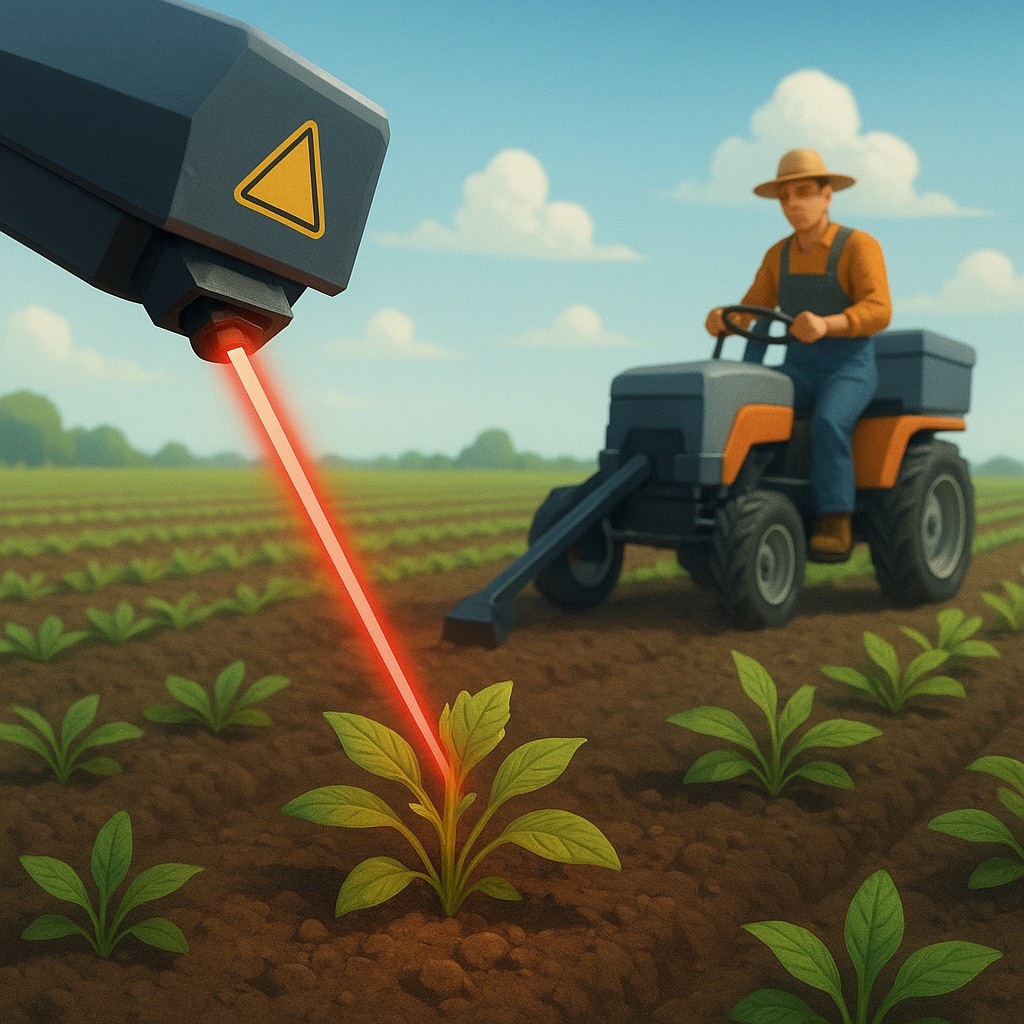
For decades, the standard way we grow our food has involved something of a chemical arms race. Farmers, struggling against stubborn weeds that steal nutrients from their crops, have relied on a strategy of saturation. They spray massive amounts of herbicide across entire fields, hoping to kill the invaders while leaving genetically modified crops standing. However, nature is notoriously hard to outsmart. Just as bacteria develop resistance to overused antibiotics, weeds have evolved to ignore these chemical cocktails. Today, we face a global "superweed" crisis where traditional sprays simply bounce off the leaves of the very plants they are meant to destroy, leaving farmers with ruined soil and a losing hand.
Beyond the biology of resistance, the environmental cost of this blunt-force approach is now impossible to ignore. Chemicals do not just sit on a leaf; they leach into groundwater, drift into neighboring ecosystems, and disrupt the delicate microbiome of the soil. This invisible universe of fungi and bacteria is what actually makes soil "alive," and drenching it in poison is like trying to heal a patient by destroying their immune system. We have reached a tipping point where the old ways are both ineffective and ecologically expensive. We are now entering the era of precision agriculture, where we are swapping the chemical sprayer for the surgical accuracy of the laser.
The Evolutionary Dead End of Chemical Warfare
To understand why we are now mounting high-powered CO2 lasers onto tractors, we have to look at the spectacular failure of the "blanket spray" philosophy. When a farmer sprays a field with a broad-spectrum herbicide, they are essentially performing a massive experiment in natural selection. If 99.9 percent of the weeds die, that 0.1 percent that survived carries a specific genetic trait that makes it immune to the poison. These survivors then breed, and within a few generations, you have an entire field of weeds that treat expensive chemicals like a refreshing morning mist. This has led to an "escalation cycle" where companies develop stronger chemicals, which lead to tougher weeds, which require even more toxic sprays.
Furthermore, chemicals do not discriminate when it comes to soil health. Healthy soil is a complex living engine. It contains a network of mycelium (underground fungal threads) and beneficial bacteria that help plants absorb minerals and retain water. When you saturate a field with herbicides, you aren't just hitting the weeds; you are also hitting these microscopic allies. This wears down the soil over time, making it harder to grow anything without even more artificial help. The move toward thermal eradication, or killing weeds with heat, is a way to hit the reset button on this cycle. By using energy instead of chemistry, we remove the weed's ability to develop resistance. No plant can evolve a way to survive being boiled from the inside out.
Teaching Machines to Play I-Spy at Forty Miles per Hour
The hardware of a laser weeder is impressive, but the real magic lies in the "brain" of the machine. Identifying a weed might seem simple to a human, but for a computer, it is an incredibly complex visual puzzle. A field isn't a clean grid; it is a chaotic jumble of shapes, shades of green, and overlapping textures. To solve this, agricultural engineers use "deep learning" models - basically computer programs that have been trained on millions of images of plants. These robots are essentially playing a high-stakes game of "I-Spy" while moving through a field at a steady pace.
When the robot’s cameras scan the ground, the onboard computer must distinguish between a tiny, two-day-old kale sprout and a tiny, two-day-old pigweed sprout. These look almost identical to the untrained eye. The system analyzes the jagged edges of the leaves, the angle of the stem, and even the specific way the plant reflects light. This processing happens in milliseconds. While a human might take a second to decide whether to pull a plant, the AI makes thousands of these decisions every minute. Once it identifies an intruder, the system locks on with the precision of a marksman.
The Physics of the Instant Boil
Once the computer vision system identifies a weed, the heavy lifting begins. The robot fires a series of high-energy CO2 lasers directly at the "meristem," which is the plant's growing point. Unlike a movie laser that might cut something in half, these lasers are designed for thermal transfer (moving heat). They strike the plant and are absorbed by the water molecules inside the plant’s cells. In a fraction of a second, that water is heated past the boiling point. Because plant cell walls are rigid, the resulting steam creates immense internal pressure, causing the cells to literally burst from the inside.
This method is known as thermal eradication, and it is remarkably efficient. By targeting only the weed and firing for just a brief pulse, the laser delivers a lethal dose of energy without heating the surrounding air or the soil. The nearby crop remains completely unaffected, even if it is only a few millimeters away from the target. This is the difference between a "carpet bomb" (chemical spraying) and a "surgical strike" (laser weeding). The weed doesn't just die; it is structurally broken and withers into organic matter that eventually decays back into the soil, providing a tiny bit of compost for the actual crops.
| Feature |
Chemical Herbicides |
Autonomous Laser Weeding |
| Primary Method |
Biochemical disruption (poison) |
Thermal cell destruction (heat) |
| Targeting Precision |
Low (covers the entire field) |
Sub-millimeter (hits specific leaves) |
| Soil Impact |
Chemical buildup; kills microbes |
No chemical residue; protects microbes |
| Resistance |
High (weeds become immune) |
None (plants cannot evolve heat resistance) |
| Weather Dependency |
High (cannot spray in wind or rain) |
Low (can operate day or night) |
| Organic Standing |
Generally not allowed |
Fully compatible with organic standards |
Preserving the Underground Architecture
One of the most profound benefits of laser technology is what it doesn't do. It doesn't touch the soil. When we talk about soil health, we are talking about a delicate underground architecture. This includes earthworm tunnels, fungal networks that act like a biological internet, and bacteria that pull nitrogen into the soil. Traditional weeding methods, like mechanical tilling (using a metal blade to rip up weeds), are incredibly destructive to this environment. Tilling flips the soil over, exposing it to the air, which releases carbon dioxide into the atmosphere and dries out the moisture needed for growth.
Laser weeding is "no-till" by nature. Since the laser only touches the surface of the plant, the soil remains undisturbed. This allows the soil's microbiome to thrive, which in turn leads to stronger, more nutrient-dense crops. Farmers are discovering that by leaving the soil alone and only removing the weeds, they can actually use less fertilizer and less water. The soil becomes more resilient and better at holding onto the resources it has. This shift signals a broader move in technology where we prioritize the "systems" of an environment rather than trying to overpower them with brute force.
Navigating the Challenges of Precision Tech
While the idea of a laser-towed robot sounds like a futuristic utopia, putting it to work faces real-world engineering hurdles. The energy requirements for these machines are significant. Carbon dioxide lasers require a lot of power, which usually means the robot needs a large diesel generator or a massive battery pack to operate for an entire day in the field. There is also the matter of speed. A chemical sprayer can move very fast, covering hundreds of feet in a minute, while a laser weeder must move slowly enough for the computer to process every square inch of dirt.
Furthermore, the initial cost of these machines is quite high. A single autonomous laser weeder can cost as much as a small fleet of traditional tractors. However, the calculation for farmers is changing. They have to weigh that "sticker price" against the rising cost of chemicals, the difficulty of finding labor for hand-weeding, and the higher price people pay for "organic" or "chemical-free" produce. Over several seasons, the robot often pays for itself by eliminating the need for expensive poisons and improving crop yields. It is an investment in a future where the farm is a high-tech laboratory rather than a chemical manufacturing plant.
The Future of Food is Visual
The shift toward autonomous laser weeding represents a fundamental change in how we interact with the natural world. For the last century, our primary tools for large-scale tasks have been "blunt tools." We used huge amounts of water, huge amounts of chemicals, and huge amounts of land. As our computing power increases, we can replace that "bigness" with "smartness." We no longer need to drown a field in poison if we can simply see the one plant that doesn't belong and remove it with a microscopic pulse of light. This is the transition from chemistry to information.
By treating agriculture as a visual and data-driven task, we unlock a more sustainable way to feed a growing population. These robots don't get tired, they don't accidentally spray the wrong field, and they don't leave behind a legacy of contaminated water. They represent a harmonious marriage between the raw power of physics and the delicate needs of biology. As you look at the food on your plate in the coming years, there is a growing chance that it was protected by a silent, roaming robot that used a beam of light to keep the invaders at bay, proving that sometimes the smartest solutions are the ones that leave the smallest footprint.