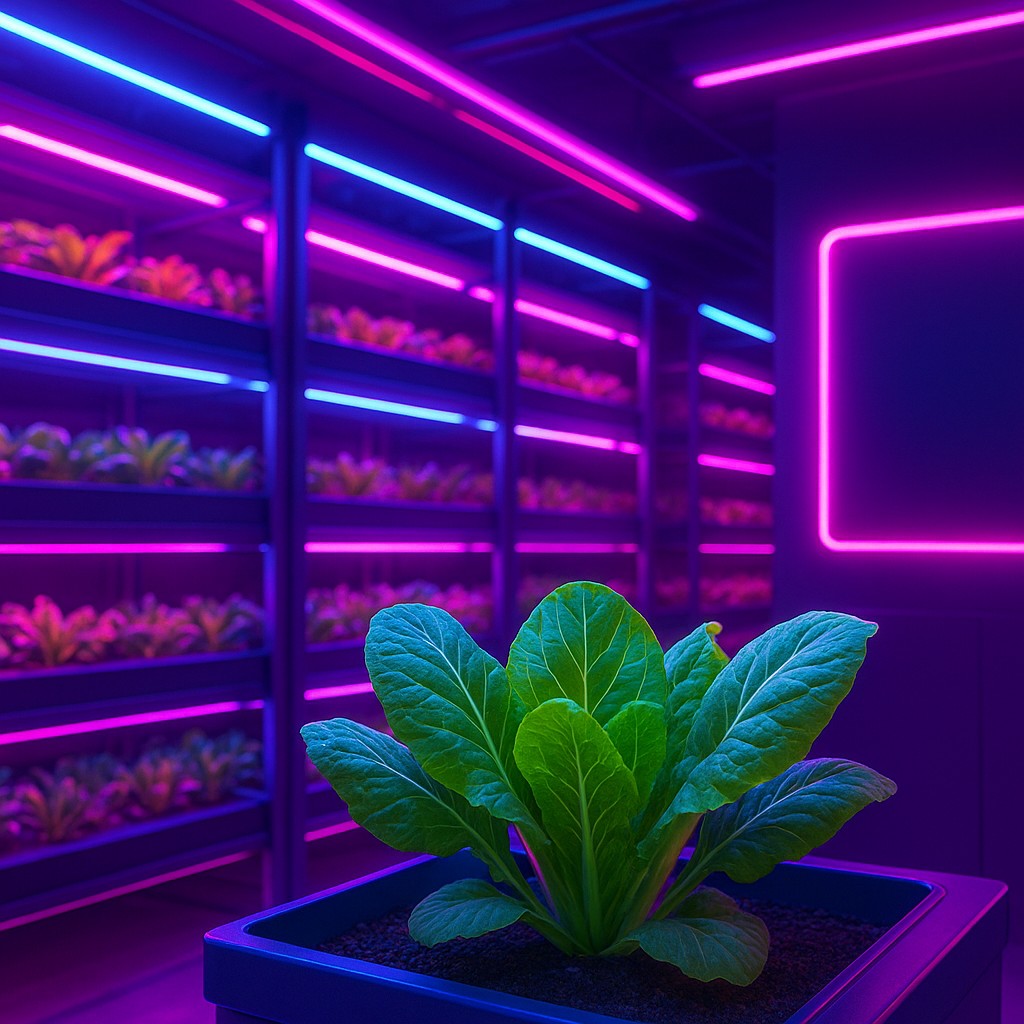
If you were to step inside a modern vertical farm, the first thing you would notice is the color. Instead of the golden, full-spectrum glow of the sun, you would likely find yourself bathed in an eerie, futuristic wash of neon pinks, deep purples, and sharp blues. This isn't just a style choice made by trendy agricultural tech startups; it is a carefully engineered environment designed to manipulate the very core of a plant’s biology. We have moved past the era of simply providing enough light for photosynthesis. Today, scientists are essentially "hacking" the internal software of crops, using light as a language to dictate how a plant grows, tastes, and protects itself.
This shift in agriculture treats light not as a fixed resource, but as a series of biological triggers. In a traditional field, a head of romaine lettuce is at the mercy of the weather, the season, and the specific angle of the sun. In a controlled indoor environment, however, we can create a "light recipe" that tells the plant it is under attack or that the sun is about to set, even when neither is true. By pulsing specific wavelengths at precise intervals, growers can trick a plant into producing massive amounts of vitamins and antioxidants that it would normally only create in small doses to survive a harsh environment. The result is a vegetable that is more nutritious than its outdoor cousins, provided we don't push the "stress" button so hard that the plant gives up entirely.
The Plant as a Chemical Factory
To understand how we manipulate plants with light, we first have to stop thinking of them as passive green objects and start seeing them as sophisticated chemical laboratories. Plants cannot run away when things get tough. If it gets too hot, or if a bug starts chewing on a leaf, the plant has to fight back using chemistry. This is the world of secondary metabolism. While primary metabolism handles the basics like growing stems and leaves, secondary metabolism produces specialized compounds like polyphenols, flavonoids, and anthocyanins. These are the plant's weapons, sunscreens, and repair kits.
When we eat a "superfood," what we are usually consuming are these secondary metabolites. For the plant, these chemicals serve a defensive purpose, but for humans, they act as powerful antioxidants and essential nutrients. In a standard outdoor farm, a plant might produce just enough of these chemicals to get by. In a vertical farm, however, we can convince the plant that it is living in a much more "dangerous" world than it actually is. By isolating specific parts of the light spectrum, we can trigger the production of these chemicals on demand, effectively turning a standard salad green into a nutrient-dense powerhouse.
Decoding the Language of Color
The sun provides a broad "white" light that contains every color of the rainbow, but plants are picky eaters. They don't use the whole spectrum equally. For decades, the goal of indoor farming was simply to provide red and blue light, the two colors most efficient at driving photosynthesis. Red light is like the fuel for bulk growth, helping plants stretch and gain mass, while blue light acts like a manager, controlling the opening of pores and the thickness of leaves. However, the real magic happens when we move beyond these basics and start using "spectral signaling."
Recent breakthroughs have shown that adding "far-red" light, which sits right on the edge of what the human eye can see, changes the game. When a plant senses an increase in the ratio of far-red to red light, it thinks it is being shaded by a neighbor. It enters "shade avoidance mode," stretching its leaves and growing faster to find the sun. But if you suddenly hit that same plant with a blast of high-intensity blue light, you trigger a "photoprotective" response. The plant thinks it is suddenly exposed to harsh, direct sunlight and frantically starts producing antioxidants to protect its delicate tissues from UV damage. By switching between these states, growers can maximize both the size of the plant and its nutritional density.
Light Wavelengths and Their Biological Roles
| Light Color |
Wavelength (nm) |
Primary Biological Function |
Resulting Nutrients |
| Blue |
400 - 500 |
Triggers stress and defense mechanisms |
Higher Vitamin C and Polyphenols |
| Green |
500 - 600 |
Penetrates deep into the canopy |
Improved CO2 absorption and biomass |
| Red |
600 - 700 |
Primary driver of photosynthesis |
Large leaf area and fast growth |
| Far-Red |
700 - 800 |
Signals competition or shading |
Faster flowering and leaf expansion |
The Art of "Goldilocks" Stress
The technical term for this light manipulation is "eustress," which literally translates to "good stress." It is the same principle as a person lifting weights at the gym. You are technically damaging your muscle fibers, but that damage triggers a repair process that makes you stronger. In a vertical farm, the light spectrum is used to provide this constructive level of tension. If the light is too perfect and the environment is too comfortable, the plant becomes "lazy." It grows big and green, but it doesn't bother investing energy into those complex, healthy chemicals because it doesn't feel the need to defend itself.
However, there is a very thin line between a healthy workout and an injury. If a grower provides too much blue light for too long, the plant’s defense mechanisms will go into overdrive. It will stop growing upward and focus entirely on chemical production, leading to small, leathery leaves that may be packed with nutrients but look unappealing to a shopper. This is why the "light recipe" is a guarded secret for many farms. Finding the exact rhythm of light shifts, where the plant is stressed just enough to produce nutrients but not enough to stop growing, is the ultimate goal of modern agriculture.
Correcting the Synthetic Myth
One of the most persistent myths about vertical farming is that "artificial" light must be worse than "natural" sunlight. Many people assume that because a plant isn't grown in soil under the sun, it must be lacking some fundamental quality or nutritional value. In reality, the natural sun is often an inefficient and inconsistent light source for specific nutritional goals. The sun provides a lot of "noise" (wavelengths the plant can't use) and its intensity changes based on cloud cover or the time of day.
By using targeted LED lights, we aren't creating "fake" growth; we are simply speaking more clearly to the plant. Because we can control the environment, we can also eliminate the need for pesticides. This means the plant doesn't have to waste energy fighting off pests and can instead use that energy for internal nutrient synthesis. Furthermore, the ability to control the sunrise and sunset means we can actually extend the plant's most productive hours. Field-grown lettuce often loses nutritional value the moment it is harvested and shipped across the country. A head of lettuce grown in a warehouse three miles from your grocery store, under a custom light recipe, is often fresher and more chemically complex than anything pulled from a field a thousand miles away.
A New Framework for Food Security
This technology represents a shift from "volume-based" farming to "value-based" farming. For the last century, the goal of agriculture was simply to grow as many calories as possible. We succeeded, but in doing so, we often sacrificed the nutrient density of our food. As we face a future with a growing population and shrinking farmland, the ability to grow "functional foods" (crops specifically designed to be higher in iron, zinc, or specific vitamins) becomes a vital tool for public health.
Imagine a future where a vertical farm in an urban food desert produces spinach specifically engineered via light recipes to help combat local vitamin deficiencies, or berries with boosted levels of heart-healthy anthocyanins. This isn't genetic modification; it is environmental optimization. By mastering the language of light, we are finally learning how to ask plants to be the best versions of themselves, providing us with a toolkit to design a food system that is not only more efficient but fundamentally more nourishing.
The next time you see a neon-lit photo of a vertical farm, don't just see a high-tech garden. See it as a conversation. Every flash of blue and every shift into far-red is a command being sent to a biological machine, coaxing out the very ingredients that keep us healthy. We are no longer just waiting for the rain and the sun to cooperate. We have taken control of evolution's chemical factory, and the results are blooming right before our eyes.