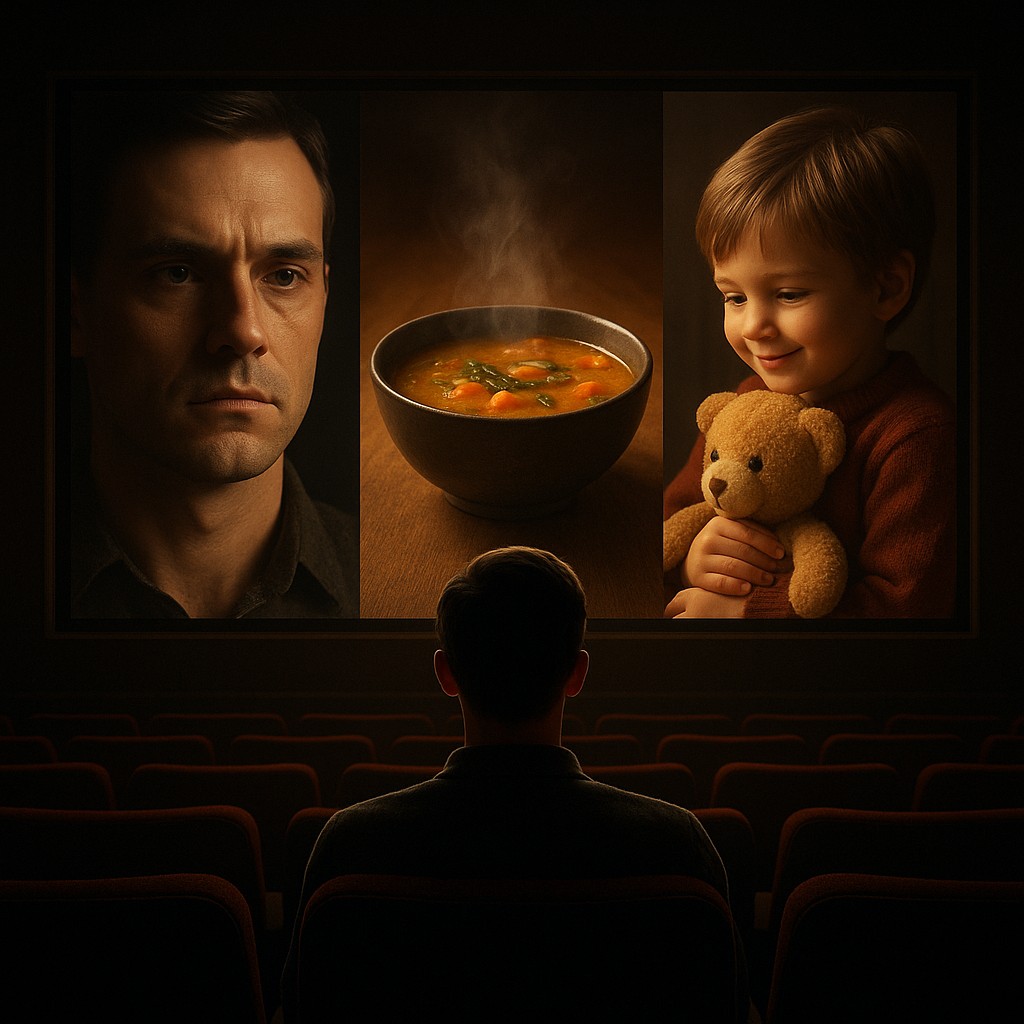
Imagine you are sitting in a dark theater, watching a close-up of an actor’s face. His expression is perfectly still, almost like a machine. But when the film cuts to a steaming bowl of soup, you feel a twinge of sympathy for how hungry he looks. A moment later, the film cuts from that same face to a child playing with a teddy bear. Suddenly, the actor’s expression seems to soften into a warm, fatherly glow.
You might praise the actor for his amazing range, but here is the secret: the footage of his face was exactly the same in both clips. You didn't actually see hunger or love on the screen. Instead, you projected those feelings from your own mind onto the blank canvas the editor provided.
This psychological mystery is the foundation of visual storytelling. For over a century, filmmakers have known that the human brain is obsessed with finding patterns. We hate a vacuum. When we see two unrelated images in a row, our subconscious builds a bridge between them to make sense of things. We don't just see "A" and then "B." We see a relationship where "A" causes "B," or "A" feels something about "B." This suggests that the true power of movies doesn't live in a single beautiful shot, but in the invisible sparks that fly when two shots collide.
The Experiment That Changed How We See
In the early 1920s, a Soviet filmmaker named Lev Kuleshov set out to prove that the heart of cinema was not acting, but montage - the art of editing clips together. He conducted a famous experiment by taking a long, neutral close-up of the actor Ivan Mozhukin. Kuleshov then paired this identical footage with three different subjects: a bowl of hot soup, a girl in a coffin, and a woman resting on a sofa.
When he showed these sequences to an audience, the reaction was the same across the board. They marveled at Mozhukin’s "thoughtful" look over the soup, his "deep sorrow" for the girl, and his "lustful" gaze at the woman.
The audience was convinced they were watching a masterclass in acting. In reality, they were witnessing their own brains at work. This became known as the Kuleshov Effect. It proved that the meaning of a shot is fluid and depends entirely on what comes before or after it. This discovery changed the director's job from simply recording a stage play to manipulating time and space. It showed that if you give viewers a sequence, they will do the heavy lifting of building the story, often seeing emotions that weren't even there during filming.
Why Your Brain Loves Finishing the Story
To understand why this happens, we have to look at how our brains process information. Evolution has turned us into experts at making educated guesses, or inferences. If you hear a loud crash in the kitchen and then see your cat bolt away, you don’t need a witness to tell you the cat knocked something over. Your brain "stitches" the sound and the sight together into a single event.
In a movie theater, the Kuleshov Effect taps into this biological shortcut. Because we are social creatures, we are constantly scanning faces to see how others react to the world around them. When an editor shows a face followed by an object, our brains instinctively assume a "Point of View" relationship. We believe the person is looking at the object, so their face must reflect how they feel about it.
This is why a neutral face is often more effective than a very emotional one in movies. A blank face acts as a vessel that the audience fills with their own expectations. If an actor is already sobbing over a coffin, the audience’s job is done. But if the actor is neutral, the audience must provide the sadness themselves, making the experience feel much more personal and intense.
Crafting Meaning Through Contrast
The magic of the Kuleshov Effect lies in the many different connections an editor can create. By choosing the right "before" and "after" shots, a storyteller can change a character’s entire personality without changing a single line of dialogue. This technique isn't just for drama; it is the building block of suspense, humor, and even propaganda.
The table below shows how different pairings can create vastly different meanings using the exact same footage of a neutral face.
| First Image (The Subject) |
Second Image (The Context) |
Resulting Meaning |
| Neutral Close-up |
A ticking time bomb |
The character is anxious or resolute |
| Neutral Close-up |
An empty desert road |
The character is lonely or searching |
| Neutral Close-up |
A heavy bag of money |
The character is greedy or relieved |
| Neutral Close-up |
A messy, cluttered room |
The character is overwhelmed or lazy |
| Neutral Close-up |
A mountain peak |
The character is ambitious or inspired |
As the table shows, the "input" stays the same, but the "output" is a wide range of human experiences. This is why directors like Alfred Hitchcock loved this method. Hitchcock called it "pure cinema." He believed you could tell a whole story just by arranging shots, much like a composer uses notes. If the notes are in the wrong order, the melody is lost. If the shots are in the right order, the audience hears a symphony in their own heads.
The Hidden Hand of the Editor
Modern filmmaking has turned the Kuleshov Effect into a high art, often using it to trick us in ways we don't notice. Think of the "reaction shot" in a comedy. When a character says something incredibly stupid, the director often cuts to a silent observer. We read that silence as judgment or embarrassment, even if the actor was just looking at a piece of tape on the wall. This rhythm creates a conversation in our minds that isn't actually in the script.
This manipulation also changes how we see space and time. An editor can make us believe two people are in the same room when they actually filmed their scenes months apart in different countries. By cutting between a man looking left and a woman looking right, our brains create a shared space between them. We assume they are making eye contact because the sequence of shots demands it. This "creative geography" allows movies to build worlds that don't exist, relying entirely on the viewer's willingness to connect the dots.
Misconceptions and Limits
A common myth is that the Kuleshov Effect only works with "stiff" or "bad" acting. In reality, even the most expressive actors are affected by it. While a great performance adds depth, the editor still has the final word on what that performance means.
Another misconception is that this only happens in film. We see the Kuleshov Effect in comic books (in the white space between panels), in news photos, and even on social media. When you see a post about a natural disaster right next to a post about a luxury vacation, the contrast often makes the vacation look heartless, regardless of what the user intended.
However, the effect does have limits. For the brain to "bridge the gap," there must be a logical or emotional thread to follow. If the two images are too different or the cuts are too fast, the brain just sees "visual noise" instead of a story. Timing is also key. If the neutral face stays on screen too long, the audience starts to notice the lack of movement and the illusion falls apart. The editor must act like a magician, giving just enough information to spark the imagination before moving to the next trick.
Seeing the Fabric of Visual Media
Once you understand the Kuleshov Effect, you can never look at a screen the same way again. You start to see the invisible seams of the story. When you feel a sudden surge of fear or laughter, you can pause and ask yourself: "Is the actor doing this to me, or is the editor?"
This awareness doesn't ruin the magic. Instead, it helps you appreciate the incredible skill behind your favorite stories. You realize you aren't just sitting there watching a movie; you are an active participant, helping write the emotional journey with every blink and every cut.
This perspective is a powerful tool for visual literacy. In an age of short videos and rapid-fire editing, we are being "Kuleshov-ed" constantly. Understanding how context creates meaning helps you stay mindful of how your emotions are being guided. Whether you are watching a classic film, the news, or a 15-second clip on your phone, you now know that the most important part of the story isn't what is being shown, but what your brain is filling in between the lines.