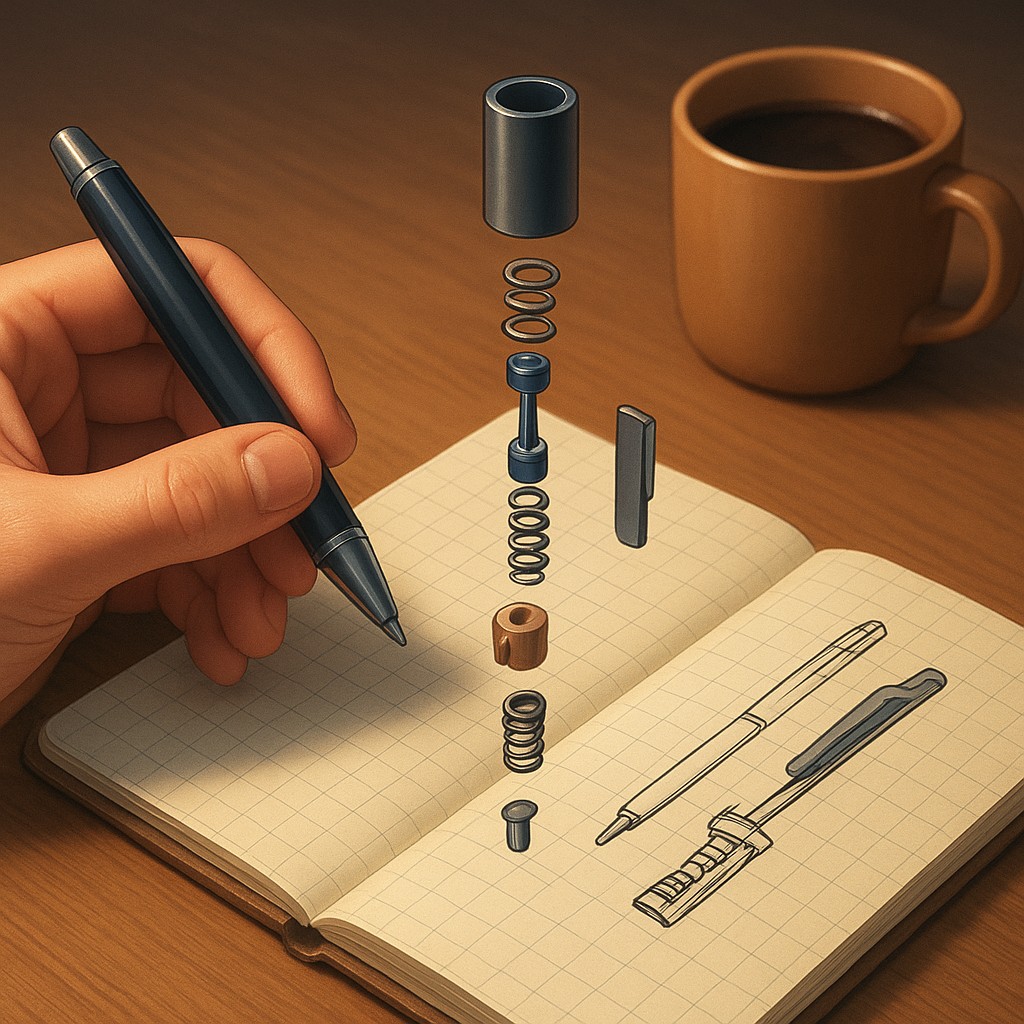
Imagine for a moment that you are standing in your kitchen holding a simple ballpoint pen. If someone asked whether you know how it works, you would likely nod with confidence. After all, you have used thousands of them since you were a child. You click the top, the tip pops out, and ink appears on the paper. It feels like a basic piece of knowledge, tucked away in the "I understand this" folder of your brain.
However, if that same person handed you a blank sheet of paper and asked you to draw the internal mechanism, a strange thing usually happens. If you had to detail exactly how the spring, the cam (the rotating part), and the locking track work together to keep the tip out, you would likely freeze. The mental image that felt so clear just seconds ago suddenly dissolves into a foggy blur of "stuff" that somehow makes the pen function.
This humbling moment is not a sign of low intelligence, nor is it a personal memory fail. Instead, you have just hit a mental wall known as the Illusion of Explanatory Depth. This phenomenon is our universal tendency to believe we understand the complex world around us far better than we actually do. Because we can operate a system, like a toilet, a zipper, or a smartphone, our brains take a massive shortcut. They trick us into thinking we understand the internal mechanics. We mistake "knowing how to use it" for "technical mastery," a bug in human psychology that keeps us moving through life efficiently but leaves us surprisingly overconfident.
The Mental Shortcut Between Doing and Knowing
The human brain is an efficiency machine designed to save energy. In the prehistoric past, knowing exactly how a plant turned sunlight into food was far less important than knowing that the plant produced edible berries. This evolutionary pressure created a "need-to-know" basis for our consciousness. As long as we can get the result we want, our brains mark the task as "solved."
When we apply this logic to the modern world, we find ourselves surrounded by objects we use every day but could never build or explain. We feel like masters because we are experts at the interface: the buttons, the levers, and the handles.
In 2002, psychologists Leonid Rozenblit and Frank Keil conducted a famous study that exposed this gap. They asked participants to rate their understanding of everyday objects, such as a sewing machine or a crossbow, on a scale of one to seven. Most people gave themselves high marks, confident they understood these familiar tools. However, the researchers then asked the participants to provide a detailed, step-by-step explanation of how the objects actually worked.
As they struggled to describe the mechanics, the participants' confidence crashed. By the end of the exercise, they significantly lowered their own knowledge ratings. They had been victims of an illusion, a mental mirage of depth where there was actually only a shallow pool of familiarity.
This illusion is particularly strong because we often confuse the "community of knowledge" with our own personal knowledge. We live in a world where someone knows how a refrigerator works, so we feel as though we know how it works by proxy. We are constantly outsourcing our thinking to experts, designers, and engineers. While this is a brilliant survival strategy for our species, the transition from "we know" to "I know" happens so smoothly in our minds that we fail to notice the hand-off. This leads to a false sense of security that can have major consequences when we have to make decisions or vote on complex issues.
Testing the Mechanics of Your Own Mind
To truly see how strong this illusion is, look at the classic "bicycle test." Most people have spent hundreds of hours on a bike. If you ask a random group of adults if they understand how a bicycle works, almost all will say yes. Yet, when asked to draw the frame, the chain, and the pedals in their correct positions, a shocking number of people fail. They place the chain on the front wheel, or they connect the pedals to the frame in a way that would make it impossible to turn the gears. They know that pedaling makes the bike move, but the specific mechanical transfer of energy is a mystery they didn't know they had.
Below is a comparison of how we perceive our knowledge versus how that knowledge actually holds up under pressure. This table helps show why this illusion is so persistent.
| Feature of Knowledge |
Perceived Understanding (The Illusion) |
Actual Understanding (The Reality) |
| Complexity |
We see the system as simple because the interface is easy to use. |
The system involves many connected parts and laws of physics. |
| Internal Mechanics |
We feel we have a "mental map" of the inner workings. |
The map is mostly empty space with a few labels. |
| Source of Confidence |
Based on how often we use the object successfully. |
Based on our ability to rebuild the system from scratch. |
| Response to Challenge |
Surprise and defensiveness, followed by realization. |
Humility and a desire to learn the actual details. |
| Social Role |
Allows us to feel confident and decisive. |
Requires us to rely on experts and teamwork. |
This gap exists because our brains prioritize "skimming" over "deep diving." We scan our environment for the information we need to survive, but we rarely look under the hood unless the engine starts smoking. This is actually a feature of human intelligence, not a flaw. If we had to consciously think about the physics of our coffee maker every morning, we would never make it out of the kitchen. The problem only starts when we forget we are skimming and start making big assumptions based on a surface-level glance.
Why Our Politics and Opinions Are Often Thinly Veiled
The Illusion of Explanatory Depth does not stop at zippers and bicycles; it extends into much more sensitive territory, like social and political beliefs. We often hold very strong opinions on complex systems like the national economy, healthcare policy, or international trade deals. Because we hear these terms often and "use" politics by voting or debating, we believe we have a deep understanding of how these policies work in the real world. We feel certain that a specific tax law will lead to a specific result, much like we feel certain that pushing a button will start a car.
Researchers have found that when people are asked to explain the specific, step-by-step causal steps of a policy they support or oppose, their political extremism often softens. Just like the people trying to explain the crossbow, people trying to explain the details of carbon-trading programs often realize they don't know as much as they thought. This realization shatters the illusion. When the illusion breaks, people tend to become more moderate and more open to other viewpoints because they have been forced to face their own ignorance.
This suggests that much of our social conflict is fueled by a mutual misunderstanding of our own expertise. We mistake our emotional feelings about a topic for a technical understanding of it. If we could move beyond slogans and simple participation, we might find that we are all operating with very limited blueprints. Recognizing this doesn't mean we shouldn't have opinions, but it does suggest that our opinions should be balanced with the knowledge that we are likely missing large pieces of the puzzle.
Turning Your Blind Spots into Intellectual Strengths
The good news is that once you are aware of this illusion, you can use it as a tool for self-improvement. It becomes a "litmus test" for your own certainty. Whenever you find yourself feeling incredibly confident about a complex topic, pause and try to explain it. Attempt to describe the concept, out loud or on paper, to an imaginary five-year-old. If you find yourself using vague buzzwords or skipping over key steps with phrases like "and then it just happens," you have found a hole in your knowledge.
Embracing this reality is the foundation of intellectual humility. It allows you to become a better student of the world because you are no longer blinded by the false sense that you already "get it." When you realize you don't actually know how your Wi-Fi router works or how a bill becomes a law in detail, it opens up space for genuine curiosity. You stop being a passive user and start becoming an active investigator. This mindset shift is essential for leaders, engineers, and citizens alike. It encourages us to seek out different perspectives and expert advice rather than relying on "gut feelings" about complex mechanics.
- Practice the "Feynman Technique": Name the concept, explain it as if to a child, find the gaps in your explanation, and go back to the source material to fill those gaps.
- Question your certainties: When you feel a surge of confidence about a controversial topic, ask yourself if you could draw a "mechanical diagram" of how that idea actually works.
- Value the "How" over the "What": Instead of just knowing that something is true, try to understand the process that makes it true. Focus on the chain of cause and effect.
- Seek out the expert's perspective: Acknowledge that just because you use a system, you are not an expert on it. Respect the years of study required to truly see beneath the surface.
Ultimately, navigating the world with an awareness of this illusion makes life more interesting. It turns everyday objects, from the toaster to the light switch, into tiny mysteries waiting to be solved. It reminds us that the world is far more intricate and wonderful than our simplified mental models suggest. By admitting that we don't know the exact path of the bicycle chain, we become more capable of learning how to build a better one.
As you go about your day, take a second look at the devices you touch and the ideas you hold dear. Recognize that while you are a master of using them, their inner lives are likely a beautiful, complex secret that you have only begun to uncover. This realization is not a sign of weakness, but an invitation to a lifetime of discovery. By staying curious and acknowledging the limits of your own mental maps, you gain the superpower of being able to learn anything, one gear and one lever at a time. The world is waiting for you to look beneath the surface, and the rewards are deeper than any illusion could ever provide.