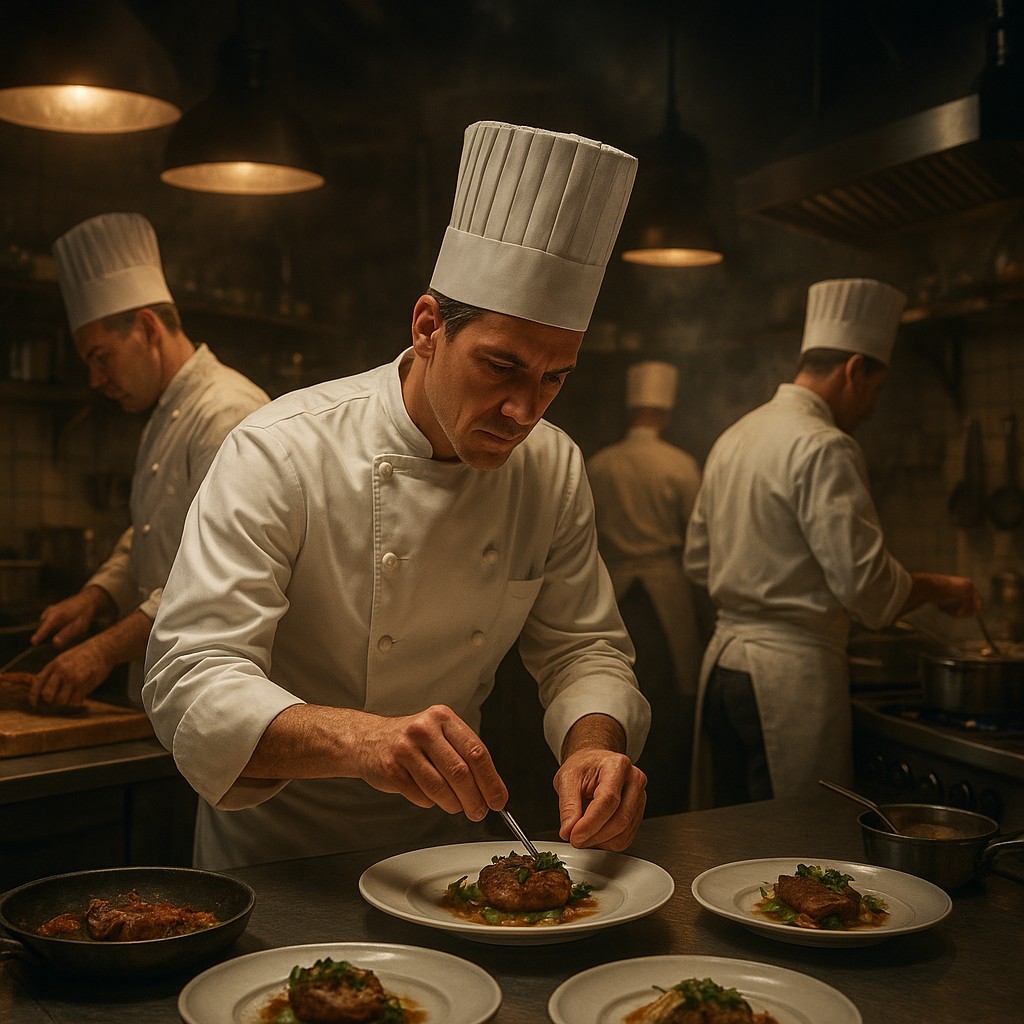
Imagine the chaotic energy of a world-class restaurant at eight o'clock on a Friday night. The dining room is a sea of dim light, clinking crystal, and soft laughter, but a different reality exists behind the swinging double doors. It is a high-temperature, high-stakes environment where hundreds of complex plates must be finished with surgical precision in a matter of minutes. If this were a standard "collaborative" workspace where everyone had an equal say in seasoning a sauce or plating a steak, the entire operation would grind to a halt before the first appetizer hit the table. Instead, the kitchen runs like a finely tuned engine because it uses a system designed to eliminate the one thing that kills productivity in a crisis: the need for a debate.
This organizational marvel is known as the Brigade de Cuisine. It is a system that took the rigid, uncompromising structure of the nineteenth-century French military and applied it to fine dining. It was developed by Georges Auguste Escoffier, a man who realized that the secret to brilliant cooking was not just the recipes, but the logistics of the people making them. By removing decision fatigue and establishing a strict chain of command, the brigade system allows individual creativity to flourish within a framework of absolute order. This approach reaches far beyond the kitchen, offering a profound lesson for modern life: when the pressure is on, clear roles and direct lines of communication are much more effective than open-ended teamwork.
The Architect of Culinary Order
Before Escoffier arrived in the late 1800s, professional kitchens were often disorganized, noisy, and chaotic. Cooks would prepare entire dishes from start to finish, frequently bumping into one another as they rushed from the stove to the pantry. There was no standard dress code, and the atmosphere was often loud and undisciplined. Escoffier, who had served in the French army during the Franco-Prussian War, realized that the military’s divisional structure could solve these problems. He envisioned a kitchen where every person had a specific, non-negotiable task, moving the focus away from the individual and toward the collective output of the "battery," or the kitchen crew.
By introducing this structure, he transformed the image of the chef from a messy laborer into a disciplined professional. He insisted on clean uniforms, banned smoking and drinking on the job, and most importantly, established a hierarchy that left no room for confusion. In this system, every person knows exactly who they report to and exactly what they are responsible for. This eliminates the "bystander effect," where everyone assumes someone else is handling the garnish or checking the meat. In a brigade, if a roast is overcooked, everyone knows exactly which station is responsible, and the sous-chef knows exactly who to hold accountable.
Navigating the Ranks of the Kitchen Battery
To understand how this system prevents decision fatigue, we have to look at the specific roles within the hierarchy. At the very top is the Executive Chef, who functions like a CEO or a General, focusing on the big picture, menu design, and costs. Below them is the Chef de Cuisine, the person actually running the kitchen day-to-day. However, the real "middle management" heroes are the Sous-Chefs and the Chefs de Partie. These individuals are the glue that holds the operation together when the "rush" begins and orders start flying off the printer.
A Chef de Partie is a station leader, a specialist who manages one specific area of production. For example, the Saucier is responsible for all sauces and sautéed items, which is often considered the most demanding role. The Rotisseur handles roasted and braised meats, while the Entremetier takes care of vegetables, soups, and eggs. Because each leader manages a self-contained "cell," they only need to communicate with their direct staff and the Sous-Chef. This keeps lines of communication short and functional, preventing the information overload that happens when fifty people all try to talk to the person in charge at the same time.
| Role |
Responsibility |
Reporting Line |
| Executive Chef |
Strategy, Menu, and Management |
Ownership / General Manager |
| Chef de Cuisine |
Daily Kitchen Operations |
Executive Chef |
| Sous-Chef |
Direct Supervision of the Line |
Chef de Cuisine |
| Chef de Partie |
Management of a Specific Station |
Sous-Chef |
| Commis |
Junior Cook / Apprentice |
Chef de Partie |
| Plongeur |
Cleaning and Maintenance |
Sous-Chef |
Why Modular Systems Prevent Catastrophic Failure
One of the most brilliant aspects of the Brigade de Cuisine is its modular design. In a traditional team where everyone helps with everything, one person falling behind can cause a ripple effect that confuses the entire group. If Bill is slow at chopping onions, Nancy might stop what she is doing to help him. That means the steak she was supposed to be searing gets neglected, which means the waiter is left waiting, and so on. In the brigade system, roles are so clearly defined that a bottleneck becomes immediately visible to the Sous-Chef. They can then move a specific resource, like a "floater" or a junior apprentice, to fix the problem without interrupting anyone else's workflow.
This visibility is the enemy of decision fatigue. When a leader can see exactly where the flow has stopped, they don't have to spend precious mental energy investigating the problem; they can simply act. For the workers on the line, the psychological benefit is just as powerful. A Chef de Partie doesn't have to worry about whether the dessert is ready or if the dishes are clean. They only have to worry about perfect execution in their own domain. This narrow focus allows for a level of excellence that is impossible to achieve when your attention is scattered across unrelated tasks.
The Paradox of Creative Freedom Within Structure
A common misconception about the brigade system is that it stifles creativity. People often assume that such a rigid hierarchy turns chefs into mindless robots who just follow orders. In reality, the opposite is true. By automating the "how" of the workflow, the system frees up mental energy for the "what" of the cooking. When the logistics of the kitchen are handled by a proven system, the chef can focus entirely on the nuance of flavor, the texture of a purée, or the artistry of the plating. Structure provides the safety net that allows for high-level performance under extreme pressure.
In our daily lives, we often resist this kind of organization, fearing it will feel restrictive. We prefer "flat" hierarchies and open-ended collaboration because they feel more democratic and modern. However, when the pressure is on, these flat structures often collapse into a sea of endless meetings, conflicting opinions, and "analysis paralysis." By adopting a personal brigade system, such as setting strict rules for how we handle emails or how we structure our work hours, we actually create more room for our brains to do deep, creative work. We stop wasting time deciding where to start and start spending time getting things done.
Applying Military Precision to Personal Productivity
You don't need to wear a tall white hat to benefit from the lessons of the French kitchen. Many successful people use a version of the brigade's "station" philosophy to manage their lives. This involves identifying the recurring "stations" in your own life and creating a standard process for each. For instance, if you view your morning routine, your deep work hours, and your evening chores as distinct stations with specific rules, you eliminate the need to negotiate with yourself throughout the day. You don't "decide" to exercise; you simply report to that station at the scheduled time, just as a Saucier reports to their station at five o'clock.
Furthermore, the brigade system teaches us the value of the "Commis" mindset, which is the idea of the apprentice. In a kitchen, a Commis spends months or even years doing basic work, like peeling potatoes or cleaning herbs, to master the fundamentals before moving up. In our fast-paced world, we often want to jump straight to being the Executive Chef of our own lives without mastering the basics. Embracing the hierarchy means respecting the process of growth. It reminds us that every great leader was once a great follower, and that the ability to take direction effectively is the first step toward the ability to give it.
As you move through your next high-pressure project or a busy week, consider the wisdom of Escoffier and his kitchen army. When the heat rises and the tasks start piling up, remember that clarity is your greatest ally and ambiguity is your greatest enemy. By defining your roles, shortening your lines of communication, and trusting in the power of a well-organized system, you can turn a potential disaster into a masterpiece. Don't fear the structure; embrace it as the very thing that gives your talent the room it needs to breathe. When the underlying workflow is locked in, you are finally free to cook with fire.