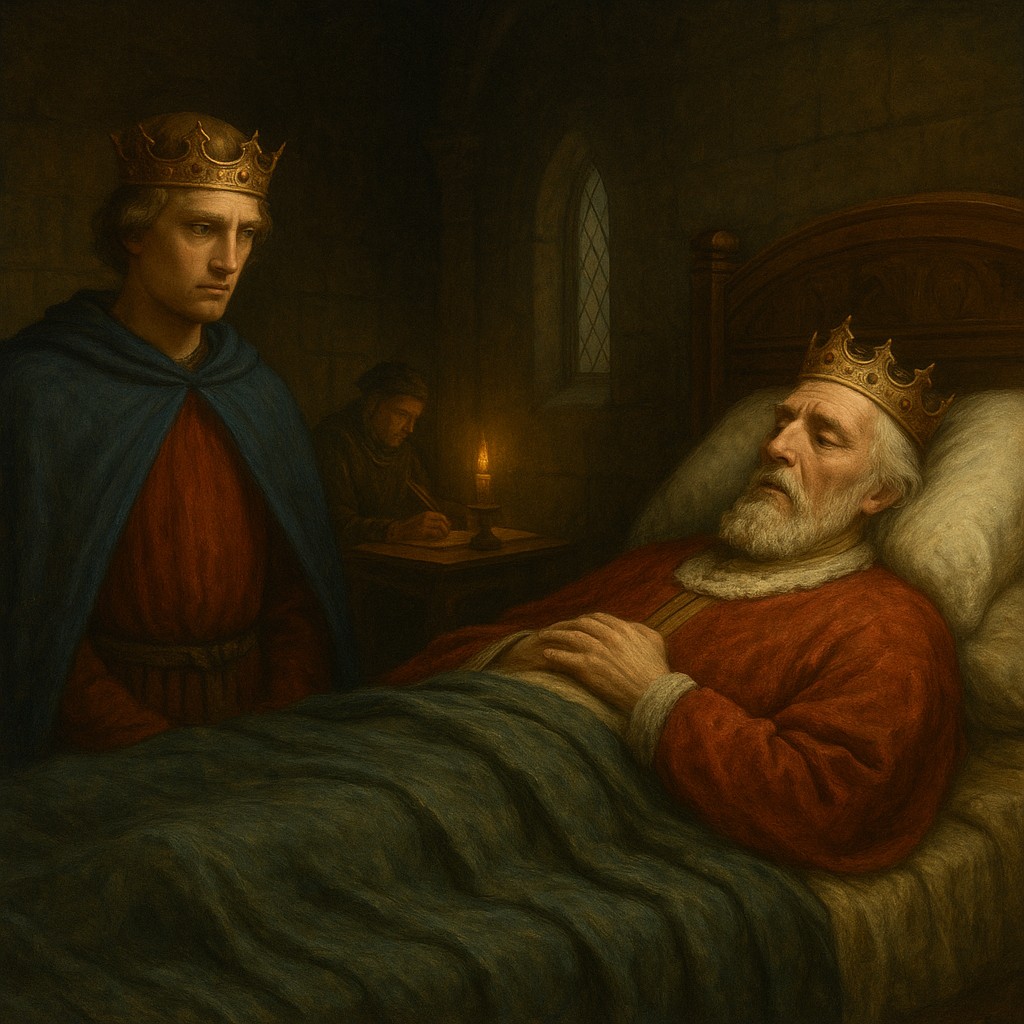
Imagine for a moment that you are a citizen of a medieval kingdom. Tension hangs heavy in the air because the old King, who has ruled for forty years, is on his deathbed. In many ancient societies, this moment was a recipe for total disaster. If the King is the source of all law, does the law die with him? If the person who signed the deed to your land is now in the ground, can your neighbor simply kick you off your farm? For much of human history, a leader’s death meant the temporary death of the state itself. Every time a heart stopped beating, it triggered messy transitions, civil wars, and a complete collapse of public order.
To solve this terrifying puzzle, medieval lawyers and theologians came up with one of the most brilliant and lasting "legal fictions" ever created. They decided that the King was not just one person, but two. This wasn't a claim that the monarch was a supernatural shapeshifter or suffered from a split personality. Instead, it was a clever way to separate the temporary person in charge from the permanent institution of government. By inventing the concept of the "King’s Two Bodies," our ancestors paved the way for modern democracy, corporate law, and the very idea that a government can be bigger and more durable than any single individual.
The Mortal Frame and the Invisible Office
At the heart of this theory is a distinction between the "Body Natural" and the "Body Politic." The Body Natural is the King as a human being. This body is born, grows old, catches the flu, makes bad fashion choices, and eventually passes away. It is subject to all the weaknesses of biology and the passage of time. If you were to poke the King’s Body Natural with a needle, it would bleed. This version of the King is a private individual with personal feelings, family arguments, and a physical heart that will one day stop.
On the other hand, the Body Politic is a mystical, invisible entity that represents the state, the law, and the continuity of the people. This body cannot be seen or touched, but it is the one that truly holds the power. The Body Politic is perfect, immortal, and never sleeps. It is the "office" of the crown rather than the person wearing it. When legal scholars in the 1500s wrote about this, they argued that the Body Politic is entirely free from infancy, old age, or any other defects of the physical body. Essentially, the King’s "second body" is an indestructible legal ghost that moves from one physical shell to the next.
This distinction was vital because it meant the state did not have to hit the "reset" button every time there was a funeral. When the physical body of King Henry died, the invisible Body Politic immediately moved to the next person in line. This is the origin of the famous historical cry, "The King is dead, long live the King!" It sounds like a contradiction, but it makes perfect sense in this context. The first part refers to the mortal Body Natural which has just passed away, while the second part refers to the immortal Body Politic which has already settled into the successor.
Building a State That Never Sleeps
Why did medieval thinkers go to such lengths to invent this complex double identity? The reasons were strictly practical. Before this theory took hold, the legal world was a mess of personal loyalties. If you swore an oath to a specific King and that King died, your oath was technically over. If a King signed a treaty, his successor could argue the deal was a personal arrangement with a dead man and no longer valid. This made the world incredibly unstable, as every transition of power was an excuse for people to tear up contracts, ignore debts, and start private wars.
By separating the human from the office, the law created a sense of permanence. This allowed for the creation of "public property" that didn't belong to the King as a person, but to the Crown as an institution. Imagine if a President owned the White House personally. They could sell it to a hotel chain or leave it to a cousin in their will. Because of the "Two Bodies" concept, we understand that a leader is just a temporary tenant in a permanent house. The house belongs to the Body Politic, which exists long after any specific tenant has moved on.
This concept also provided a way to criticize or even resist a ruler without being a traitor to the state. In later centuries, parliaments used this idea to justify going to war against a specific King while claiming they were still loyal to the "Crown." They argued they were fighting the "Body Natural" (the flawed person) to protect the "Body Politic" (the laws and the state). While that sounds like a stretch, it shows how flexible this legal fiction became. It gave people a vocabulary to hold leaders accountable to something higher than their own personal whims.
A Ghostly Framework for Modern Life
The idea of the King’s Two Bodies might seem like a dusty relic from the Middle Ages, but it is the secret DNA of almost every modern institution today. Whether it is a government agency, a massive corporation, or a local non-profit, this logic is at work. When you sue a company like Google or Apple, you aren't suing the physical bodies of the employees or the CEO; you are suing a "legal person" that exists on paper and in the eyes of the law. This entity can own property, sign contracts, and be held responsible, even though it doesn't have a physical heart or a brain.
| Feature |
The Body Natural |
The Body Politic |
| Duration |
Temporary and mortal |
Permanent and immortal |
| Physicality |
Flesh, blood, and bones |
Invisible, legal, and symbolic |
| Weaknesses |
Can be sick, young, or old |
Always at full "legal" capacity |
| Ownership |
Personal property (a private watch) |
State property (the national treasury) |
| Stability |
Changes with every generation |
Remains constant across centuries |
This table shows the fundamental split that allows a society to function. Without this distinction, every time a CEO retired, the company's bank accounts would technically belong to their heirs rather than the business. Every time a President's term ended, the foreign treaties they signed would vanish. We live in a world of "immortal" institutions that operate through "mortal" agents. We have taken the medieval legal fiction designed for kings and applied it to every part of our public and commercial life.
Navigating the Myth and the Reality
The King’s Two Bodies was never meant to be a literal biological fact. No one in the 1300s actually thought the King had a shimmering ghost-twin hovering behind him. Instead, it was a "legal fiction," a term lawyers use for a "useful lie" that helps the world run smoothly. We use legal fictions all the time today. For example, in the United States, corporations are often treated as "persons" regarding certain constitutional rights. We know a corporation isn't a human being, but treating it as one allows our legal system to handle complex issues using existing rules.
One common mistake is thinking this theory was created only to give Kings more power. While it helped stabilize their reigns, it actually acted as a significant check on them. If the King has an immortal "Body Politic" that represents the law and the welfare of the people, then the King’s "Body Natural" is expected to live up to that standard. It shifted the King from being a private warlord to a public servant, at least in theory. The monarch became a caretaker of an office that was more important than their own desires.
The transition from "The King" to "The State" was a slow process of moving from religious to secular ideas. Over time, the religious language of the medieval church was stripped away, leaving behind the secular machinery of modern government. We moved from believing in the mystical continuity of a royal bloodline to believing in the continuity of a Constitution or a set of democratic values. The "Body Politic" survived, but it changed its name to "The State" or "The Republic."
The Enduring Power of Collective Imagination
The story of the King’s Two Bodies reminds us that our world is built out of ideas just as much as it is built out of bricks and mortar. We often think of "law" as something rigid and dry, but at its heart, law is an incredible act of imagination. It is our collective agreement to treat symbols as reality so that we don't have to live in constant chaos. By inventing an immortal "second body," our ancestors gave us the gift of institutional stability, allowing us to build projects and systems that last for hundreds of years.
The next time you see a change in leadership, whether it is an election or a corporate transition, take a moment to appreciate the invisible "Body Politic" moving silently from one person to the next. It is a testament to human creativity that we can create things that are greater than ourselves. We are mortal, but the structures we build, our laws, our cultures, and our shared institutions, have the capacity to live forever if we continue to believe in the fiction that holds them together. Thinking this way shouldn't make the state feel cold; instead, it should show us that we are part of a long, continuing story that began long before us and will continue long after we are gone.