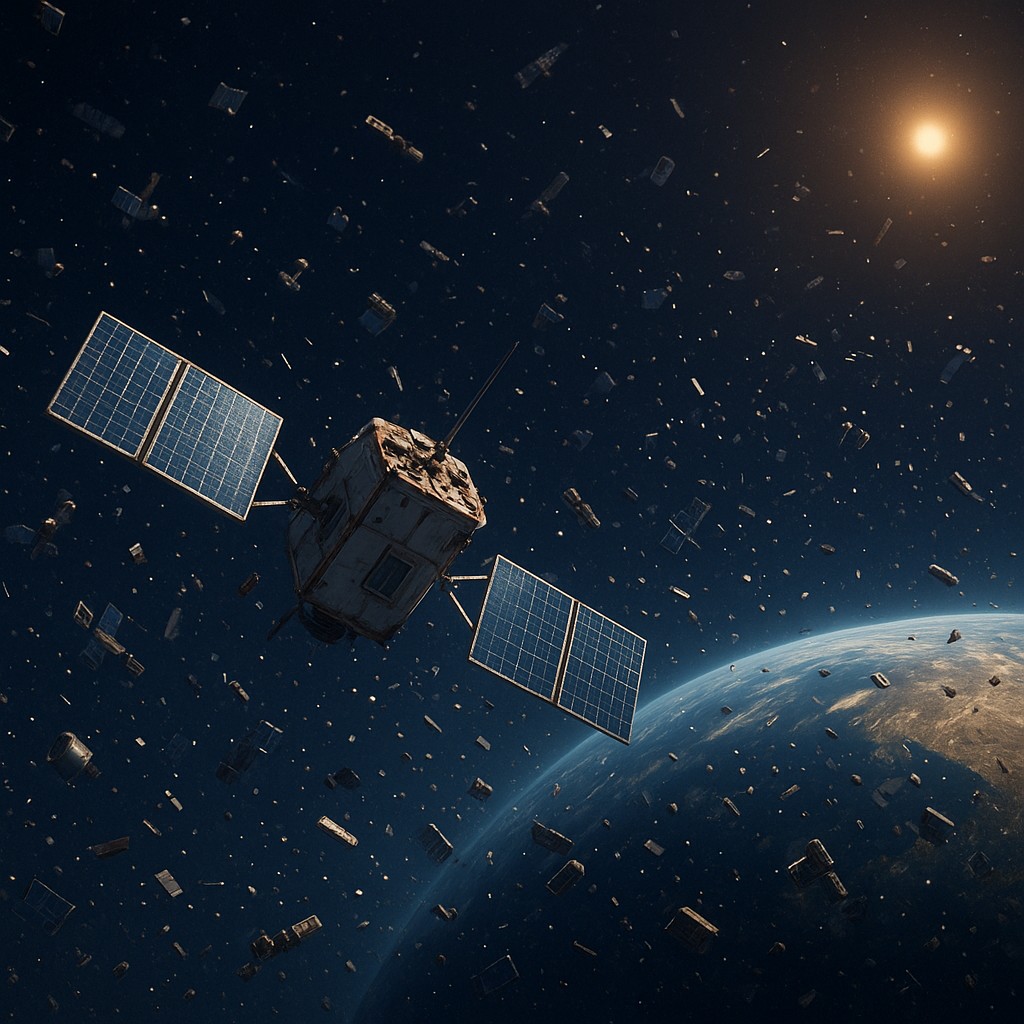
Imagine looking up at the night sky and seeing more than just stars. Instead, picture a bustling highway of invisible trade. Thousands of satellites are currently zooming around our planet at incredible speeds. They form the backbone of modern life, providing everything from your morning weather report to the high-speed data that allows you to read these words. We often think of space as a vast, empty void with plenty of room for everyone, but the reality is much more crowded. In truth, the most useful parts of space, specifically Low Earth Orbit (LEO), are starting to look like a busy city intersection during rush hour - and there are no traffic lights in sight.
The danger comes down to the physics of moving in orbit. Objects up there aren't just floating; they are falling around the Earth at speeds over 17,000 miles per hour. At those rates, a tiny screw or a dried fleck of paint carries the same punch as a hand grenade. When two large objects, such as old weather satellites or spent rocket boosters, slam into each other, they don't just dent. They explode into thousands of jagged, fast-moving fragments. This sets the stage for a nightmare scenario that scientists have feared for decades: a runaway chain reaction that could effectively lock humanity inside a cage of our own making.
The Mathematical Ghost in the Machine
In 1978, NASA scientist Donald J. Kessler looked at the growing number of satellites and reached a chilling conclusion. He realized that as the density of objects in orbit goes up, the chance of a collision goes up too. That part is simple math. However, the "syndrome" named after him describes a much more dangerous feedback loop. Every time two objects collide, they shatter. One large satellite becomes ten thousand small projectiles. Each of those fragments then becomes a potential "bullet" that can hit another satellite, creating even more debris.
Kessler’s main insight was that we could eventually reach a "tipping point." This is the moment when there is so much trash in orbit that even if we stopped launching rockets entirely, the number of objects would keep growing. The existing junk would continue hitting other junk, grinding itself down into a permanent, lethal cloud of shrapnel. It is like a slow-motion explosion that takes decades to play out, eventually wrapping the planet in a layer of supersonic trash that destroys anything we try to launch into the sky.
Navigating Earth's Invisible Highways
To understand why this is such an urgent problem, we have to look at how we use the space around us. While the universe is huge, the "prime real estate" near Earth is actually quite limited. Most of our vital technology sits in specific altitude bands. If these bands become polluted, we cannot simply move the satellites somewhere else. The laws of gravity and signal transmission dictate exactly where a satellite needs to be to do its job.
Low Earth Orbit is the most sensitive region because it holds the majority of our modern infrastructure. It is home to the International Space Station, climate-tracking satellites, and the massive new "megaconstellations" built to provide global internet. Because this region is so close to our atmosphere, it is the busiest and most cluttered part of the sky. A bit further out is Medium Earth Orbit, where GPS satellites live. Much further out is Geostationary Orbit, where large communications satellites hover over a single spot on the globe.
| Orbit Region |
Altitude Range |
Primary Uses |
Debris Risk Level |
| Low Earth Orbit (LEO) |
100 to 1,200 miles |
ISS, Imaging, Internet Networks |
Critical / High |
| Medium Earth Orbit (MEO) |
1,200 to 22,000 miles |
GPS, Navigation Systems |
Moderate |
| Geostationary Orbit (GEO) |
~22,236 miles |
TV, Weather Monitoring |
Stable but Growing |
The table above shows the hierarchy of orbital zones. As you can see, LEO is the danger zone. It has the highest density of objects and is where the Kessler Syndrome is most likely to start. If we lose access to LEO, we lose the ability to monitor our planet's health in real-time. We also lose the gateway all deep-space missions must pass through. A mission to Mars cannot happen if a rocket has to fly through a curtain of lead just to leave the atmosphere.
The Lethal Power of a Paint Fleck
It is hard for the human brain to imagine the sheer violence of a crash in orbit. On Earth, if a car hits another at 60 miles per hour, it is a tragedy. In orbit, objects meet at "hypervelocities," which are typically ten to twenty times faster than a rifle bullet. At these speeds, the traditional rules of how materials behave start to break down. Metal doesn't just bend; it acts more like a liquid or a gas upon impact.
Consider a piece of debris the size of a marble. In the vacuum of space, traveling at 17,500 miles per hour, that marble has the same energy as a large SUV driving at highway speeds. Now imagine thousands of those "SUVs" flying in every direction, completely invisible to the eye. Even a fragment just a millimeter wide can pierce the pressurized hull of a space station or fry the delicate electronics of a billion-dollar satellite. Because there is no air in space to slow these pieces down, they can stay in orbit for centuries, circling the globe like ghosts waiting for a victim.
The real danger of the Kessler Syndrome is that it doesn't need one big event to start. It can be triggered by a single unlucky strike. If an old Russian satellite from the 1980s drifts into the path of a modern Chinese rocket stage, the resulting cloud of debris might spread out over several years. This cloud eventually crosses the paths of other satellites, and suddenly, the rate of collisions begins to speed up. Once the cascade reaches a certain point, it becomes self-sustaining. We become grounded by a barrier we built ourselves.
Correcting the "Empty Space" Myth
One common mistake people make about orbital debris is thinking that since space is big, the fragments will just spread out and vanish. While space is indeed vast, satellites aren't scattered randomly. They are concentrated in specific "shells" based on what they do. Imagine a giant ocean where every boat is required by law to stay in one specific ten-foot-wide lane. Even if the ocean is huge, that specific lane is going to get crowded very fast.
Another myth is that we can just "vacuum" the junk out of the sky. While there are experimental designs for space harpoons, giant nets, and magnetic tow trucks, the scale of the debris makes cleaning it up an engineering nightmare. There are currently over 100 million pieces of debris smaller than a centimeter that are almost impossible to track. We cannot clean what we cannot see. The best way to deal with the Kessler Syndrome is to prevent the mess from happening in the first place through strict international rules and sustainable satellite design.
Treating the Vacuum Like a Resource
For decades, we treated the space around Earth like an infinite trash can. If a satellite stopped working, we left it to drift. If a rocket stage was no longer needed, it was abandoned in orbit. This "disposable" mindset is exactly what brought us to the edge of the Kessler Syndrome. Today, scientists and environmentalists argue that we must treat Earth's orbit as a limited natural resource, much like our oceans or our atmosphere. It is a fragile ecosystem that needs active management.
The shift toward "space sustainability" involves several key strategies. First, new satellites must be designed to "de-orbit" themselves at the end of their lives, using their last bit of fuel to dip back into the atmosphere and burn up safely. Second, we are seeing the rise of "active debris removal" missions, where specialized robots are sent up to grab large, dangerous pieces of junk and pull them down. Finally, countries are discussing international treaties to stop the creation of new debris, such as banning the testing of anti-satellite missiles, which can create thousands of fragments in an instant.
If we fail to move to a sustainable model, the impact on life on Earth would be massive. Our global economy depends on the sky. GPS is for more than just finding a coffee shop; it synchronizes the global banking system and provides the timing signals for our power grids. Weather satellites give us the early warnings needed to evacuate cities before a hurricane hits. Losing these tools wouldn't just be an inconvenience; it would be a technological step backward that could take generations to fix.
The Fragility of Our Technological Mirror
There is a deep irony in our current situation. The more advanced we become, and the more we rely on precision satellites to run our civilizations, the more vulnerable we are to the basic physics of trash. We have built a world where our most sophisticated tools can be brought down by a stray bolt from the 1970s. This forces us to face a hard truth: our move into the stars is not guaranteed. It is a privilege kept in place by careful care and international cooperation.
However, recognizing the threat of the Kessler Syndrome is the first step toward stopping it. For the first time, space agencies and private companies are sharing data and coordinating launches to avoid close calls. We are developing automated systems that allow satellites to sidestep oncoming debris without human help. We are also seeing a change in the industry, where the success of a mission is now measured not just by its launch, but by how responsibly it is cleaned up at the end.
As we look toward a future of Moon bases and Mars colonies, we must ensure the "front door" of Earth stays open. By treating the space around our planet with the same respect we give our national parks or vital waterways, we make sure the stars remain reachable. The Kessler Syndrome is not a destiny; it is a warning. It reminds us that even in the infinite reaches of the cosmos, our actions have consequences. We have the tools to keep the sky open; we simply need the will to use them.