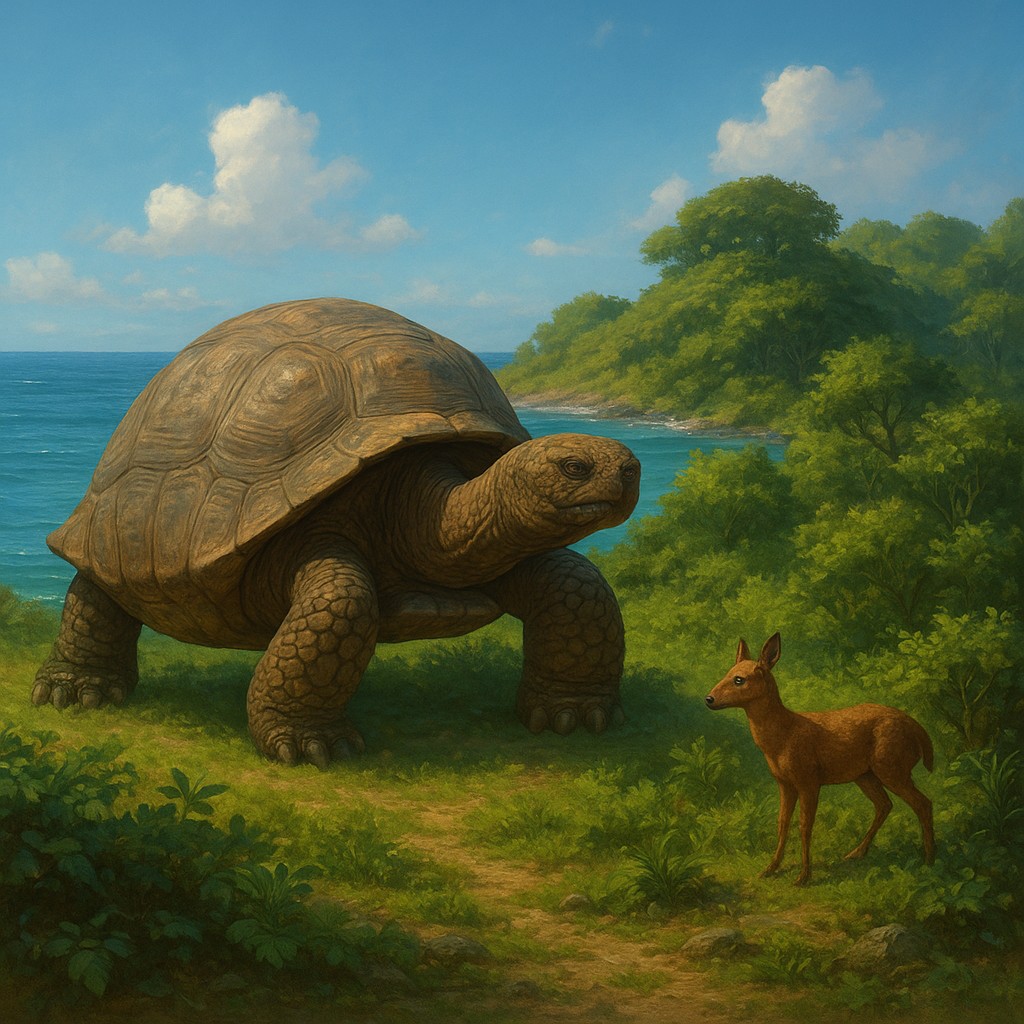
Imagine sailing across a vast blue horizon and coming across a landmass that has been cut off from the mainland for ten thousand years. On this isolated patch of earth, the rules of biology look like they were written by a surrealist painter. In one corner, you might find a tortoise as big as a dining table, while in a nearby thicket, a species of deer no larger than a house cat scurries through the brush. This isn't a scene from a fantasy novel. It is the predictable, if strange, result of life in a closed system. When a species is stranded on an island, it enters a high-stakes evolutionary pressure cooker where the standard rules for body size are thrown out the window.
This phenomenon is known as the island rule, or Foster’s Rule. It is a perfect example of how the environment shapes an animal's body. On the mainland, animals are part of a complex, sprawling web of competition and hunting that keeps their physical traits locked in place. Large animals must stay big to defend themselves, while small animals must stay tiny to hide or breed quickly. Once those species move to the confines of an island, the external pressure disappears. Without the constant threat of being eaten or the presence of too many competitors, the "ideal" size for survival shifts, leading to two biological wonders: insular gigantism and insular dwarfism.
The Math of Shaping Down
To understand why a majestic elephant might shrink to the size of a pony over several thousand years, we have to look at the island like a bank account. On the mainland, being massive is a great defense. If you are an elephant, very few things can hunt you, which makes the massive cost of feeding a multi-ton body worth it. However, an island is a small space with a limited buffet. When a group of large plant-eaters gets stranded, the biggest threat to their survival isn't a predator, but the very real chance of eating everything until they go extinct.
In an environment with limited food, the individuals who need the least energy to survive and breed have a clear edge. A smaller elephant eats less, drinks less water, and can move across rugged island terrain more easily than its giant cousins. Over many generations, the smaller individuals are the ones who survive the lean years and pass on their "compact" genes. This process of island dwarfism has happened all over the world. Famous examples include the extinct Pygmy Mammoths of the Channel Islands and Homo floresiensis, a tiny human relative nicknamed the "Hobbit" who lived on the island of Flores in Indonesia. These species didn't just get smaller because they were malnourished; their DNA actually changed the instructions for their adult size to match what the island could provide.
When Small Neighbors Become Local Giants
While the giants are busy shrinking, the local underdogs are often doing the opposite. On the mainland, rodents, insects, and reptiles are usually small for a reason: the world is full of things that want to eat them. Staying small lets them use tiny burrows and hide in cracks. But islands are often "simplified" ecosystems, meaning they lack big predators like wolves, lions, or eagles. When a small lizard or mouse arrives on an island where nothing is hunting it, the biological pressure to stay tiny and hidden vanishes.
Without the need to hide, being larger becomes a massive benefit. Larger bodies can store more fat, allowing an animal to survive seasons when food is scarce. Furthermore, when there are no outside predators, the main competition comes from others of your own kind. In the battle for mates and territory, bigger is usually better. This leads to island gigantism, the process that turned ordinary pigeons into the dodo and gave us the Komodo dragon. On an island, a mouse no longer needs to act like a mouse; it has the space to try its hand at being a badger.
The Evolutionary Middle Ground
The island rule suggests there is an "ideal" size for backboned animals, roughly the size of a large cat or a small dog. If you are much larger than that, the island’s limited resources will likely shrink you toward that middle ground. If you are much smaller, the lack of predators and the need to store energy will likely pull you up toward it. This move toward a medium size shows that evolution isn't a ladder of "progress," but a constant fine-tuning for efficiency.
| Feature |
Island Dwarfism |
Island Gigantism |
| Original State |
Large mainland species (Elephants, Deer) |
Small mainland species (Rodents, Insects) |
| Primary Cause |
Limited food and resources |
Lack of predators and competition |
| Benefit of Change |
Lower energy needs; higher efficiency |
Better energy storage; social dominance |
| Famous Example |
Pygmy Mammoths (California) |
Galapagos Giant Tortoises (Ecuador) |
| History |
Happens over thousands of years |
Needs stable, isolated environments |
It is important to separate this evolutionary shift from how an individual grows. A common mistake is thinking an animal grows larger or smaller because of what it eats in its own lifetime, like a plant staying small in a tiny pot. However, the island rule is a genetic change. An individual elephant doesn't "decide" to be small; rather, the smaller elephants are the only ones who don't starve to death during a drought. over thousands of years, the average height of the group drops because the "large" genes are being weeded out by the environment.
Limits and the Speed of Change
One might wonder why every island isn't full of weirdly sized versions of every animal. In reality, the island rule depends on a few things: the size of the island, how far it is from the mainland, and the specific biology of the animal. A very large island, like Madagascar or Australia, is often big enough to act like a mainland, with enough predators and habitats to stop these radical size shifts. The most dramatic examples happen on "true" islands, those small specks of land far enough away to keep mainland animals from arriving and mixing their standard-sized DNA back into the gene pool.
The timeline for these changes is also fascinating. Biology often moves at a snail's pace, but island evolution can be surprisingly fast. When a population is small and isolated, genetic changes can take hold much quicker than they would in a massive mainland group. In some cases, visible changes in body size have been seen in just a few centuries, though the full shift from a giant to a dwarf usually takes several thousand years. This quick adaptation shows how flexible life is, proving that species are not fixed in stone but are fluid responses to the world around them.
The Fragility of Island Wonders
While the island rule creates some of the most amazing creatures on Earth, it also makes them very vulnerable. Animals that evolve in isolation often lose the traits that kept their ancestors safe. Birds might lose the ability to fly because there are no ground predators to run away from, and plant-eaters might lose their fear of hunters. When humans eventually arrive on these islands, often bringing "invader" species like rats, cats, and dogs, the island giants and dwarfs are often defenseless. They traded their old defenses for island efficiency, a gamble that works perfectly until the isolation is broken.
Understanding the island rule changes how we look at nature. It teaches us that being "big" or "small" isn't a permanent trait, but a temporary solution to a specific problem. An elephant is huge because the mainland requires it, but that elephant has the potential to be small if the world changes. It reminds us that every living thing is a conversation between genetic code and the landscape. When you look at a giant tortoise or a tiny island fox, you aren't just looking at an animal; you are looking at the shape of the island itself, reflected in the bones of the creatures that call it home.