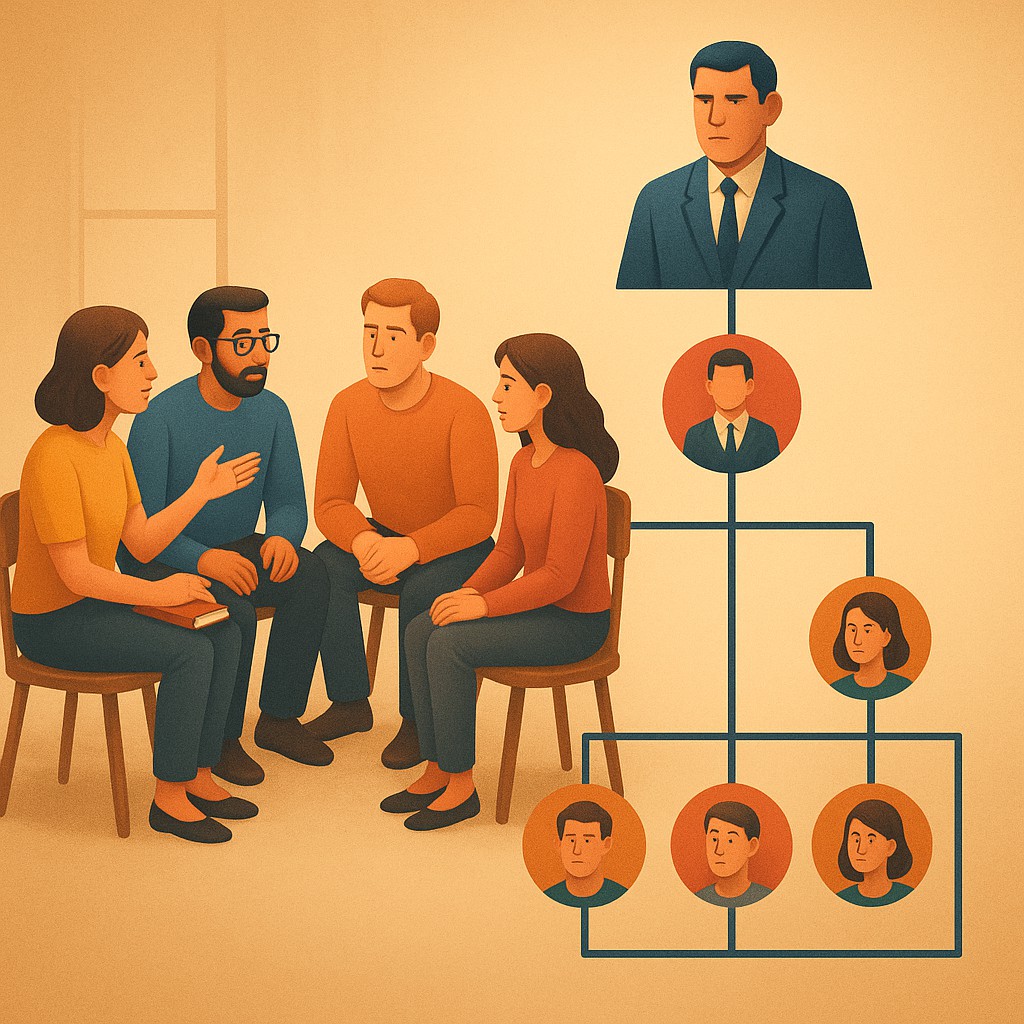
Imagine you decide to start a neighborhood book club with five of your closest friends. At first, everything is perfectly equal. You sit in a circle, argue for two hours about whether to read historical fiction or sci-fi, and everyone chips in to buy the snacks. It is a beautiful, messy, democratic dream.
But then the club grows. Suddenly, there are fifty members. You can no longer pick a book by shouting over one another in a living room. You need an email list. You need a treasurer to manage the snack fund. You need someone to book a room at the local library. Before you know it, a small "steering committee" is making all the decisions. The average member just shows up to be told what next month’s reading will be.
This shift does not happen because your friends have become power-hungry villains or because the new members are lazy. It happens because of a social pattern known as the Iron Law of Oligarchy. Coined by the sociologist Robert Michels in 1911, this concept suggests that any complex organization, no matter how democratic it starts out, will eventually be ruled by a small elite group. Michels reached this conclusion after studying socialist political parties and labor unions - groups that were founded on the idea of equality but ended up looking like top-down hierarchies. Understanding this "law" is like understanding gravity: it is not a judgment of character, but a description of how social structures settle under the weight of their own complexity.
The Inevitable Gravity of Growth
The main trigger for the Iron Law of Oligarchy is size. When a group is small, every person can talk to every other person. Information flows freely, and it is easy to reach an agreement. However, as an organization grows, the "cost" of communication goes up. If you have a thousand people in a room, you cannot have a thousand-way conversation. To get anything done, the group must give power to representatives. This creates a practical need for leaders who can process information, make quick decisions, and represent the group to the outside world. This is the moment the door opens for a small elite to take over.
Once you hand power to a few individuals, a specialized class of leaders begins to emerge. These people spend their entire day thinking about the organization’s problems, while the regular members go about their own lives. The leaders gain access to specialized knowledge: they know the budget, the legal hurdles, and the "important" people in other organizations. Over time, this creates a massive information gap. The leaders become experts in how the organization runs, and the members become reliant on that expertise. It becomes much easier for a member to simply nod along with a leader’s suggestion than to spend forty hours a week catching up on the data needed to challenge it.
This reliance is the foundation of elite control. Even if the leaders have good intentions, the mere act of handling complex information for the group concentrates power at the top. In any large-scale system, whether it is a global corporation or a national government, the sheer amount of data makes it impossible for the public to stay informed on every tiny detail. As a result, the people at the top become the gatekeepers of reality for everyone else. They decide which problems are urgent, which solutions are realistic, and which voices deserve to be heard.
How Organizations Trade Ideals for Survival
The most fascinating, and perhaps most unsettling, part of Michels' theory is how the goals of an organization shift over time. When a group is first formed, it usually has a clear mission, such as protecting the environment or improving wages. The organization is just a tool to reach that goal. However, as the organization turns into a massive entity with buildings, payrolls, and professional reputations, the tool becomes more important than the task. The leaders, whose lives and careers are now tied to the organization, begin to prioritize keeping the institution alive over its original mission.
This is often called "goal displacement." If the group's original goal becomes too risky or might lead to the organization being shut down, the leadership will often soften their stance to ensure the institution survives. They become conservative - not necessarily in politics, but in how they manage the group. They avoid radical moves that might upset donors or cause legal trouble. They start to view the hierarchy itself as the highest good, believing that without the structure, nothing can be accomplished at all. This creates a paradox where a group founded to change the status quo eventually becomes part of the status quo just to keep its doors open.
To the leaders, this feels like being practical. To the idealistic members at the bottom, it feels like a betrayal. But from the perspective of the Iron Law of Oligarchy, it is a structural necessity. A leader who burns the organization to the ground to chase a pure ideal is no longer a leader. Therefore, the leaders who "survive" and stay in power are almost always those who are best at compromise, fundraising, and paperwork. The system naturally selects for people who value the institution's long-term survival, which further solidifies the rule of the elite.
| Feature |
The Small Group Ideal |
The Large Group Reality |
| Decision Making |
Every member participates directly. |
Handed off to specialized committees. |
| Information |
Shared openly and understood by all. |
Held by a few expert leaders. |
| Primary Goal |
Achieving the original mission. |
Keeping the organization alive. |
| Leadership |
Temporary and done by volunteers. |
Permanent, professional, and specialized. |
| Communication |
Informal and goes in all directions. |
Top-down and highly structured. |
The Psychological Gap Between Leaders and Members
As the hierarchy firms up, a psychological gap grows along with the structural one. Leadership is a full-time job that requires specific skills: public speaking, negotiation, and strategic planning. These are often very different from the skills used by the general members. For example, the leader of a construction union spends time in boardrooms with lawyers and politicians, while the members spend their time on job sites. Over several years, the leader’s social circle, lifestyle, and daily concerns start to look more like those of other "leaders" than the people they represent.
This isn't a story of villains plotting in secret. Instead, it is the result of the social environment. If you spend all your time talking to other executives, you begin to see the world through an executive lens. You start to believe that only you and your peers truly understand how things work. You might even begin to view the general members as uninformed or overly emotional people who "don't see the big picture." This sense of superiority, which is often unconscious, justifies keeping more power at the top. Leaders convince themselves they are protecting the members from their own poor choices.
Furthermore, leaders gain a monopoly on communication. In any large organization, the leadership controls the newsletter, the social media accounts, and the meeting agendas. They can frame every issue so that their preferred outcome seems like the only logical choice. If a group of members wants to challenge the leadership, they often find they have no way to organize because the leadership controls the very platforms they would need to reach their peers. This creates a loop where the elite use the organization's resources to keep themselves in power.
How to Slow the Slide
If the Iron Law of Oligarchy is truly a "law," does that mean democracy is a lost cause? Not necessarily. While Michels was pessimistic, many modern thinkers believe that while we cannot fully stop the drift toward elite rule, we can certainly slow it down. The key is to create "friction" within the organization that prevents any one group from getting too comfortable. This means building in checks and balances that prioritize transparency and member involvement, even when it feels inefficient.
One of the most effective tools is mandatory leadership rotation. When leaders know their time in power is limited by term limits, they are less likely to treat the organization like their own private kingdom. This also ensures that "regular" members move into leadership roles, bringing fresh perspectives and preventing the leadership culture from becoming too isolated. Another method is decentralizing power. By breaking a large organization into smaller, independent chapters, you keep that "small group" feel where people can still participate directly. While the national level might remain top-heavy, the local levels can stay democratic.
Finally, the most powerful weapon against the Iron Law is an informed and active membership. Elite rule thrives on apathy. When members stop paying attention, leaders stop feeling accountable. Successful democratic groups often invest heavily in education, making sure members understand the finances, legal issues, and long-term strategy. It is about closing the information gap. If the members are just as knowledgeable as the leaders, the excuse that only "experts" can lead starts to fall apart. It turns out that the price of democracy is not just staying alert, but also doing the "homework" of staying informed.
Facing the Challenge of Human Connection
The Iron Law of Oligarchy serves as a vital reminder that our systems are only as healthy as the effort we put into them. It teaches us that centralizing power isn't always a sign of bad intentions, but often a side effect of trying to be efficient. In our fast-paced world, it is tempting to hand over the reins to a few "experts" so we can get back to our busy lives. However, this theory warns us that such convenience comes at a steep price. When we outsource our voice, we eventually lose our seat at the table altogether.
By recognizing these patterns in our workplaces, our local governments, and even our social circles, we are better prepared to build strong communities. We can create environments where questions are encouraged, power is shared, and the original mission remains the priority. The journey toward a fairer society isn't about finding a perfect system that runs itself; it is about choosing to stay involved even when the organization gets big and the problems get complex. Keep your eyes open to how power shifts, and remember that every voice raised in the name of transparency is a necessary rebellion against the iron laws of the past.