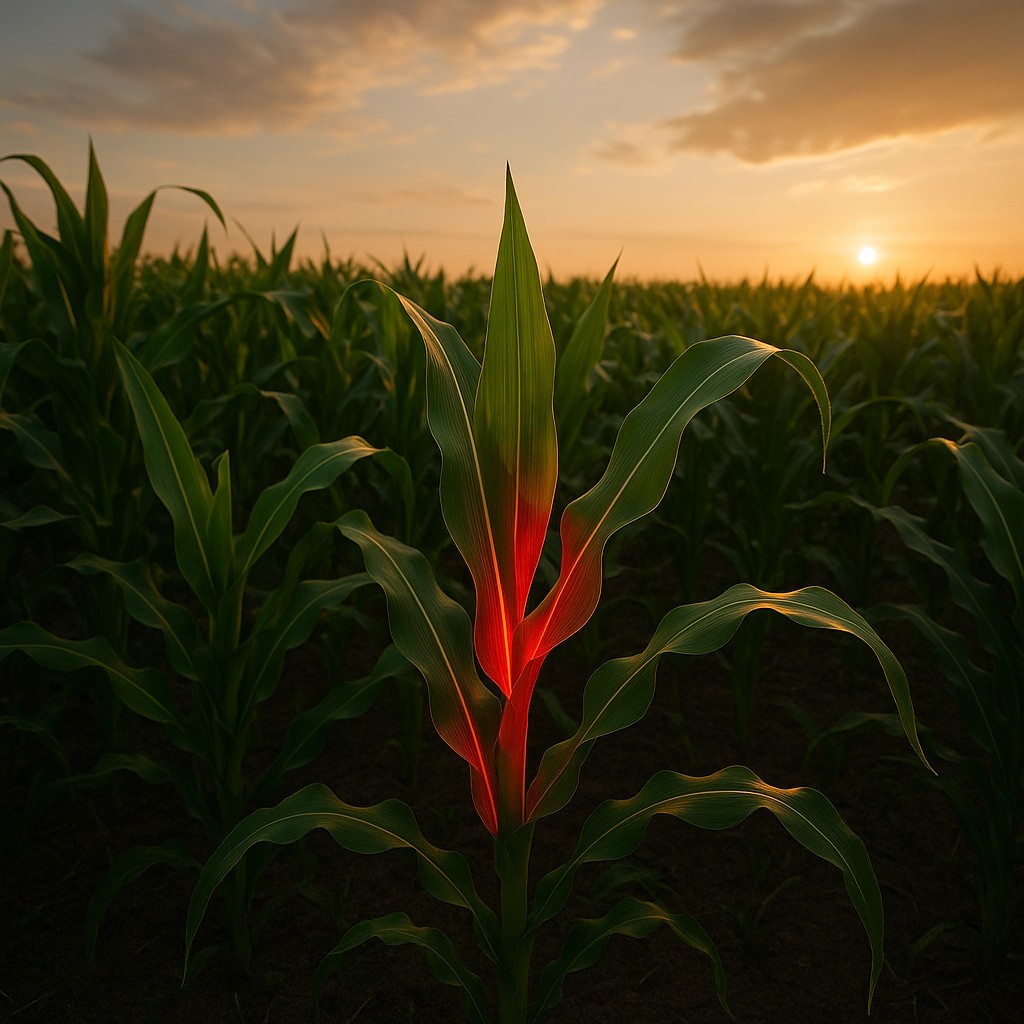
Imagine a vibrant cornfield or a lush vineyard soaking in the mid-afternoon sun. To us, the plants look perfectly healthy, their emerald leaves standing tall and firm. We might walk past them and assume everything is fine, yet deep within their cellular structure, a crisis is already unfolding. By the time those leaves start to curl, turn brown at the edges, or wilt toward the soil, the plant has already spent days or even weeks in a metabolic emergency. It has shut down its growth centers, stopped producing sugars, and begun a desperate internal struggle to stay alive. In the world of farming, visible wilting isn't a warning sign; it is an autopsy report of lost productivity.
However, scientists have discovered that these plants have been "shouting" for help long before the first leaf drops. They do this through a ghostly, invisible light called chlorophyll fluorescence. While we see plants as passive green objects, they are actually dynamic energy processors that behave a bit like leaky batteries. When a plant is thriving, it absorbs sunlight and uses that energy to build tissue. But as soon as water becomes scarce, the machinery begins to jam. Unable to process the incoming flood of solar energy, the plant has to get rid of the excess somehow. It releases this energy as a faint, red-hued glow. Recently, researchers have begun using specialized cameras to tune into this "cry for help," allowing us to detect drought stress long before it becomes visible to the naked eye.
The Solar Engine and the Overflow Valve
To understand why a dying plant glows, we first have to look at how a healthy one handles light. Photosynthesis is essentially an assembly line where sunlight is the electricity powering the machines. Chlorophyll molecules act as solar panels, capturing light particles called photons and passing that energy to "reaction centers." This is where water and carbon dioxide are transformed into glucose, a type of sugar the plant uses for food. In a perfect world, every photon captured would result in a snack for the plant. But plants live in an unpredictable world. Sometimes there is too much light, and sometimes the "internal plumbing" is blocked by outside stress, such as a lack of water.
When a plant lacks water, it enters a state of high alert. It closes its stomata, the tiny pores on the underside of its leaves, to prevent water from evaporating. While this saves moisture, it also cuts off the supply of carbon dioxide, which is a key ingredient for the assembly line. Now, the plant is in a bind: the sun is still hitting the leaves with immense energy, but the assembly line has stopped moving because it lacks raw materials. This creates a dangerous buildup of power. If the plant doesn't find a way to bleed off this excess, the energy will bounce around inside the leaf and create "reactive oxygen species," which are essentially tiny chemical grenades that shred the plant's internal structures.
To prevent this catastrophic self-destruction, plants have evolved safety valves. One of these is heat dissipation, where the energy is turned into warmth. The other, more fascinating mechanism is fluorescence. The plant simply re-emits the excess light at a different wavelength. It is a literal "leak" of light from a system that can no longer hold it. To us, this glow is invisible because it is incredibly faint and falls into the near-infrared part of the spectrum. However, for a sensor tuned to these specific frequencies, the plant starts to shine like a neon sign the moment it feels the first pinch of thirst.
Detecting the Invisible Signal
Detecting this glow is a feat of modern engineering because the sun is very loud and the plant's fluorescence is very quiet. Imagine trying to hear a single person whispering inside a stadium where 60,000 people are screaming at the top of their lungs. The sun provides a massive amount of light in the same part of the spectrum that the plant uses for fluorescence, which usually washes out the signal entirely. To get around this, researchers use "Fraunhofer lines." These are very narrow gaps in the solar spectrum where the atmosphere absorbs certain waves of light, creating tiny "windows" of darkness. By aiming sensors specifically at these dark windows, scientists can see the faint glow of the plant without the sun's interference.
This technology has moved from small handheld devices in labs to massive satellite arrays and drone cameras. For a farmer, this shift is revolutionary. Traditional methods of checking for drought involve walking the rows or using soil moisture sensors. Physical inspection is often too late, and soil sensors only tell you about the dirt, not the plant's internal state. Fluorescence imaging, however, provides a direct report on the plant's metabolic health. It is the difference between checking your oil with a dipstick and having a digital dashboard that warns you the engine is overheating before smoke starts pouring from the hood.
Why a Glowing Plant is an Unhappy Plant
It is a common mistake to think a "glowing" plant must be full of life. In reality, the brighter the fluorescence, the more inefficient the plant has become. It helps to think of the plant's energy management as a three-way split. Every bit of light a plant absorbs must go to one of three places: Growth (photochemistry), Heat (safe waste), or Fluorescence (accidental leakage). These three pathways are in constant competition.
When a plant is in its "Goldilocks zone" with plenty of water and perfect light, the Growth pathway is wide open. It is using almost all the energy it captures to get bigger. In this state, fluorescence is minimal because there is very little "waste" light. As soon as drought hits, the growth gate slams shut. The energy has to go somewhere, so it redirects into heat and fluorescence. By measuring the ratio of these outputs, scientists can calculate exactly how much the plant's growth has slowed. This is why researchers call fluorescence a "byproduct of inefficiency." It is the light of a system struggling to keep up with its environment.
Comparing Plant Health Indicators
| Feature |
Visible Wilting |
Soil Sensors |
Fluorescence Imaging |
| Detection Time |
Very Late (Damage is done) |
Indirect (Measures dirt) |
Early (Pre-visual stress) |
| Data Source |
Physical appearance |
Water content in soil |
Internal metabolic state |
| Actionable? |
Often too late for recovery |
Good for timing, but generic |
Precision irrigation timing |
| Scale |
Low (Manual inspection) |
Medium (Fixed points) |
High (Drones and Satellites) |
| Primary Limitation |
Growth has already stopped |
Doesn't account for variety |
Requires specialized sensors |
The Global Impact on Food Security
The implications of this technology reach far beyond saving a few gardens. We are currently facing a global challenge where we need to produce more food with less water. Climate change is making rainfall more unpredictable, and "flash droughts," which develop in days rather than months, are becoming more common. In these cases, by the time a farmer notices crops are thirsty, the harvest for the entire season may have already dropped by 20 or 30 percent. If we can see the stress coming via satellite, we can trigger irrigation or manage water resources with surgical precision before the crop sustains permanent damage.
Furthermore, this tech helps plant breeders develop hardier crop varieties. Instead of waiting months to see which corn hybrid survives a dry summer better, researchers can blast thousands of seedlings with heat and use fluorescence cameras to see which ones stay "cool" and keep growing efficiently. It provides a real-time leaderboard of genetic performance. This speeds up the breeding process significantly, helping us stay one step ahead of a changing climate. It turns the field into a laboratory where the plants are constantly communicating their status.
Bridging Physics and Biology
One of the most elegant aspects of this breakthrough is how it merges the cold physics of light with the organic world of biology. We are essentially using the laws of quantum mechanics to determine if a soybean plant needs a drink. When a chlorophyll molecule absorbs a light particle, an electron is bumped up to a higher energy state. This is a brief, unstable moment. If that electron isn't quickly passed off to help make sugar, it must drop back down to its resting state, releasing that extra energy as a new light particle. This is the "fluorescence" we are capturing.
This bridge allows us to monitor the health of the entire planet from space. NASA’s Orbiting Carbon Observatory-2 (OCO-2) was originally built to measure carbon dioxide, but scientists realized it was also picking up the "glow" of Earth's vegetation. We now have a "heartbeat" monitor for the world's forests and grasslands. We can see the Amazon or the Great Plains "breathing" and processing energy in real-time. When a region begins to glow more intensely due to stress, global food organizations can predict crop failures and price spikes months before they happen, potentially preventing humanitarian crises.
Realizing that plants are constantly signaling their internal struggles changes our relationship with nature. We no longer have to guess what a plant needs or wait for it to show signs of physical distress. By learning to "see" in the spectrum of fluorescence, we are finally developing a way to listen to the silent language of the green world. This technology doesn't just make farming more efficient; it fosters a deeper empathy for the living systems that sustain us. The next time you look at a green field, remember that there is an invisible light show happening right in front of you, telling a story of survival, struggle, and the incredible dance of solar energy.